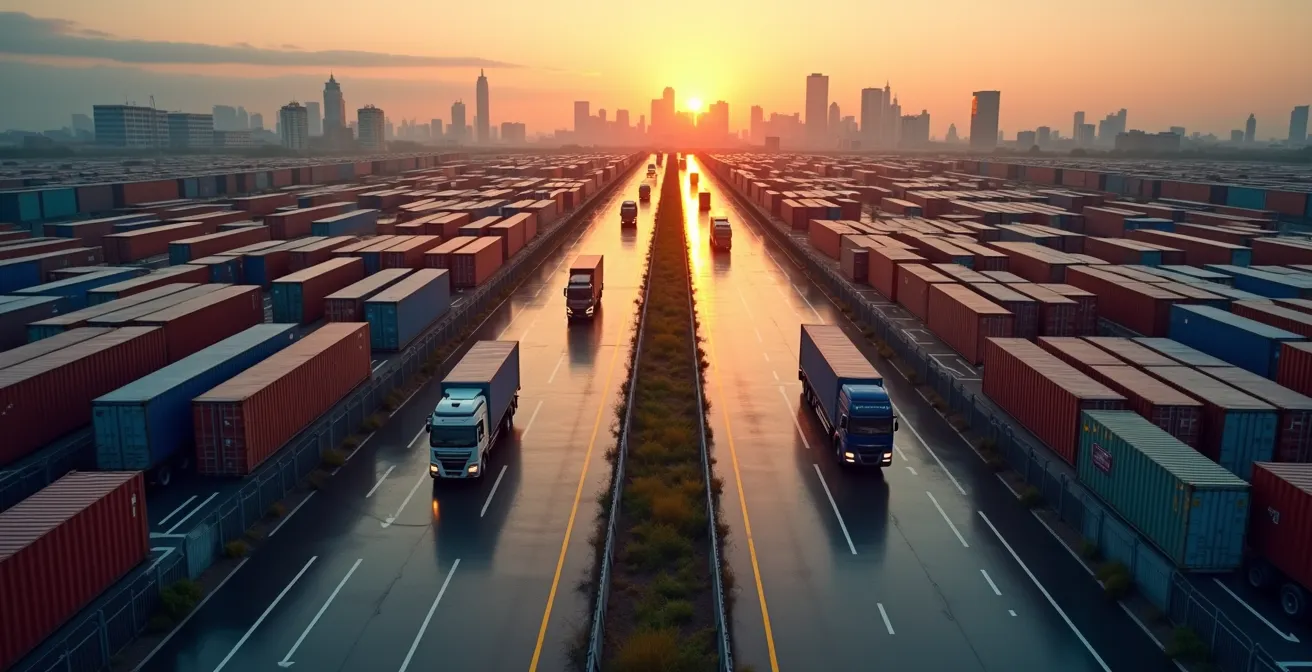
Free shipping isn’t a perk; it’s a price distortion mechanism that inflates costs across the entire supply chain.
- It masks carrier surcharges, fuel costs, and operational inefficiencies that are baked into your product’s price.
- It fuels a costly “returns crisis” and environmental strain from inefficient deliveries, raising prices for all consumers.
Recommendation: To genuinely save money, think like a logistician: consolidate your orders, choose standard shipping whenever possible, and plan major purchases to avoid peak season penalties.
The “Free Shipping” button is one of the most powerful tools in e-commerce. It feels like a victory, a final discount that seals the deal. We’ve all been conditioned to hunt for it, and as an insider in logistics operations, I can tell you that this conditioning is no accident. The promise of free delivery is so potent that research reveals free shipping influences the purchasing decisions of 92% of consumers. But as the old saying goes, there’s no such thing as a free lunch, and there is most certainly no such thing as free shipping.
The common assumption is that retailers simply absorb the cost or bake it into the product’s price. While true on the surface, this view misses the deeper story. “Free shipping” isn’t just a line item that gets moved around; it’s a catalyst that creates immense pressure on the entire supply chain. It forces compromises, creates inefficiencies, and generates a cascade of hidden costs—what we call logistical friction—that ultimately inflate the price of goods in ways far more complex than a simple markup. You aren’t just paying for shipping; you’re paying for the systemic distortions it creates.
In this analysis, we will pull back the curtain on the world of logistics. We’ll dissect exactly how that “free” delivery translates into higher product costs, examine the operational chaos caused by express orders and returns, and explore the surprising impact on everything from urban traffic to the price of your groceries. By the end, you’ll understand the true cost of convenience and be equipped to make smarter purchasing decisions.
To navigate the complex world of shipping costs, it’s essential to understand the key factors at play. This article breaks down the hidden fees, operational pressures, and consumer habits that secretly drive up the prices of the goods you buy.
Summary: The True Cost of Your ‘Free’ Delivery
- Why Do Products with “Free Shipping” Cost 20% More on Average?
- How to Group Your Orders to Reduce Carbon and Packaging Waste?
- Express vs. Standard: The Real Cost of Getting It Tomorrow
- The Returns Crisis: How Serial Returners Drive Up Prices for Everyone
- When to Order Holiday Gifts: Avoiding the December Surcharge Spike
- Why Have Egg and Dairy Prices Risen Faster Than General Inflation?
- Why Are Delivery Vans Responsible for 30% of Urban Congestion?
- Will Drone Delivery Solve the Last-Mile Crisis in Dense Cities?
Why Do Products with “Free Shipping” Cost 20% More on Average?
The 20% premium on items with “free shipping” isn’t an arbitrary markup; it’s a carefully calculated buffer designed to absorb the volatility of logistics. From a manager’s perspective, I’m not just covering a single, predictable shipping fee. I’m building a financial cushion for a dozen potential cost-shifting mechanisms. This includes fluctuating fuel surcharges, residential delivery fees, and the possibility of a package traveling across the country versus across the state. The price has to account for the worst-case shipping scenario, not the best.
Mega-retailers have mastered this model by leveraging immense volume. For example, Amazon’s “free” Prime shipping is built on a foundation of billions in logistics spending. To offer its famous two-day delivery, Amazon has to navigate enormous shipping costs, which it offsets through its Prime membership fee and the sheer volume of packages it moves, allowing it to negotiate significant discounts with carriers. Smaller retailers can’t compete on that scale.
Instead, they must embed a higher universal shipping cost into every item’s price. This creates a significant price distortion: customers who live closer to the warehouse effectively subsidize the shipping for customers who live farther away. The “free” sticker hides a complex system of cross-subsidization where the final price reflects a blended average of logistical expenses, not the actual cost to deliver that specific item to your door. You’re not just paying for your shipping; you’re paying for everyone’s.
How to Group Your Orders to Reduce Carbon and Packaging Waste?
Every time you place a small, individual order to take advantage of free shipping, you’re contributing to what we in the industry call the “warehouse lottery.” Your items might be sitting in different fulfillment centers across the country. One order can trigger multiple separate shipments, each with its own truck, its own fuel consumption, and its own cardboard box. This fragmentation is a logistical and environmental nightmare.
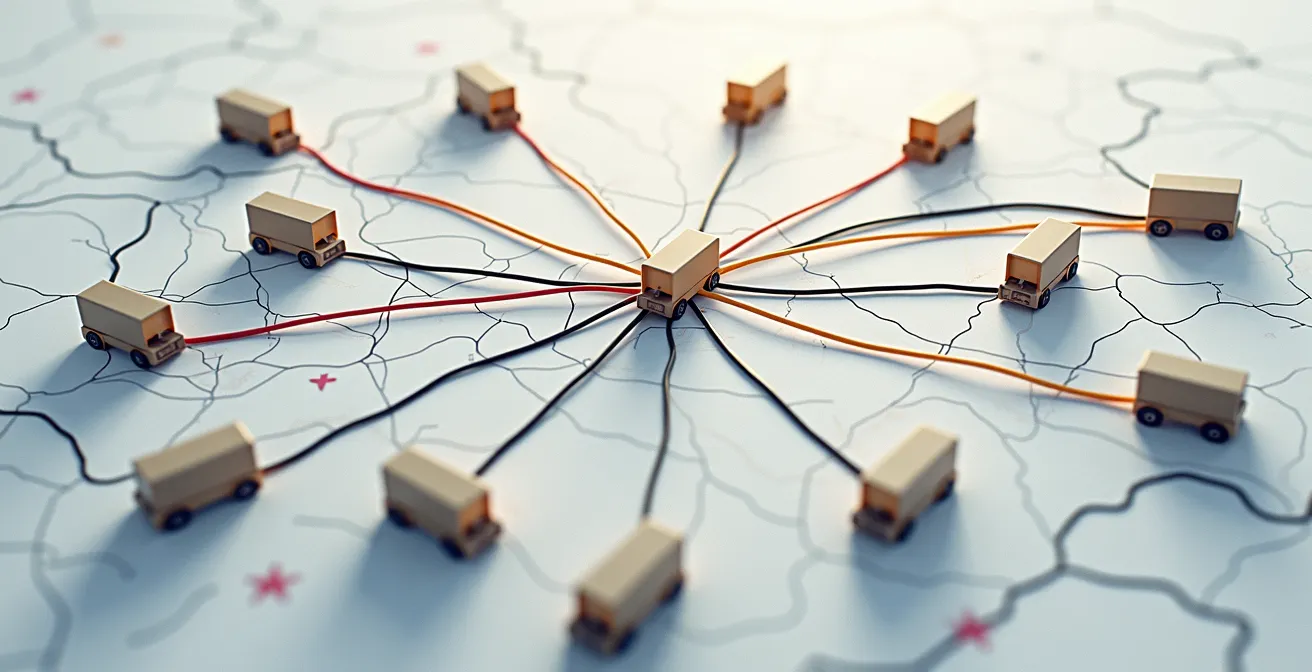
As the illustration above shows, a single shopping cart can activate a complex and inefficient web of delivery routes. The most effective way to combat this is through conscious order consolidation. By planning your purchases and grouping them into a single, larger order, you dramatically increase the chances that your items can be fulfilled from one location and shipped in a single box. This isn’t just about saving cardboard; it’s about reducing the number of delivery vehicles on the road.
The collective impact of fragmented, on-demand deliveries is staggering. Without intervention, analysis from the World Economic Forum shows that urban delivery-related CO2 emissions are set to increase by over 30% in cities by 2030. Grouping your orders is one of the most powerful actions you can take as a consumer. It sends a signal to retailers to optimize their inventory and helps reduce the immense logistical friction and environmental burden of the e-commerce boom.
Express vs. Standard: The Real Cost of Getting It Tomorrow
The demand for instant gratification, epitomized by “get it tomorrow” options, places enormous strain on logistics networks. Express shipping is not just a faster version of standard shipping; it’s an entirely different, premium service that bypasses the efficient, consolidated routes that keep costs down. It requires disrupting optimized truckloads, often relying on expensive air freight, and prioritizing one package over thousands of others. This priority comes with a hefty, often hidden, price tag.
While you see a simple shipping upgrade fee at checkout, behind the scenes, carriers like FedEx and UPS apply a complex matrix of surcharges that are invisible to you but are ultimately factored into the overall cost of goods. These fees go far beyond the base rate and are the primary source of logistical friction for expedited services. A look at the typical surcharge structure reveals why “tomorrow” is so expensive.
| Surcharge Type | Express Shipping | Standard Shipping |
|---|---|---|
| Fuel Surcharge | 10-15% of base rate | 5-10% of base rate |
| Residential Delivery | $5-8 additional | $3-5 additional |
| Saturday Delivery | $15-25 premium | Not available |
| Address Correction | $18-19 per occurrence | $18-19 per occurrence |
This table only scratches the surface. Choosing express shipping means you’re paying for a higher fuel percentage, premium residential fees, and the operational costs of weekend logistics. By opting for standard shipping, you allow your package to travel along the most efficient, cost-effective routes. This patience not only saves you money directly but also reduces the overall cost burden on the system, which helps keep product prices stable for everyone.
The Returns Crisis: How Serial Returners Drive Up Prices for Everyone
If shipping a product to a customer is a science, handling its return is a chaotic and costly art. The “free returns” policy, a direct descendant of the free shipping promise, has created a massive reverse logistics burden for retailers. Every returned item embarks on a complex journey backward through the supply chain. It has to be shipped, received, inspected, cleaned, repacked, and hopefully, restocked. Many items, especially in fashion, are damaged, out of season, or simply not worth the labor to process, ending up in landfills.
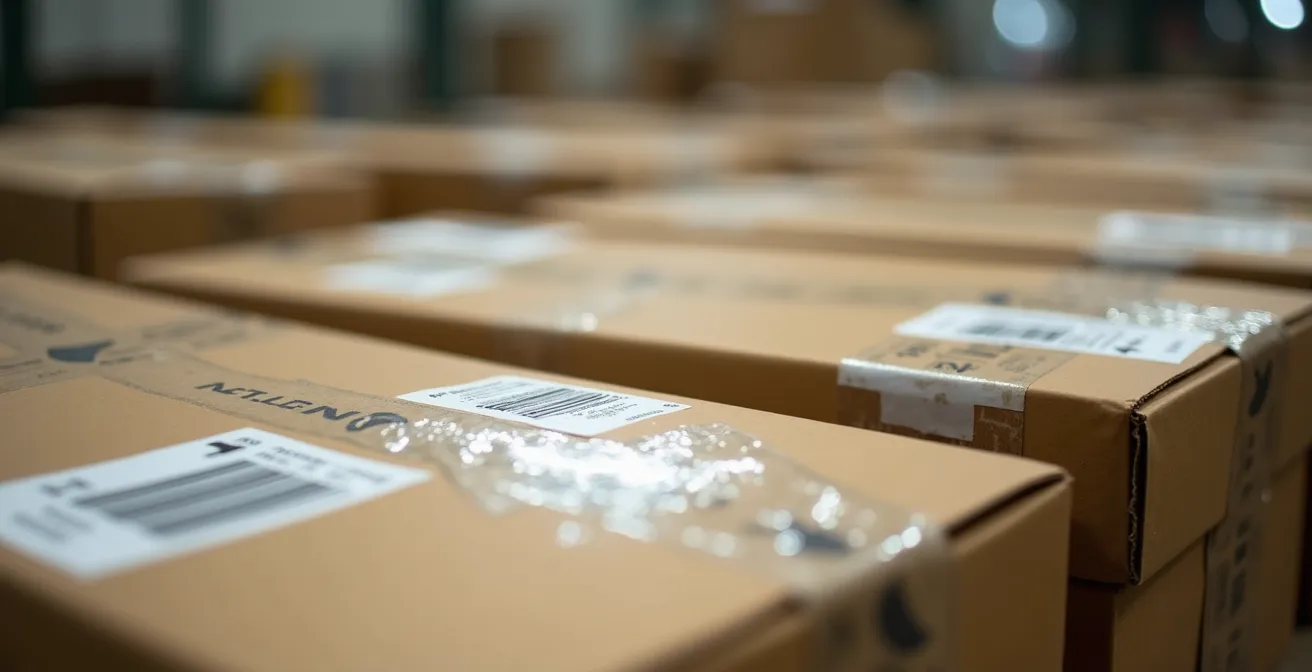
This process is wildly inefficient and expensive, and its costs are socialized across all customers through higher product prices. The problem is exponentially worsened by “serial returners”—consumers who intentionally over-order, treating their homes like a fitting room. The financial impact is immense; a report from ZigZag Global reveals that in the UK alone, serial returners are projected to account for £6.6 billion of online returns in 2024.
In response, retailers are beginning to push back, implementing cost-shifting mechanisms to penalize this behavior. This is no longer a theoretical risk; it’s a rapidly adopted industry practice.
Case Study: ASOS and Zara’s Targeted Return Fees
To combat the rising costs of the returns crisis, major fast-fashion brands have started to abandon the “free returns for all” model. Retailers like ASOS, H&M, and Zara have introduced fees for online returns. In more extreme cases, ASOS has been known to deactivate the accounts of customers with unusually high return rates. This strategy marks a significant shift, moving the financial burden from the retailer (and by extension, all its customers) back to the individuals whose behavior generates the most cost.
This trend is a clear signal: the era of consequence-free returns is ending. The costs have become too high to ignore, and the only way to cover them is to either raise prices for everyone or charge the users who create the problem.
When to Order Holiday Gifts: Avoiding the December Surcharge Spike
The holiday season is the ultimate stress test for any logistics network. From Black Friday through late December, the sheer volume of packages pushes carriers to their absolute limits. To manage this surge, carriers like UPS and FedEx implement “Peak Season Surcharges.” These are temporary, but significant, fee increases applied to shipments during the busiest times of the year. This is a classic example of supply-and-demand economics in logistics, and it’s a cost that is inevitably passed on to you.
These surcharges are layered on top of the annual rate hikes that are already a standard part of the industry. For instance, carrier rate data shows that both UPS and FedEx implemented average rate increases of 5.9% in 2024, a trend that directly contributes to rising product prices year-round. During the holidays, however, these costs spike dramatically. Retailers who offer free shipping have no choice but to build this predictable surge into their pricing models, meaning products are often most expensive when demand is highest.
As a savvy consumer, you can avoid paying this “holiday tax” by simply planning ahead. Ordering your gifts before the peak season surcharges kick in (typically mid-November) not only saves you money but also helps reduce the strain on the logistics system. Here is a practical timeline for navigating the holiday rush.
Action Plan: Your Holiday Shipping Timeline
- Late October: Begin your holiday shopping. You’ll have access to full inventory before the rush and avoid nearly all peak surcharges.
- Early November: Place orders for any customized or personalized items that require longer lead times.
- Mid-November: Aim to complete the bulk of your shopping before most carriers implement their heaviest peak surcharges.
- Early December: This is the cutoff for most standard shipping options. After this point, you’re venturing into expensive express territory.
- December 15-20: Last-resort orders. Expect to pay a significant premium for expedited shipping with no guarantee of on-time arrival due to network congestion.
By treating holiday shopping like a strategic operation, you can bypass the worst of the price hikes and ensure your packages arrive on time without paying a premium.
Why Have Egg and Dairy Prices Risen Faster Than General Inflation?
While general inflation affects all goods, certain product categories, like eggs and dairy, are uniquely susceptible to logistical pressures. The reason their prices climb faster is due to the enormous hidden cost of the cold chain—the specialized, temperature-controlled supply chain required to move perishable goods from the farm to your doorstep.
A standard package can sit in a hot truck or a non-air-conditioned warehouse with no issue. But a carton of milk or a tray of eggs requires an unbroken chain of refrigeration. This means refrigerated trucks, climate-controlled sorting facilities, and specialized last-mile delivery vehicles. This infrastructure is incredibly expensive to build, maintain, and power. The energy costs alone are immense, and any break in the chain means the entire shipment is lost—a cost that must be factored into the price of every successful delivery.
The numbers behind cold chain logistics are startling. It’s a classic case of the 80/20 rule, but even more extreme. Analysis of supply chain costs shows that temperature-controlled distribution, while only accounting for a tiny fraction of total shipping volume, can be responsible for nearly half of the transport costs. This disproportionate expense is a primary driver of food price inflation in the e-commerce era. When you order groceries online with “free delivery,” you’re not just paying for transport; you’re paying a massive premium for the energy and infrastructure needed to keep your food safe.
Why Are Delivery Vans Responsible for 30% of Urban Congestion?
The promise of fast, free delivery has turned our city streets into the final, chaotic frontier of logistics. This is the “last-mile penalty” in its most visible form. The last mile of a package’s journey—from a local distribution center to your front door—is by far the most expensive and inefficient part of the entire process. In dense urban areas, it’s a logistical nightmare of traffic, parking restrictions, and failed delivery attempts.
Delivery vans are a primary cause of this urban gridlock. They cruise residential streets looking for addresses, double-park on busy roads, and block traffic lanes, all to fulfill the demand for individual, on-demand deliveries. Each van represents dozens of separate orders that could have potentially been consolidated or delivered to a centralized pickup point. Instead, they contribute disproportionately to congestion, noise, and air pollution.
This isn’t just an inconvenience; it’s a measurable drain on urban life and the environment. The cumulative effect of e-commerce deliveries has a direct and severe impact on city infrastructure and quality of life.
Deliveries will cause related emissions to rise by nearly one-third and add 11 minutes to each passenger’s commute.
– World Economic Forum, The Future of the Last-Mile Ecosystem report
This finding highlights a critical truth: the convenience of a package arriving at your door is directly paid for by the collective inconvenience of a slower, more polluted city. The 30% figure isn’t just a statistic; it represents a fundamental conflict between on-demand consumer culture and the sustainability of our urban environments.
Key takeaways
- “Free” shipping inflates product prices by embedding a buffer for volatile logistics costs like fuel, surcharges, and distance.
- Consumer habits like demanding express shipping and making frequent returns create massive operational burdens and environmental waste, driving up costs for everyone.
- Making smarter choices—consolidating orders, choosing standard shipping, and planning ahead—can significantly reduce both the final cost and the strain on the supply chain.
Will Drone Delivery Solve the Last-Mile Crisis in Dense Cities?
With the last mile of delivery accounting for a staggering 53% of total shipping costs, the industry is desperately searching for a silver bullet. Drones are often touted as the futuristic solution to the last-mile crisis. The vision is compelling: autonomous aerial vehicles zipping over congested streets to drop packages on doorsteps, cutting delivery times and emissions. While promising for specific applications in rural or suburban areas, from a practical logistics standpoint, the idea of drones solving the crisis in *dense cities* is largely a fantasy for the foreseeable future.
The challenges are immense: regulatory hurdles, safety concerns with flying over crowded areas, the inability to deliver to high-rise apartments, and limited payload capacity. Drones may one day find their niche, but they are not the cure-all for the urban last-mile penalty. However, a much simpler, existing technology is already proving to be dramatically more effective: the cargo bike.
Case Study: Cargo Bikes Outperform Vans in Urban Centers
A study modeling deliveries in a dense city like Brussels found that cargo bikes are a superior solution for the last mile. The research showed that cargo bikes can deliver packages more than twice as fast as vans in congested urban environments. Their agility allows them to bypass traffic, use bike lanes, and access pedestrianized areas that are off-limits to vans. This combination of speed and access leads to a 51% reduction in total delivery time, proving that sometimes the most effective solution is also the simplest.
This real-world data shows that solving the last-mile crisis doesn’t necessarily require a technological leap. Instead, it requires a shift in thinking toward solutions that are better adapted to the urban landscape. By embracing methods like cargo bikes and centralized pickup points, we can create a more efficient and sustainable delivery ecosystem without waiting for a futuristic technology that may never fully arrive.
The next time you click “buy” on an item with free shipping, you’re no longer just a consumer; you are a key player in a global logistics chain. By making informed choices about how and when you order, you can not only save money in the long run but also contribute to a more efficient, less wasteful, and more sustainable system for everyone.