In almost all current semi-autonomous vehicle crashes, the legal and financial responsibility, including the insurance deductible, falls squarely on the driver.
- Level 2 systems (like Tesla’s Autopilot) are legally considered “driver-assist,” making you 100% liable for any system failure.
- Technological glitches like “phantom braking” and cognitive delays in driver takeover create a significant “liability gap” that exposes owners to unforeseen risk.
Recommendation: Do not treat your vehicle as fully autonomous. Understand its specific limitations and be prepared to intervene instantly, as you are the legally designated failsafe.
The appeal of a self-driving car is rooted in a promise of convenience, safety, and a hands-free future. Early adopters of features like Tesla’s Autopilot or Waymo’s systems are pioneers on this new frontier. However, when the silicon-driven reflexes of your vehicle fail and a crash occurs, a critical question emerges: who is financially responsible? Many assume the manufacturer bears some burden, especially if the system was engaged. The reality is far more sobering.
Current legal frameworks and insurance policies have not kept pace with the technology. This has created a dangerous “liability gap”—a grey area where the driver is no longer fully in control, but the machine is not yet fully accountable. In this gap, the driver becomes the default point of failure in the eyes of the law and insurance carriers. This article, from the precise and cautionary perspective of a liability lawyer, will deconstruct the specific scenarios and technological quirks that place the burden of the deductible, and potentially far more, directly on you.
This analysis will dissect the critical distinctions between automation levels, the cognitive risks of system monitoring, and the legal precedent being set by technological failures. By understanding the underlying mechanics of liability, you can better navigate the risks you accept every time you engage autonomous mode.
Summary: Navigating the Legal Realities of Semi-Autonomous Vehicle Accidents
- Why Does Autopilot Usage Increase Reaction Time by 3 Seconds?
- How to Disengage Autonomous Mode Instantly on Icy Roads?
- Level 2 vs. Level 3 Automation: Which Allows You to Take Your Hands Off?
- The “Phantom Braking” Issue: Why Radar Systems Panic at Shadows?
- When to Update Your Car’s Firmware: Avoiding Buggy Releases
- When Will Autonomous Delivery Be Legal in Residential Areas?
- The Headphone Mistake: Why Noise Cancellation Makes You a Target?
- How to Stay Safe on Public Transport Late at Night as a Solo Traveler?
Why Does Autopilot Usage Increase Reaction Time by 3 Seconds?
The primary legal defense for manufacturers is that the driver must remain alert and ready to intervene. However, the very nature of automation fosters a state of cognitive disengagement. When a driver delegates the primary task of steering and speed control to a machine, their mind shifts from active participation to passive monitoring. This mental shift is not trivial; it has a measurable and dangerous impact on reaction time. The brain is no longer primed for immediate action.
Research provides stark evidence of this delay. While a fully engaged driver might react to a hazard in 0.5 to 1.5 seconds, studies have shown that autopilot users take up to 3.5 seconds to respond to the same alert. This delay is not a sign of negligence but a predictable human-factors consequence. Further research into remote driving scenarios confirms that mental disengagement can slow reaction times by over 5 seconds when a system requires human intervention.
This “takeover delay” is at the heart of the liability gap. The system may issue an alert, but if the human cognitive process cannot realistically meet the demand for instantaneous re-engagement, an accident becomes inevitable. From a legal standpoint, the driver failed to react in time. In reality, the system created the conditions for that failure. In the event of a claim, the insurer will point to this delay as driver error, making you responsible for the deductible.
How to Disengage Autonomous Mode Instantly on Icy Roads?
Adverse weather conditions, particularly ice, represent a scenario where the sensors and algorithms of an autonomous system can be easily deceived. A patch of black ice is often invisible to radar and cameras, yet a human driver might detect it through subtle feedback from the steering and chassis. When the system fails to recognize this risk, your ability to instantly and decisively disengage autonomous mode is your only line of defense.
You are the vehicle’s ultimate failsafe. Waiting for the system to alert you is a failing strategy; you must be prepared to override it based on your own perception of risk. Every semi-autonomous vehicle has multiple manual override triggers. Knowing them by muscle memory is not just a best practice—it is a critical component of mitigating your liability. If you are in an accident and cannot demonstrate you knew how to immediately take control, it will be argued that you were not operating the vehicle with due care.
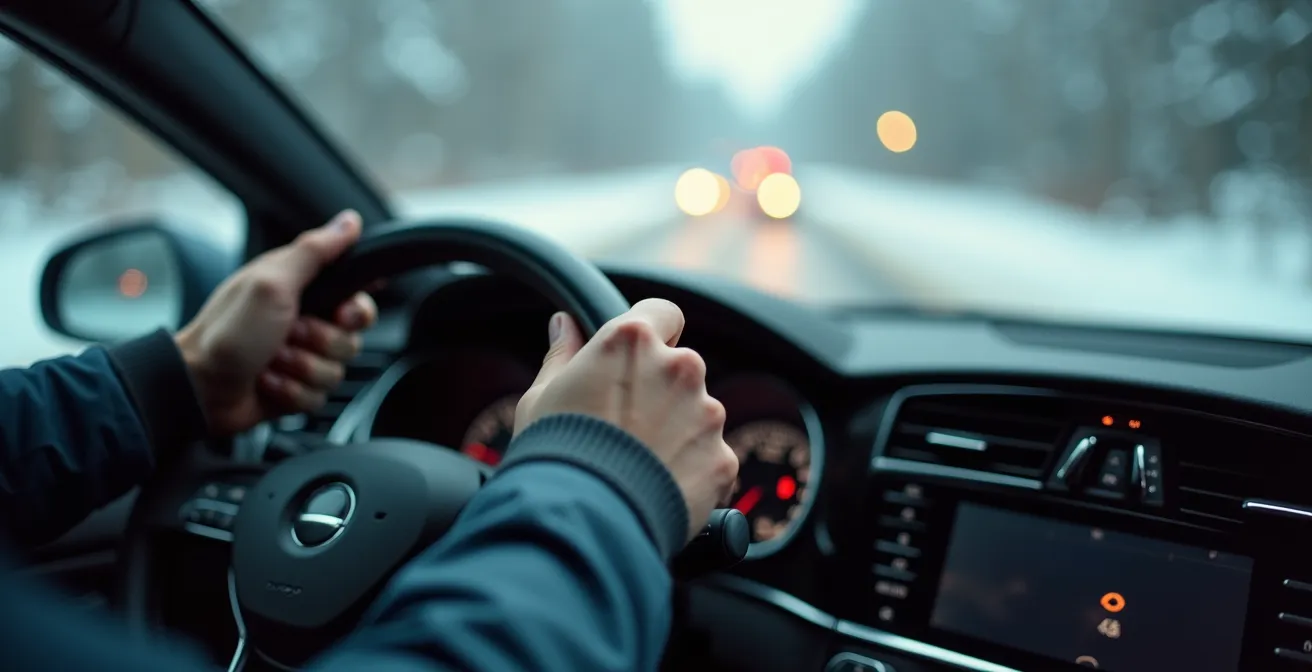
The image above illustrates the critical posture of readiness. Your hands should always be shadowing the wheel, prepared for the instant override that conditions may demand. Being a responsible operator of a semi-autonomous vehicle means treating it as a constant partnership, not a chauffeur. Your insurance company will operate on the assumption that you were, or should have been, prepared to perform this override at any moment.
Emergency Override Protocol: Regaining Manual Control
- Press the brake pedal: Applying firm pressure to the brake is the most universal and immediate method to disengage all autopilot functions.
- Apply steering input: Actively turning the steering wheel with sufficient force will override automated lane-keeping and steering controls.
- Use dedicated controls: Press the autopilot cancel button, typically located on the steering wheel or control stalk.
- Maintain manual control: Do not attempt to re-engage the system until road and weather conditions are confirmed to be safe and clear.
- Document the incident: If a disengagement is required to prevent an accident, note the time, location, and conditions. This documentation is invaluable for any potential insurance claim.
Level 2 vs. Level 3 Automation: Which Allows You to Take Your Hands Off?
Not all “self-driving” systems are created equal, and the distinction between SAE Levels 2 and 3 is the single most important factor in determining liability. As an owner, you are contractually and legally bound by the limitations of your vehicle’s certified level. Misunderstanding this difference has severe financial consequences. A common sentiment from insurance experts is that at Level 2, the driver is always accountable, while at Level 3, liability begins to blur.
Level 2 automation, which includes systems like Tesla’s Autopilot and GM’s Super Cruise, is legally defined as “driver assistance.” The system can manage steering and speed simultaneously, but the human driver is required to monitor the environment at all times and is 100% responsible for the vehicle’s operation. Taking your hands off the wheel is permitted only temporarily; your attention must never waver. If a crash occurs, liability is not shared. It is yours alone.
Level 3 automation represents a significant legal shift. In a Level 3 system, such as the Mercedes-Benz DRIVE PILOT (where legally approved), the car is considered to be driving itself under specific, limited conditions. The driver can legally take their eyes off the road. In this mode, the manufacturer assumes liability if the system causes a crash. This is the crucial difference: liability transfers from the driver to the manufacturer. If an accident is deemed the fault of the L3 system, your insurance deductible may be waived as the claim is pursued against the automaker.
The following table, based on information from industry analyses of SAE automation levels, clarifies these critical differences.
| Feature | Level 2 Automation | Level 3 Automation |
|---|---|---|
| Driver Attention | Must keep eyes on road | Can take eyes off road |
| Hands on Wheel | Can remove temporarily | Can remove completely |
| Legal Liability | 100% driver responsible | Manufacturer shares liability |
| Insurance Deductible | Driver always pays | May be waived if system at fault |
| Current Availability | Tesla, GM, Ford systems | Mercedes Drive Pilot only |
The “Phantom Braking” Issue: Why Radar Systems Panic at Shadows?
One of the most unsettling and legally problematic behaviors of current semi-autonomous systems is “phantom braking.” This occurs when the vehicle brakes suddenly and aggressively for no apparent reason, reacting to a non-existent threat. The cause is often the system’s inability to correctly interpret sensor data. A dark shadow from an overpass, a reflection off a road sign, or even changes in pavement can be misinterpreted by radar or vision systems as a stationary obstacle, triggering an emergency stop.

This is not a rare anomaly. It is a well-documented systemic failure. According to NHTSA data, there has been a dramatic spike in complaints, with 107 owners complaining about phantom braking in just a three-month period, compared to only 34 in the previous 22 months. This indicates a growing and unresolved issue with the technology. While it may seem like a mere annoyance, a phantom braking event on a highway can easily cause a rear-end collision for which you, the driver of the braking car, may be held partially or fully liable.
Case Study: German Court Confirms Phantom Braking as a Defect
In a landmark case, the Traunstein Regional Court in Germany validated the existence of dangerous phantom braking in Tesla vehicles. An independent expert conducting test drives observed a Model 3 suddenly decelerating from 140 km/h to 94 km/h without any technical necessity or road hazard. The court’s recognition of this behavior as a significant defect sets a precedent, but it does not automatically absolve drivers of liability in an accident. It opens the door for a product liability claim against the manufacturer, but the initial insurance claim will still involve you and your deductible.
Even with such legal precedent, your insurance company will first process the claim based on the facts of the accident. If you were rear-ended after a phantom braking event, the other driver’s insurer will argue you braked without cause, creating a complex liability dispute where you are the central figure.
When to Update Your Car’s Firmware: Avoiding Buggy Releases
Unlike traditional vehicles, a semi-autonomous car is an evolving product, changed remotely through over-the-air (OTA) firmware updates. These updates can introduce new features, but they can also introduce new bugs, alter system behavior, and fundamentally change your vehicle’s risk profile. From a legal perspective, every update you accept is an amendment to your vehicle’s operating contract. Your decision to install—or not install—an update has direct liability implications.
Manufacturers often push updates labeled as “beta” or for “early access.” While tempting, accepting these experimental versions significantly increases your liability. You are knowingly operating software that the manufacturer itself has not fully validated. If an accident occurs while using a beta feature, it becomes exceedingly difficult to argue that the system was defective; you explicitly accepted the risk of using an unfinished product. Always document which firmware version is installed in your vehicle, especially when participating in beta programs.
Conversely, refusing to install a mandatory update, especially one flagged for safety, can also be used against you. If a known defect that is fixed by a software patch contributes to an accident, your refusal to update could be considered negligence, potentially even voiding parts of your warranty. You are caught in a bind: accepting an update could introduce new bugs, while refusing it could make you liable for not applying a known fix. This dilemma underscores your role as the active manager of the vehicle’s safety systems, a role your insurer presumes you are fulfilling.
When Will Autonomous Delivery Be Legal in Residential Areas?
The question of when autonomous delivery robots and vehicles will become commonplace in residential areas is directly tied to the evolution of liability law. Before municipalities can broadly approve these services, a clear and robust legal framework for insurance and accountability must be established. The gradual adoption of personally-owned semi-autonomous cars is serving as the testbed for these future laws. The challenges we face today with Level 2 systems are informing the policies that will govern the Level 4 and 5 commercial fleets of tomorrow.
The scale of this transition is immense. Projections from the Insurance Institute for Highway Safety suggest there could be 3.5 million self-driving vehicles on U.S. roads by 2025. This rapid influx forces the insurance industry to innovate. We are already seeing the theoretical groundwork being laid for entirely new insurance products. According to a RAND Corporation study on the topic, the future will likely include specialized product liability insurance for manufacturers and software providers, shifting the burden away from individual owners or fleet operators.
Therefore, the answer to “when will it be legal?” is not a specific date, but a condition: it will be legal when this shift from personal to commercial, product-based liability is codified in insurance policies and state laws. The struggles over who pays the deductible for a Tesla crash today are the very battles shaping the legal environment that will allow for a Waymo delivery vehicle to legally navigate your neighborhood tomorrow. The widespread legality of autonomous delivery is contingent on solving the personal liability puzzle first.
The Headphone Mistake: Why Noise Cancellation Makes You a Target?
From the perspective of a semi-autonomous vehicle’s operator, a pedestrian wearing noise-canceling headphones is a prime example of an “edge case”—an unpredictable variable that the system’s programming may not be equipped to handle. While your car’s sensors can detect a person in a crosswalk, they cannot detect that person’s lack of situational awareness. The pedestrian, cocooned in their own audio world, may not hear your vehicle’s warning horn (if you have time to sound it) or the subtle sounds of its approach. They might step out unexpectedly, confident that their path is clear.
When this happens, the system may not have sufficient time to react, and the responsibility to prevent a collision falls back to you, the human monitor. The critical legal question in the aftermath will be whether the system’s failure to avoid the pedestrian was a defect, or if the pedestrian’s unpredictable action made the accident unavoidable. In many jurisdictions, the doctrine of comparative negligence would be applied, but your position is weakened by the fact that you are operating a vehicle with known limitations.
Consider a scenario: a pedestrian wearing headphones steps off the curb unexpectedly. Your car’s system, programmed to anticipate normal pedestrian behavior, fails to brake in time. Even if the pedestrian is found partially at fault, you and your vehicle’s system will be under intense scrutiny. The argument will be made that as the operator of a sophisticated machine, you hold a higher duty of care. If the system’s logs show it failed to alert you in time for an effective intervention, liability could potentially shift to the manufacturer. However, the initial legal and insurance proceedings will invariably focus on you, the driver in the seat.
Key Takeaways
- At Level 2 automation, the driver is always 100% legally and financially liable for any accident.
- “Cognitive disengagement” is a predictable human factor that delays reaction time, creating a liability trap for the driver.
- System flaws like “phantom braking” can cause accidents, but the initial liability and insurance claim will still fall on you.
How to Stay Safe on Public Transport Late at Night as a Solo Traveler?
On the surface, the safety of a solo traveler on a late-night train seems entirely disconnected from the liability of a self-driving car owner. Yet, the underlying principle of risk management provides a powerful and surprising analogy. When you step onto a subway or bus, you place your safety in the hands of a centralized system—the transit authority. You accept a shared risk, trusting that the operator and the system are managed under a comprehensive insurance and liability umbrella. You are not personally responsible for the train’s signaling system or the driver’s actions.
This “public transport model” offers a glimpse into the eventual endgame for autonomous vehicle liability. It is the very model that fully autonomous (Level 4/5) companies are adopting to make their services viable. Instead of forcing individual drivers to navigate the treacherous liability gap, they treat the entire fleet as a centrally managed system. The company, not the passenger, assumes the risk.
As experts from Freeway Insurance note, “Waymo, which has level four vehicles currently on the road, has fleet insurance for all Waymo vehicles. Instead of insuring individual people, the company treats the autonomous system as the driver.” This is the ultimate destination: a world where the “driver” is a corporate entity with a comprehensive insurance policy. However, as the owner of a Level 2 or even a limited Level 3 vehicle today, you are in the worst of both worlds. You have neither the full control of a traditional car nor the liability protection of a public transport passenger. You are, in effect, a solo operator of a private, experimental system, bearing all the risk yourself.
Therefore, until the day your personal vehicle is covered under a manufacturer’s fleet policy like a public bus, you must operate with extreme caution. The next logical step is to review your current auto insurance policy with your agent, asking specific, pointed questions about coverage for accidents where driver-assist technology is engaged.
Frequently Asked Questions About Autonomous Driving Liability
Who is liable if a firmware update causes an accident?
If a firmware update introduces a defect that directly causes an accident, liability may shift to the manufacturer. However, proving this requires extensive technical evidence. The initial claim will be against your policy, and your insurer would then need to subrogate against the automaker—a lengthy and complex process. The RAND study suggests insurance policies will evolve to better handle this, but for now, the driver remains the primary focus.
Should I accept beta software updates?
From a liability standpoint, accepting beta updates is highly inadvisable. You are explicitly agreeing to test experimental, potentially unstable software. In the event of a crash, it would be extremely difficult to claim the system was defective, as you acknowledged its experimental nature. This action significantly increases your personal liability risk.
Can I refuse mandatory updates?
Refusing a mandatory safety update is also risky. If an accident occurs that the update was designed to prevent, you could be found negligent for not applying the available fix. This could not only make you liable but also potentially void your vehicle’s warranty or violate your insurance policy terms. Always document your reasons for refusing any update.