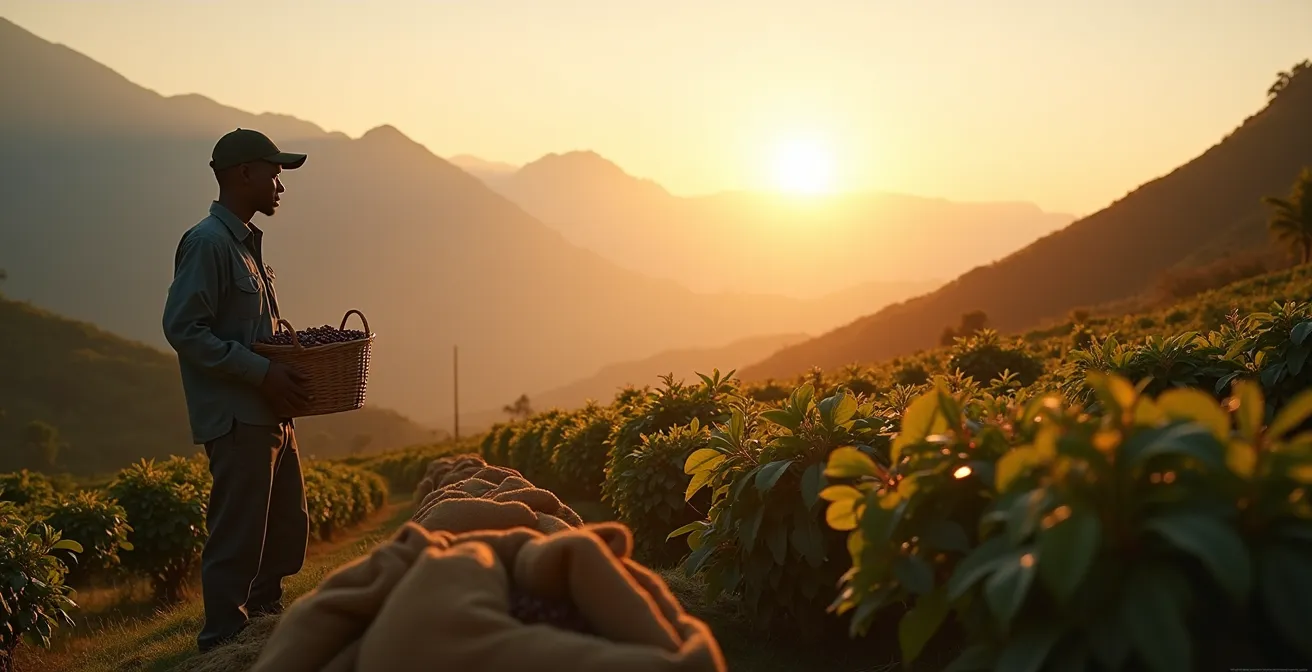
The premium you pay for “ethical” coffee often fails to significantly impact farmer income due to a complex, multi-layered supply chain and certification loopholes.
- The farmer’s share of a retail coffee price can be shockingly small, sometimes less than 1% of the final cost.
- Vague labels like “fairly traded” and in-house corporate certifications often lack the external oversight of official Fair Trade standards.
Recommendation: Shift focus from relying solely on front-of-pack labels to investigating roasters who practice transparent, direct trade and provide verifiable farmgate pricing.
That comforting feeling you get when paying a premium for a bag of coffee with a “Fair Trade” logo is a powerful driver of consumer choice. It’s rooted in a simple, noble idea: that your purchase directly contributes to a better livelihood for the small-scale farmers who grew the beans. You imagine your extra dollar traveling across the globe, rewarding the hard work of a family in a distant mountain community. But what if that narrative is an oversimplification? The journey of a coffee bean from farm to cup is a long and convoluted one, involving a chain of intermediaries, each taking a cut.
While the intention behind ethical consumption is commendable, the reality of the global commodity market is far more complex. The standard discourse often pits good (Fair Trade) against bad (conventional), but this binary view obscures the real mechanics of the value chain. It fails to account for the difference between a price floor and a living income, the rise of opaque corporate “ethical” programs, and the vast gap between the export price (FOB) and the final price paid to the farmer (farmgate).
This analysis moves beyond the marketing promise to deconstruct the financial journey of your coffee premium. We will not ask if Fair Trade is “good” or “bad,” but rather a more precise, data-driven question: where does the money actually go? By examining the supply chain’s structure, comparing certification models, and exploring new technologies, we can uncover a more accurate picture of what it truly takes to support coffee producers.
This article will dissect the intricate path from bean to cup, providing the tools you need to become a more discerning and impactful coffee consumer. We will explore the economic realities farmers face, identify misleading industry practices, and highlight the emerging models that offer genuine transparency.
Summary: Deconstructing the “Ethical” Coffee Supply Chain
- Why Does the Farmer Only See $0.10 of Your $5 Latte?
- How to Find Coffee Roasters Who Buy Directly From Farmers?
- Organic vs. Fair Trade: Which Certification Protects Workers Better?
- The “Fairly Traded” Loophole That Big Brands Use to Mislead You
- How to Tip Coffee Producers Directly Using Blockchain Apps?
- Why Is Keeping Cash in a Standard Savings Account Losing You Money?
- The “Handmade” Markup: ensuring the Creator Gets the Profit
- How Supporting Female Artisans Promotes Equitable Commerce in Developing Nations?
Why Does the Farmer Only See $0.10 of Your $5 Latte?
The disconnect between the retail price of coffee and the farmer’s income is the central paradox of the industry. The price you pay is inflated by a long series of intermediaries, a concept Fairtrade International itself acknowledges. As they state, “After leaving coffee farms, the beans pass through a succession of traders, processors, exporters, roasters and retailers. Most farmers have little knowledge of where their coffee ends up, or the price it sells for.” This value chain opacity is where the majority of the money disappears. Each step—drying, milling, bagging, shipping, roasting, and finally, brewing—adds cost and profit margin, progressively diluting the producer’s initial share.
The numbers are often starker than consumers imagine. While a $0.10 share on a $5 latte is a common illustration, specific analyses can be even more revealing. For instance, research in San Francisco revealed that a farmer might earn as little as one-third of a cent from a $2.75 cup of Fair Trade coffee. The premium paid by the consumer is not a direct transfer; it’s absorbed into this complex system.
A crucial metric for understanding this is the “Freight-on-Board” (FOB) to farmgate price transmission ratio. This measures how much of the price paid to the exporter actually makes it back to the farmer. This ratio varies dramatically by country, highlighting inefficiencies and power imbalances. In Brazil and Vietnam, producers may receive up to 90% of the FOB price. In contrast, the rate in Ethiopia can be less than 50%. This means that even before the coffee leaves its country of origin, half of its value can be lost to local intermediaries, a fact entirely invisible to the end consumer.
How to Find Coffee Roasters Who Buy Directly From Farmers?
Given the dilution of value in the traditional supply chain, “Direct Trade” has emerged as a compelling alternative. This model aims to bypass many of the intermediaries by having roasters purchase beans directly from farmers or cooperatives. This fosters relationships, improves quality feedback, and, in theory, allows a much higher percentage of the final price to reach the producer. However, “Direct Trade” is not a certified term, so the onus is on the consumer to verify the roaster’s claims. A truly transparent roaster will do more than just use the phrase; they will provide verifiable proof of their sourcing relationships.
This proof often comes in the form of “transparency reports.” Look for roasters who publish the exact FOB or even farmgate prices they paid for their green coffee lots. They should name the specific farm, cooperative, or washing station. Many high-end specialty roasters now include this information on their websites or even on the coffee bags themselves. They tell the story of the producer not as a marketing gimmick, but as a form of accountability. They showcase their sourcing trips and the people they work with, moving beyond abstract ethical claims to demonstrate tangible connections.
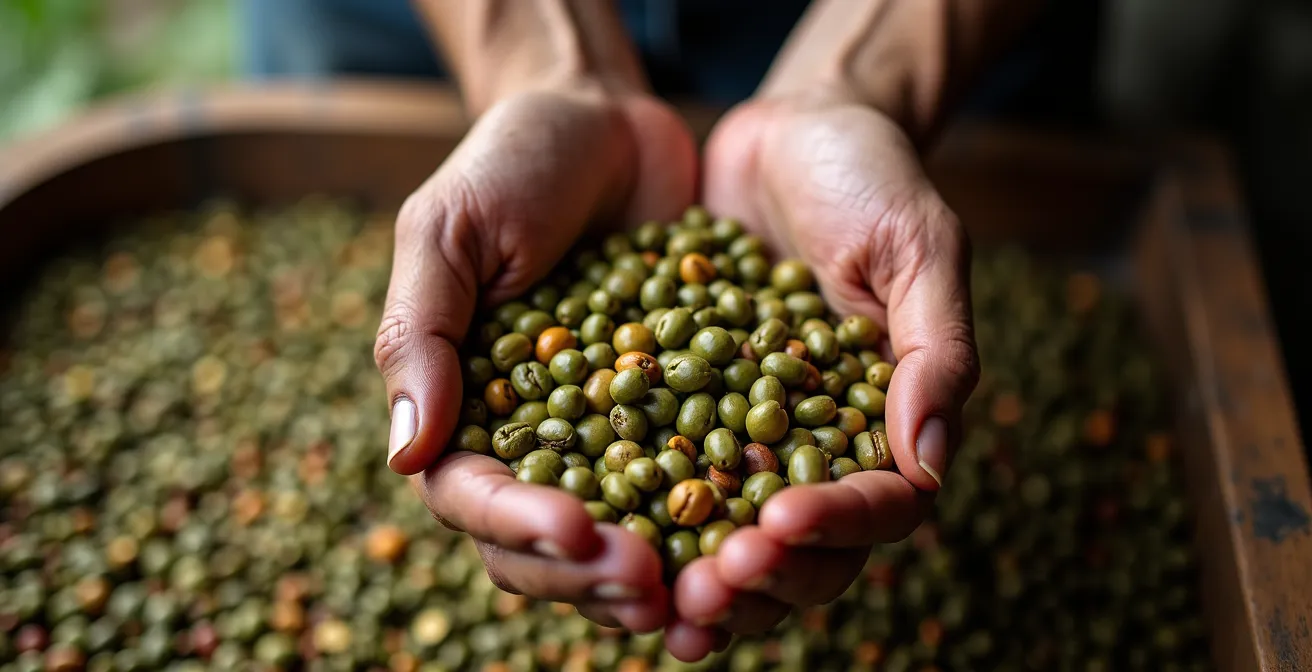
Finding these roasters requires moving beyond the supermarket aisle and exploring the world of specialty coffee. Local, independent roasters are often a great place to start. Engage with them, ask questions about their sourcing model, and look for those who are passionate about sharing the origin of their beans. Their willingness to discuss price, location, and producer is a strong indicator of genuine commitment.
Your Action Plan: Auditing a Roaster’s “Direct Trade” Claim
- Points of contact: Check the roaster’s website, coffee packaging, and social media for sourcing information.
- Collecte: Inventory the specific details provided. Do they name the farm, producer, or cooperative? Do they specify the region and altitude?
- Cohérence: Does the roaster publish a transparency report? Do they explicitly state the FOB or farmgate price paid for the coffee?
- Mémorabilité/émotion: Does the roaster share stories, photos, or videos from their visits to the farms? Does it feel like a genuine partnership or generic marketing?
- Plan d’intégration: Compare the level of transparency between different roasters. Prioritize purchasing from those who provide the most concrete and verifiable data.
Organic vs. Fair Trade: Which Certification Protects Workers Better?
Consumers often see “Organic” and “Fair Trade” labels as interchangeable signals of ethical production, but they address fundamentally different aspects of the coffee supply chain. Understanding their distinct primary goals is key to making an informed choice. Organic certification is overwhelmingly focused on environmental standards and consumer health. Its rules govern soil management, prohibit synthetic pesticides and fertilizers, and ensure non-GMO practices. While this provides a significant benefit to worker health by reducing exposure to harmful chemicals, it does not directly regulate wages, working conditions, or pricing structures.
Fair Trade, on the other hand, is built on a foundation of economic justice. Its core mechanisms are the Fairtrade Minimum Price, which acts as a safety net when market prices collapse, and the Fairtrade Premium, an additional sum of money paid to cooperatives for community development projects. The standards also explicitly prohibit child labor and forced labor and mandate safe working conditions. However, the enforcement of these standards, especially for temporary or seasonal workers, can be challenging across thousands of small farms.
The following table breaks down their primary areas of focus and protection:
| Aspect | Organic Certification | Fair Trade Certification |
|---|---|---|
| Primary Focus | Environmental protection & pesticide-free production | Economic justice & fair pricing |
| Worker Health | Protects from pesticide exposure | Requires safe working conditions |
| Economic Protection | No minimum price guarantee | Minimum price floor & premium payments |
| Seasonal Workers Coverage | Limited protection | Standards apply but enforcement varies |
| Child Labor Prevention | Not specifically addressed | Explicitly prohibited |
Ultimately, neither certification is a silver bullet for poverty. A Fairtrade analysis shows that among the ten largest coffee producing countries, only farmers in Vietnam and Brazil consistently earned a living income from coffee in recent years. This sobering statistic reveals that even with the Fair Trade price floor and premium, systemic issues of farm size, yield, and global price volatility often keep farmers in a state of precarity. The ideal scenario for comprehensive protection is often a coffee that is dual-certified as both Organic and Fair Trade, combining environmental safeguards with economic support.
The “Fairly Traded” Loophole That Big Brands Use to Mislead You
As consumer demand for ethical products has grown, a new, more ambiguous category of certification has appeared: in-house corporate programs. Large multinational companies, rather than submitting to the standards and fees of external bodies like Fairtrade International, have developed their own sustainability schemes. You might see labels like “Sourced with Care,” “Responsibly Grown,” or the particularly nebulous “Fairly Traded.” These programs create a significant “fair-washing” loophole that can mislead well-intentioned consumers.
The core problem with these in-house labels is a profound lack of independent oversight. As noted in an analysis of the trend, many major brands have their own programs: “McDonald’s has its own programme for its coffee. Nestle has its own version and Starbucks has its own one and they’re all different.” This fragmentation makes it impossible for a consumer to compare standards or verify claims. The company sets the rules, measures its own performance, and reports its own success. There is no external organization to review the terms of trade or audit whether the promised benefits are actually delivered to the farmer.
Companies often defend these programs by claiming they can have a greater and more tailored impact by managing sustainability efforts directly. They argue their scale allows them to invest in specific farmer training programs or environmental projects. While some of these initiatives may have genuine merit, critics remain skeptical. Without the accountability of a third-party audit, consumers have no way of knowing if the program is a genuine effort to improve livelihoods or a sophisticated marketing exercise designed to mimic the appearance of ethical sourcing while maximizing corporate profit. The term “fairly traded” has no legal definition, allowing it to be used freely to imply a standard of fairness that may not exist in practice.
How to Tip Coffee Producers Directly Using Blockchain Apps?
The fundamental challenge of the coffee supply chain is its opacity. Blockchain technology offers a radical solution: creating a transparent, immutable ledger that tracks beans from the farm to the final consumer. Several platforms are now using this technology to provide unprecedented visibility and enable new economic models, including the ability for consumers to tip producers directly. This disintermediates the process, creating a direct financial link that bypasses the entire traditional value chain.
Platforms like iFinca have built a system that connects all players—from individual farmers to exporters, importers, and roasters—on a shared digital ledger. The platform requires buyers to pay farmers a significant portion of the agreed price within days of delivery, solving a major cash-flow problem for producers. By 2020, the platform had already grown to include over 9,400 individual farmers. For consumers, a QR code on a bag of coffee can open an app that shows the bean’s entire journey, including the price the farmer was paid and an option to send a digital tip directly to them.

Other companies, like Bext360, combine physical machinery with blockchain. Their automated machines can grade coffee cherries by the batch and facilitate instant digital payment to the farmer’s phone. One analysis notes that the Bext360 grading machine can process up to 30 kilograms of coffee cherries at a time, with the option for instant payout. This technology not only ensures fair and immediate payment but also provides valuable data on quality that can help farmers improve their crops and command higher prices in the future.
While still in its early stages, blockchain-powered traceability represents a paradigm shift. It moves the conversation from relying on trust in a label to demanding verifiable, cryptographic proof of a coffee’s origin and the financial transactions behind it. It empowers consumers to reward producers directly and gives farmers unprecedented access to data and financial services.
Why Is Keeping Cash in a Standard Savings Account Losing You Money?
In personal finance, a standard savings account is often seen as the safest place for money. However, in an inflationary environment, it’s a guaranteed way to lose purchasing power. The interest earned is typically far below the rate of inflation, meaning your money is worth less each year. This illustrates a critical economic principle: the difference between nominal stability and real value. A coffee farmer’s income faces a similar, though more complex, erosion of value, not from inflation, but from market volatility and supply chain costs.
The Fair Trade system attempts to address this by providing a minimum price, which acts like a fixed-term deposit, offering a degree of predictability. As one analysis on price stability notes, this predictable price is highly valuable for long-term planning. However, this safety net is benchmarked against the “C-Market,” the wildly fluctuating global commodity price for coffee. The Fair Trade “premium” is a small interest payment on a principal—the market price—that can swing dramatically.
Just as an investor must look beyond a simple savings account to truly grow wealth, a conscious consumer must look beyond the simple Fair Trade price floor to understand if a farmer is truly building a sustainable livelihood. The real value is eroded not just by low prices, but by the opaque system of intermediaries between the farm and the port, which functions like a hidden, high-fee management cost on the farmer’s primary asset.
The “Handmade” Markup: ensuring the Creator Gets the Profit
In the coffee world, the equivalent of a “handmade” or artisanal product is specialty coffee. These are coffees graded at 80 points or higher on a 100-point scale for their exceptional flavor profiles, aroma, and quality. Achieving this level of quality requires immense skill, care, and specific environmental conditions from the farmer—the original “creator.” This superior quality commands a significant price markup, but the key question remains: does that markup reliably flow back to the producer who created the value?
Data shows a clear price stratification based on quality. The 2024 Specialty Coffee Transaction Guide indicates that moving from conventional to regular specialty grades can add a significant premium. For example, some data shows the price can increase by $0.70-$0.75 per pound for these higher grades. This premium increases even more for the highest tiers of specialty coffee. Coffees scoring 84 points or more can fetch a median FOB price of $4.18 per pound, compared to just $2.93 for those in the low-80s range. This demonstrates a clear market reward for exceptional agricultural craftsmanship.
However, this “handmade markup” is only guaranteed to reach the farmer in a transparent trading model. In a conventional, multi-layered system, this premium can be absorbed by intermediaries who may blend high-quality lots with lower-quality ones or simply fail to pass the full value back to the farm. This is where the principles of Direct Trade become paramount. Roasters who build direct relationships are not just buying a commodity; they are investing in a farmer’s ability to produce exceptional quality year after year. They provide feedback, pay for exclusivity, and often pre-finance harvests, ensuring the creator reaps the financial rewards of their meticulous work.
Key takeaways
- The farmer’s share of a coffee’s retail price is minimal due to a long, opaque supply chain.
- “Direct Trade” models and blockchain verification offer more transparency than relying on labels alone.
- Corporate “in-house” ethical programs often lack the independent oversight of official certifications like Fair Trade.
How Supporting Female Artisans Promotes Equitable Commerce in Developing Nations?
Within the broad discussion of ethical commerce, focusing on gender equity provides a powerful lever for community-wide impact. In the coffee industry, women are foundational to the production process, yet they are often the most marginalized. While research shows that women head 20-30% of coffee-producing households and provide a significant portion of the labor, they systematically have less access to land ownership, credit, and agricultural training than their male counterparts. This structural inequality limits their economic potential and the well-being of their families.
Targeting support specifically toward female coffee producers and cooperatives is not just an act of social justice; it is a highly effective economic development strategy. Studies have consistently shown that when women control household income, they are more likely to invest it in critical areas that benefit the entire community. As one report on the topic highlights, this income is often prioritized for family nutrition, children’s health, and education. This creates a powerful multiplier effect, where empowering a female artisan financially leads to healthier, better-educated future generations and a more resilient community.
Supporting these women involves more than just purchasing coffee from female-led cooperatives. It means championing roasters and importers who actively invest in gender equity programs, which can include leadership training, financial literacy workshops, and support for securing land tenure. By consciously choosing to support businesses that empower female artisans, consumers can help dismantle the structural barriers they face and ensure that the profits from their skilled labor are reinvested in a way that generates exponential social returns. This transforms a simple coffee purchase into a targeted investment in equitable and sustainable development.
By moving beyond simplistic labels and embracing a more analytical approach, you can transform your coffee consumption from a passive act of trust into an active, informed choice that genuinely supports the creators at the start of the chain. The next step is to apply this knowledge to your own purchasing habits.