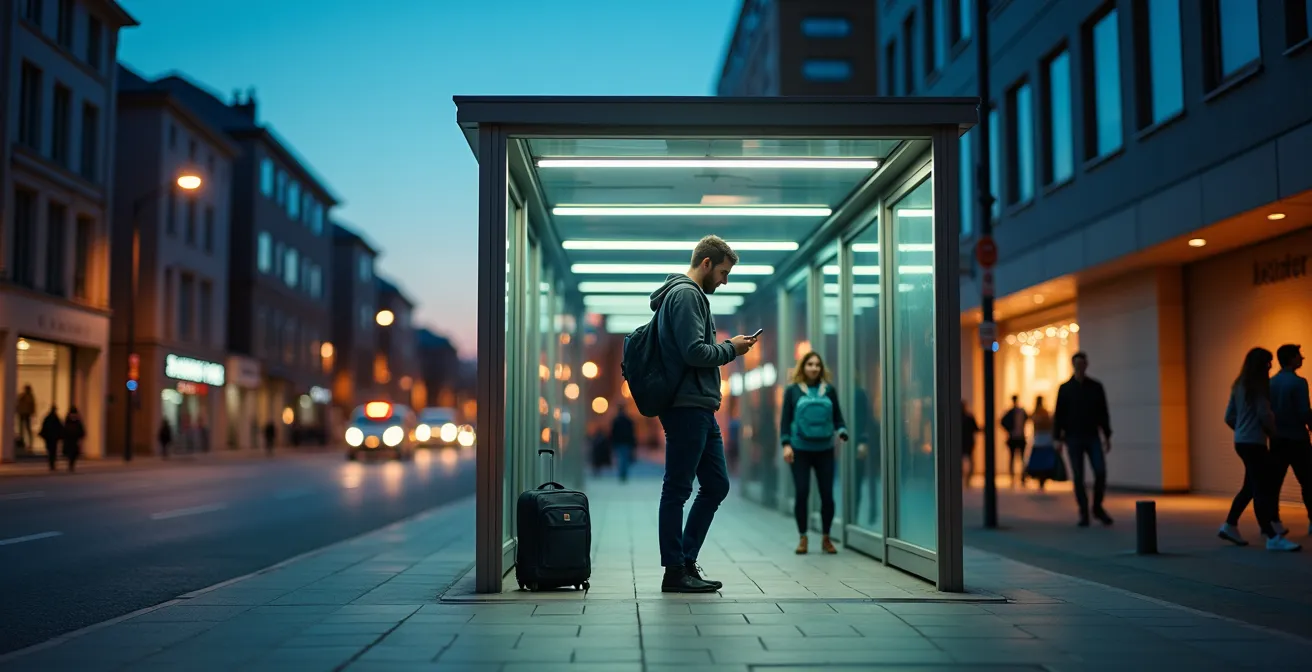
In summary:
- Understand and leverage environmental design (like lighting) to choose safer waiting spots.
- Master bystander intervention techniques to de-escalate harassment without direct confrontation.
- Ditch noise-cancelling headphones to eliminate the “auditory bubble” that makes you a target.
- Use data triangulation with multiple apps to avoid long waits for “ghost buses” or trains.
- Build temporary social connections and use digital reconnaissance to secure your entire journey, from transit to destination.
The feeling is universal for solo travelers: the sun sets, the city’s energy shifts, and the simple act of getting from A to B on public transport becomes fraught with tension. Your senses are on high alert, and every shadow seems to hold a potential threat. Well-meaning advice often boils down to generic platitudes like “be aware of your surroundings” or “don’t flash your valuables.” While not wrong, this advice places the entire burden of safety on your personal vigilance, a resource that can wane with fatigue or distraction.
This approach is incomplete. It treats safety as a purely personal responsibility, ignoring the systemic and environmental factors that truly dictate risk. But what if the key wasn’t just being a more alert target, but becoming a strategic navigator of the urban environment? What if you could understand and use the systems of the city—its lighting, sightlines, data streams, and social fabric—to your advantage?
This guide moves beyond the basics. We will deconstruct the “why” behind transit crime, giving you the power to not just react to your environment, but to proactively shape it. We will explore how urban design influences behavior, how to report incidents safely, why your choice of headphones matters more than you think, and how to leverage technology and social dynamics to build a bubble of security around your entire journey. It’s time to shift from a mindset of fear to one of empowered awareness.
This article breaks down the essential strategies you need to master. By understanding these core principles, you can transform your approach to night travel, moving with confidence and control through any urban landscape.
Contents: A Strategic Approach to Night Transit Safety
- Why Do Well-Lit Bus Stops Reduce Crime Rates by Over 20%?
- How to Report Harassment on the Subway Without Escalating the Situation?
- Bus vs. Train: Which Mode Is Statistically Safer for Night Commutes?
- The Headphone Mistake: Why Noise Cancellation Makes You a Target?
- How to Use Real-Time Data to Avoid “Ghost Buses” in Winter?
- How to Map “Low-Surveillance” Walking Routes in Downtown Areas?
- Why Do Connected Neighborhoods Experience 40% Less Petty Crime?
- How to Build Social Cohesion in High-Density Apartment Complexes?
Why Do Well-Lit Bus Stops Reduce Crime Rates by Over 20%?
The answer lies in a powerful urban planning principle: Crime Prevention Through Environmental Design (CPTED). This isn’t just about adding a brighter bulb; it’s about fundamentally altering the psychology of a space. Good lighting eliminates the deep shadows and blind spots that criminals rely on for concealment. It creates what experts call “natural surveillance,” where clear sightlines make it more likely that illicit activity will be witnessed by passersby or from nearby buildings. This increased visibility creates a powerful deterrent, as the perceived risk of being caught is significantly higher.
While the 20% figure is a widely cited benchmark, the specific impact varies. A comprehensive meta-analysis of 17 studies on urban lighting confirmed a significant impact, with an average 14% decrease in crime in experimental areas. Research in Los Angeles examining bus stops as crime “hot spots” further validated this, finding that environmental factors like visibility and surveillance opportunities were key predictors of criminal activity. A poorly lit, enclosed bus shelter provides a perfect “defensible space” for an attacker, not the victim.
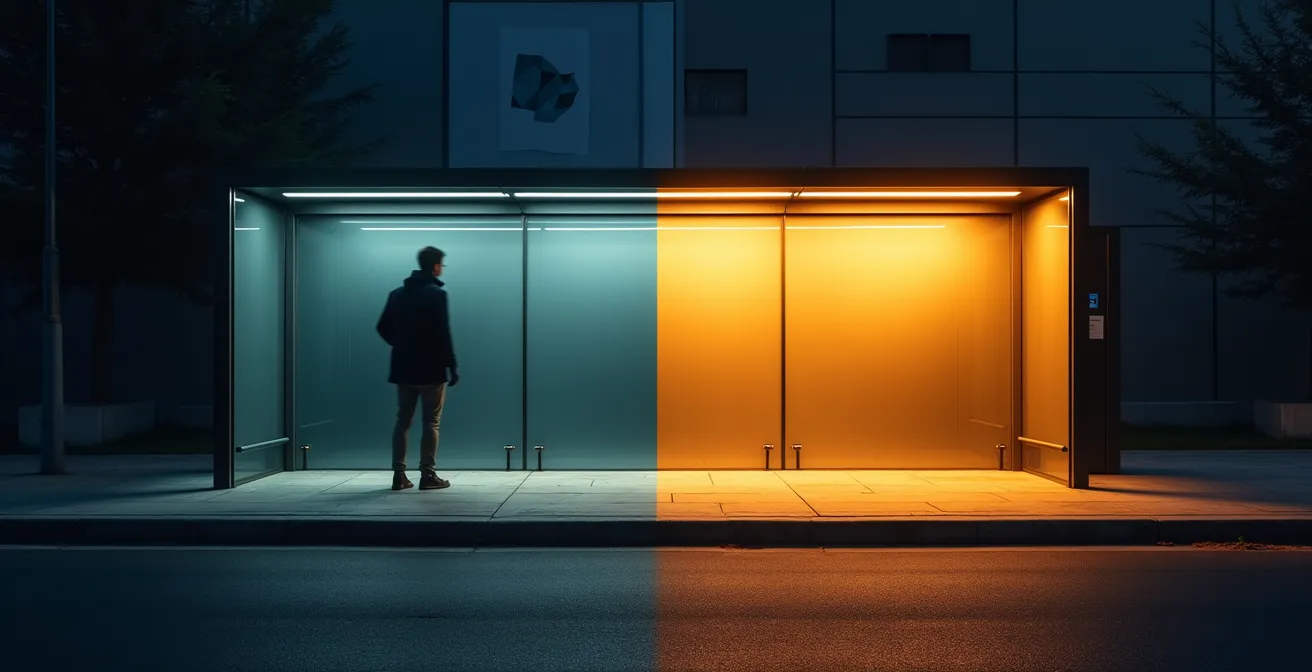
As a traveler, you can leverage this. When waiting for a bus at night, consciously choose your position based on CPTED principles. Avoid enclosed shelters with blocked views and instead stand in a well-lit area with clear visibility in all directions. Position yourself where you can be seen from active storefronts or residential windows. By understanding that light is a strategic tool, not just an amenity, you actively reduce your vulnerability and reclaim control over your environment.
How to Report Harassment on the Subway Without Escalating the Situation?
Direct confrontation is often your first instinct, but it’s rarely the safest or most effective option. Escalation is a real risk, not just for you but for the person being targeted. The key is to shift your goal from confronting the harasser to supporting the victim and de-railing the incident. An internationally recognized framework for this is the 5Ds of Bystander Intervention, developed by the experts at Right To Be.
This method provides a toolkit of non-confrontational strategies that empower you to act without putting yourself in harm’s way. Instead of engaging the aggressor, you create a disruption that breaks the tension and gives the person being harassed an escape. The focus is on intervention, not heroism. It’s about subtly changing the dynamic of the situation.
Here are the 5Ds you can deploy:
- Distract: Engage directly with the person being harassed, completely ignoring the aggressor. Ask for directions, comment on their book, or ask for the time. This simple act breaks the harasser’s focus and creates a buffer.
- Delegate: If you don’t feel safe intervening directly, get someone else involved. Alert a transit employee or discreetly ask another passenger for help. The resource from Right To Be notes that involving police can escalate situations, especially for marginalized communities, so a transit authority figure is often a better first choice.
- Document: Record the incident on your phone, but only if someone else is already helping the target. If no one is intervening, your priority is to use another method, not to be a passive observer.
- Delay: After the incident is over, check in with the person who was harassed. Ask if they are okay and if they need anything. This act of solidarity can combat the feelings of isolation that often follow such an event.
- Direct: This is the riskiest option and should be used with extreme caution. If you choose to speak to the harasser, be brief, firm, and to the point (e.g., “Leave them alone.”). Do not engage in a dialogue or argument.
Bus vs. Train: Which Mode Is Statistically Safer for Night Commutes?
Statistically, there is no universal “safer” mode; the risk is highly contextual and depends more on the specific route, time, and environment than on whether you’re on a bus or a train. Crime risk isn’t evenly distributed. Instead, it clusters around “hot spots.” Research mapping over 600 bus stop locations found that a high concentration of stops in certain areas can facilitate crime by creating predictable patterns for offenders. The risk is highest in the immediate vicinity of the stop and decays with distance.
The key takeaway is that safety is determined by proximity to authority and a vigilant crowd, not the vehicle type. On a bus, this means the area near the driver. On a train, this means a well-lit car with other passengers, away from the isolated end carriages. The primary difference lies in the scale of the environment. A bus offers a contained space with a clear authority figure (the driver), making it easier to manage your immediate surroundings. A train system, with its multiple cars and sprawling stations, presents more variables and potential for isolation.
Therefore, your safety assessment should focus on these practical factors:
- Proximity to the Operator: On buses, always aim for a seat near the driver. They are your first line of defense and can contact authorities.
- Passenger Density: On trains, avoid empty or near-empty carriages at all costs. A car with a handful of other calm passengers is your safest bet. Position yourself near emergency intercoms.
- Personal Alertness: Regardless of the mode, keep your valuables secured and out of sight. Wear a crossbody bag in front of your body and keep your phone in a front pocket, not a back pocket or dangling from your hand.
- Trust Your Instincts: If a situation or an individual makes you feel uneasy, do not hesitate. Get off at the next stop, switch train cars, or simply wait for the next vehicle. Your intuition is a powerful safety tool.
The Headphone Mistake: Why Noise Cancellation Makes You a Target?
In the chaotic environment of public transport, headphones feel like a sanctuary. They offer an escape from noise and a private world. However, this comfort comes at a steep price: your situational awareness. Noise-cancellation technology, in particular, creates a dangerous “auditory bubble” that disconnects you from your surroundings, making you an easier and more attractive target for opportunistic criminals.
This isn’t a minor issue; research shows over 24% of people wear headphones for a significant part of their day, often without considering the safety implications. Your hearing is a critical component of your personal security system. It alerts you to subtle cues that your eyes might miss: the sound of someone approaching too quickly from behind, an aggressive tone in a nearby conversation, or the tell-tale rustle of a bag being unzipped.
As the personal safety experts at NFPS Ltd. state in their analysis:
Wearing headphones can make individuals easy targets for theft or assault, as they might not notice someone following or approaching them.
– NFPS Ltd, Personal Entertainment v Personal Safety Analysis
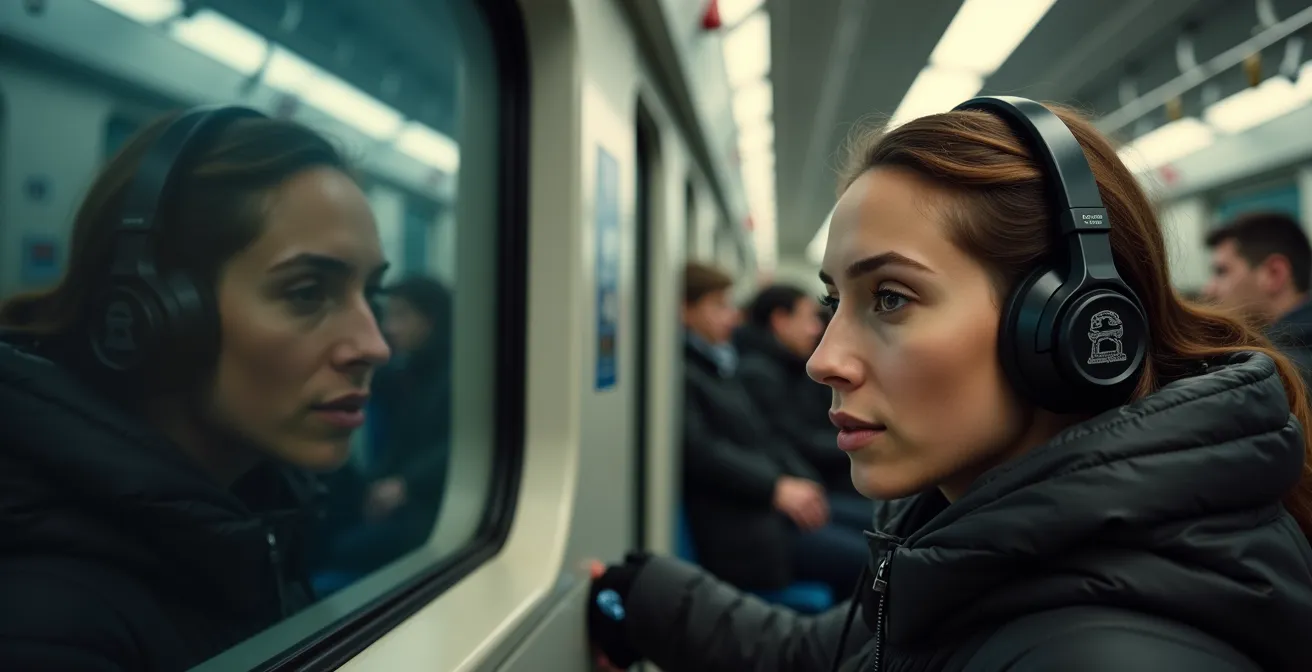
The solution isn’t to travel in silence. It’s about being strategic. If you must listen to something, use only one earbud. Keep the volume low enough that you can still hear conversations and ambient sounds around you. Better yet, save the music or podcast for when you’ve reached your safe destination. At night, your full sensory toolkit is your best defense. Sacrificing your hearing for entertainment is a risk that simply isn’t worth taking.
How to Use Real-Time Data to Avoid “Ghost Buses” in Winter?
The “ghost bus”—a vehicle that appears on your transit app but never arrives—is one of the most frustrating and dangerous aspects of winter travel. It leaves you waiting on a cold, dark street corner, extending your exposure to potential threats. This happens because official transit apps often run on fixed schedules, failing to account for real-time disruptions like weather delays, mechanical issues, or unannounced cancellations. To combat this, you must become a savvy data analyst, using a technique called data triangulation.
This strategy involves cross-verifying information from multiple, independent sources to get a more accurate picture of reality. Never rely on a single app. As a case study on multi-app verification confirms, successful travelers use official apps for the *scheduled* time, user-reported apps for *actual* conditions, and social media for *instant* alerts. This layered approach helps you distinguish between a bus that’s a few minutes late and one that isn’t coming at all, allowing you to make a timely decision to seek shelter or find an alternative route.
By implementing this disciplined approach, you move from being a passive waiter to a proactive navigator, minimizing your time in vulnerable locations. Your goal is to build a reliable, real-time intelligence system for your specific journey.
Action Plan: Your Data Triangulation Checklist
- Cross-Verify Apps: Check your official transit app against a third-party aggregator like Transit or Citymapper. Discrepancies are a major red flag.
- Check Live Traffic: Open Google Maps or Apple Maps and look at the traffic overlay along your bus route. Heavy red lines mean significant delays, no matter what the transit app says.
- Scan Social Media: Search your transit authority’s official Twitter/X handle and the route number (e.g., “#Route57”). Real-time reports from other passengers are often the first sign of a major problem.
- Monitor Live Locations: Use the live vehicle tracking feature available in many apps. If the bus icon hasn’t moved in ten minutes, it’s likely out of service, even if the app still shows an arrival time.
- Have a Backup Plan: Before you leave, save alternative route options and the number for a local taxi service offline. If your data points to a ghost bus, you can pivot immediately without fumbling with your phone in the cold.
How to Map “Low-Surveillance” Walking Routes in Downtown Areas?
Your journey doesn’t end when you step off the bus or train; the walk from the stop to your final destination is often the most vulnerable part of your trip. This is where digital reconnaissance becomes a non-negotiable part of your safety protocol. Before you even leave, you must virtually walk your route to identify and avoid “low-surveillance” zones—areas with poor lighting, long windowless walls, and a lack of “eyes on the street.”
The goal is to map a path that maximizes natural surveillance and provides clear escape routes. This aligns with CPTED principles, which emphasize that routes with active storefronts and residential windows create a powerful deterrent to crime. A potential attacker is far less likely to act when they feel they are being watched. Your task is to find these “corridors of commerce” and stick to them.
Use these steps to conduct your digital reconnaissance before traveling:
- Use Google Street View: This is your primary tool. Virtually “walk” the entire route from the transit stop to your door. Look for long, windowless facades (like parking garages or warehouses), vacant lots, and unkempt landscaping that could provide hiding spots. These are red flags.
- Identify “Permeable” Routes: A safe route has frequent cross-streets, providing multiple options for you to change direction or flee if necessary. Avoid paths that lock you into long, inescapable stretches.
- Map Safe Havens: Identify and mentally bookmark late-night businesses along your route, such as hotels, 24/7 convenience stores, or restaurants. These are places you can duck into if you feel you are being followed.
- Consult Local Intel: If staying at a hotel or hostel, ask the front desk staff to mark up a map, showing you which streets are safe after dark and which to avoid. They have invaluable, up-to-the-minute local knowledge. Memorize the route, but keep the map hidden to avoid looking like a lost tourist.
- Screenshot for Offline Access: Once you’ve mapped your ideal route, take a screenshot. This ensures you have access to it even if you lose connectivity.
Why Do Connected Neighborhoods Experience 40% Less Petty Crime?
The 40% reduction in crime is often attributed to a concept pioneered by Jane Jacobs: “eyes on the street.” In a connected, socially cohesive neighborhood, residents feel a sense of collective ownership and informal surveillance. People know their neighbors, they notice when something is out of place, and they are more likely to intervene or report suspicious activity. This web of “weak ties” creates a powerful, passive security system that makes criminals feel exposed and unwelcome. The logic is simple: crime thrives in anonymity, and social cohesion destroys it.
While that 40% figure represents a long-term community benefit, the underlying principle is something you can leverage as a solo traveler in the short term. By making yourself a “familiar face,” even temporarily, you can tap into this protective social fabric. For instance, studies on CPTED projects have shown that improving community safety can lead to a massive boost in community engagement; one project saw social activities increase by 90.4% within a year. This demonstrates the powerful link between a safe environment and a connected community.
Your goal is to build temporary social capital quickly. Here’s how:
- Become a “Regular”: If you’re staying in an area for more than a day, frequent the same local coffee shop or small store. A simple “hello” and a smile are enough to transition from a complete stranger to a recognized face.
- Befriend Service Staff: Bartenders, servers, and hotel staff are your allies. They are trained to notice when patrons are in distress. If someone is hassling you, they are likely to come to your aid.
- Join Online Communities: Before you even arrive, join city-specific backpacker or expat Facebook groups. You can gather hyper-local safety intelligence and even connect with other travelers.
- Check-In Protocol: Always let someone know your plans. Leave a note in your room or send a text to a friend with your destination and expected return time. Carry a card from your hotel or hostel with the address clearly on it.
Key Takeaways
- Safety is Systemic, Not Just Personal: Your security depends on understanding and navigating environmental design (CPTED), social dynamics, and data systems—not just on personal vigilance.
- Awareness is Your Primary Weapon: The greatest risks come from self-imposed isolation. Eliminating auditory bubbles (headphones) and digital blindness (relying on one app) is paramount.
- Proactive Planning Defeats Opportunistic Threats: Most crime is opportunistic. Digital reconnaissance, data triangulation, and building temporary social ties are proactive steps that make you a less attractive target.
How to Build Social Cohesion in High-Density Apartment Complexes?
As a temporary resident in an Airbnb or apartment rental, you are outside the established social fabric of the building. This makes understanding and integrating with its existing security protocols absolutely critical. You can’t build deep social cohesion overnight, but you can leverage the building’s infrastructure and personnel to create a secure bubble. Your safety begins with choosing the right accommodation and continues with how you conduct yourself within it.
When booking, scrutinize the location’s proximity to your primary transit stops and research the neighborhood’s reputation after dark. For rentals like Airbnb, pay close attention to reviews that mention check-in. Confusing entry instructions that leave you fumbling with a lockbox on a dark street corner immediately flag you as a vulnerable outsider. Look for properties with well-lit entrances and positive reviews regarding security and host communication.
Once you arrive, treat the building’s security staff as your primary safety asset. They are the permanent “eyes on the street” for that specific location. Adhering to the building’s rules isn’t just about being a good guest; it’s about reinforcing the collective security that protects everyone.
- Engage the Concierge: Upon check-in, introduce yourself to the doorman or concierge. Ask them about building security features and if there have been any recent incidents to be aware of. They are your best source of hyper-local intelligence.
- Never Allow Tailgating: Do not hold the main security door open for anyone you don’t know, even if they look like a resident. Insisting that everyone use their own key or fob is a cornerstone of building security.
- Master the Intercom: Learn how the intercom or buzzer system works. Do not buzz anyone in unless you are explicitly expecting them and have verified their identity.
- Arrange Transfers in Advance: Pre-booking an airport transfer or rideshare is far safer than trying to figure out transport on arrival, especially late at night. It reduces stress and the time you spend looking lost and vulnerable.
Ultimately, traveling safely at night is not about avoiding the world; it’s about engaging with it intelligently. By applying these strategies, you shift from being a potential victim to being a prepared, empowered solo traveler who has a right to be out after dark. Start implementing these practices today to move through any city with confidence.