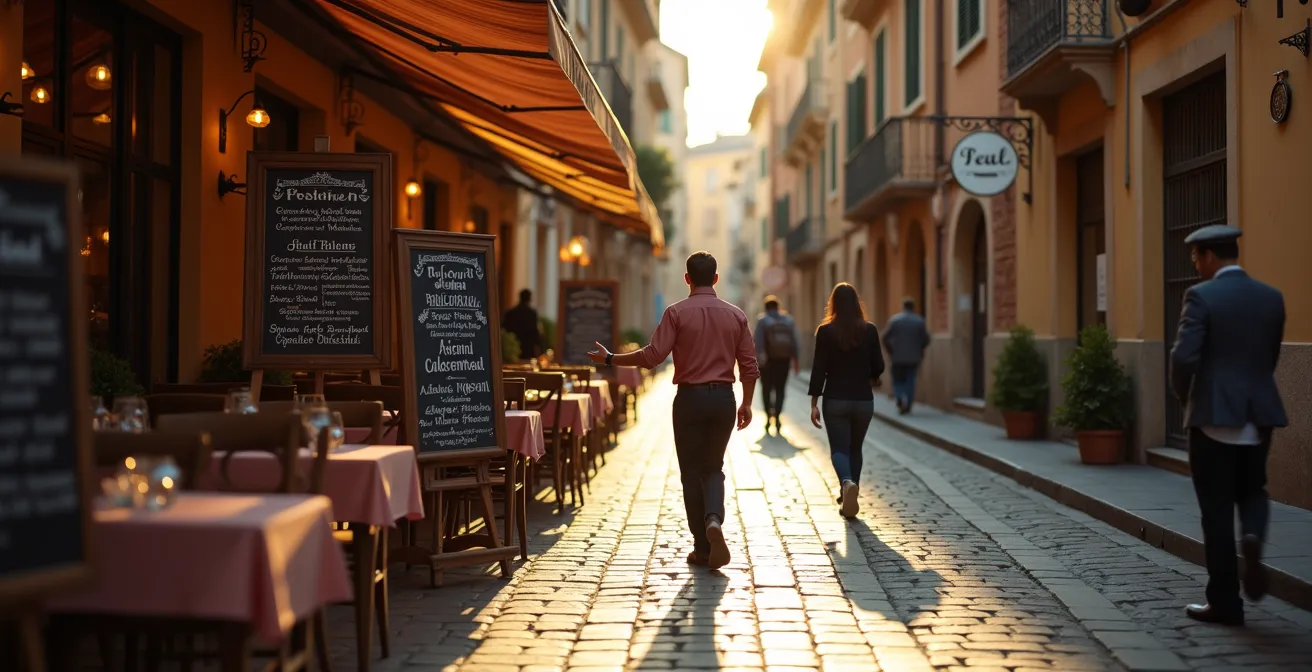
The secret to avoiding tourist traps isn’t about luck; it’s about learning to spot the “transactional” business model they can’t hide.
- Visual cues like glossy, multi-language menus reveal a focus on one-time visitors, not quality.
- True authenticity lies where locals eat, whether it’s a high-turnover street stall or a fully booked bistro.
Recommendation: Frame your questions to locals to ask for their personal favorites, not generic “good” spots, to bypass commission-based recommendations.
There is no greater travel disappointment than a bad meal. You’ve spent hours on a plane, navigated foreign streets, and are ready for that life-changing culinary moment, only to end up in a soulless restaurant paying a premium for a microwaved plate of clichés. It’s a culinary crime. For years, the common wisdom for food-focused travelers has been a simple checklist: avoid menus with pictures, walk a few blocks away from the main square, and look for places filled with locals. While this advice isn’t wrong, it’s tragically incomplete.
This surface-level approach misses the fundamental truth of the tourist trap. These establishments aren’t just bad restaurants; they are businesses ruthlessly optimized for a single, high-margin transaction with a customer they never expect to see again. Authentic eateries, by contrast, are built on relationships and repeat business from a discerning local clientele. The real skill, then, isn’t following a rigid set of rules. But what if the key wasn’t a checklist, but a mindset? What if you could learn to read a restaurant’s ‘visual economics’—the story its facade, menu, and staff tell about its business model—in under 30 seconds?
This guide will teach you to decode those signals. We’ll move beyond the obvious red flags to understand the underlying principles of what separates relational dining from transactional dining. From the psychology of a picture menu to the surprising safety of a busy street stall, you will learn to see the subtle cues that scream “tourist trap” and, more importantly, the quiet signals that whisper “this is the real deal.”
To help you navigate these insights, we’ve broken down the key strategies for identifying authentic dining experiences. This summary provides a roadmap to the concepts we will explore in detail.
Summary: A Savvy Traveler’s Guide to Authentic European Dining
- Why Do Menus With Pictures Usually Indicate Low-Quality Food?
- How to Ask a Taxi Driver for Recommendations Without Getting a Generic Answer?
- Street Stall vs. Michelin Star: Where is the Real Culture of a City?
- The “Dirty” Fallacy: Why Avoiding Street Food Makes You Miss the Best Meals?
- When to Book Top Tables: Why Walking In Doesn’t Work in Tokyo?
- Supermarket Organic vs. Local Conventional: Which Is Actually Greener?
- Expat Community or Local Immersion: Which Accelerates Adaptation?
- How Joining a CSA Farm Share Supports Short Supply Chains?
Why Do Menus With Pictures Usually Indicate Low-Quality Food?
The laminated, multi-language picture menu is the quintessential tourist trap signal. But it’s not the photos themselves that are the problem; it’s what they represent. These menus are a tool of transactional dining. They are designed for speed and clarity for a customer who doesn’t speak the language and will never return. The focus isn’t on seducing a regular with the poetry of a dish but on closing a sale with a foreigner. When a restaurant invests more in universal communication than in its actual food, it’s a massive red flag. The food itself is often an afterthought, pre-made and frozen to accommodate a sprawling menu designed to have “something for everyone.”
Authentic establishments operate on a model of relational dining. Their menus are often simple, text-based, and primarily in the local language. They may offer a translation, but it’s an accommodation, not the main feature. They expect you to ask questions. They want to build a relationship. An exception that proves the rule is Japan’s tradition of ‘shokuhin sanpuru’ (display food). These hyper-realistic models are a point of pride and a significant investment, signaling transparency and commitment to quality, the exact opposite of what a glossy, faded picture of spaghetti bolognese signifies in Rome, which might as well have a neon sign flashing ‘EAT HERE, TOURISTS!’
To train your eye, think like an auditor. The visual evidence of a menu tells you everything about the restaurant’s financial and culinary priorities. A handwritten daily special signals a connection to the market; a permanently printed “special” signals a connection to the freezer.
Your 5-Point Restaurant Authenticity Audit
- Contact Points: Scan the facade, menu board, and entrance. What’s the first message they’re sending? (Price, convenience, or culture?)
- Collection: Inventory the menu’s visual language. Are there glossy photos? Multiple languages? Lamination?
- Coherence: Does the menu’s promise (e.g., “traditional grandma’s recipe”) match the visual evidence (e.g., generic, mass-produced look)?
- Memorability/Emotion: Is there a unique, handwritten special? A dish that shows personality? Or is it a generic “greatest hits” of the country’s cuisine?
- Integration Plan: Based on the red flags, decide: walk away or, if a minor flag, ask a specific question to test their authenticity (“What’s fresh from the market today?”).
How to Ask a Taxi Driver for Recommendations Without Getting a Generic Answer?
Asking a local for a recommendation seems like the perfect way to find an authentic spot. Yet, this strategy can easily backfire. The key is *how* and *who* you ask. Asking a concierge or a taxi driver, “Where is a good place to eat?” is an invitation to be sent to a restaurant that pays them a commission. This is especially true for hotels; a study found that some hotels receive kickbacks for sending guests to nearby tourist traps. You’re not getting an honest recommendation; you’re becoming part of a lead-generation scheme.
The secret is to reframe the question to make it personal and specific. Instead of asking where is “good,” you need to tap into their personal experience. A better question is, “Where do *you* go with your own family for a celebration?” or “What’s your favorite spot for a casual lunch with friends that tourists don’t know about?” This shift does two things: it bypasses the scripted, commission-based answer and forces them to access a genuine memory. It’s no longer a business transaction; it’s a human sharing a personal favorite.
This principle of seeking personal, passionate recommendations over generic “good” ones is a recurring theme among seasoned travelers. As travel expert Chelsea Dickenson notes in an interview with Explore Magazine:
I love asking my taxi drivers, the hotel staff, and even people I meet out and about what their favorite place is that they’d visit with friends
– Chelsea Dickenson, Travel Expert Interview, Explore Magazine
This approach transforms a potentially compromised source into a valuable ally. You’re not asking for a tourist spot; you’re asking to be let into their world, and people are often happy to share that piece of themselves.
Street Stall vs. Michelin Star: Where is the Real Culture of a City?
The debate between high-end dining and humble street food often frames them as opposites. But when it comes to finding the “real culture” of a city, they can be two sides of the same coin, while the tourist trap is another currency entirely. Real culture resides where there is passion, specialization, and local patronage. A three-Michelin-star restaurant reviving ancient preservation techniques and a street vendor who has perfected a single family recipe for three generations are both expressions of culinary authenticity. They are specialists.
The tourist trap, conversely, is a generalist. It serves a bland, internationalized version of “everything” to offend no one and impress no one. Its cultural driver is not heritage or passion, but location-based profit. The true indicator of authenticity is not the price point but the patronage. If the tables are filled with locals—whether in suits or work boots—you are likely in the right place. If it’s 95% tourists taking photos, you’re in a cultural theme park, not a restaurant.
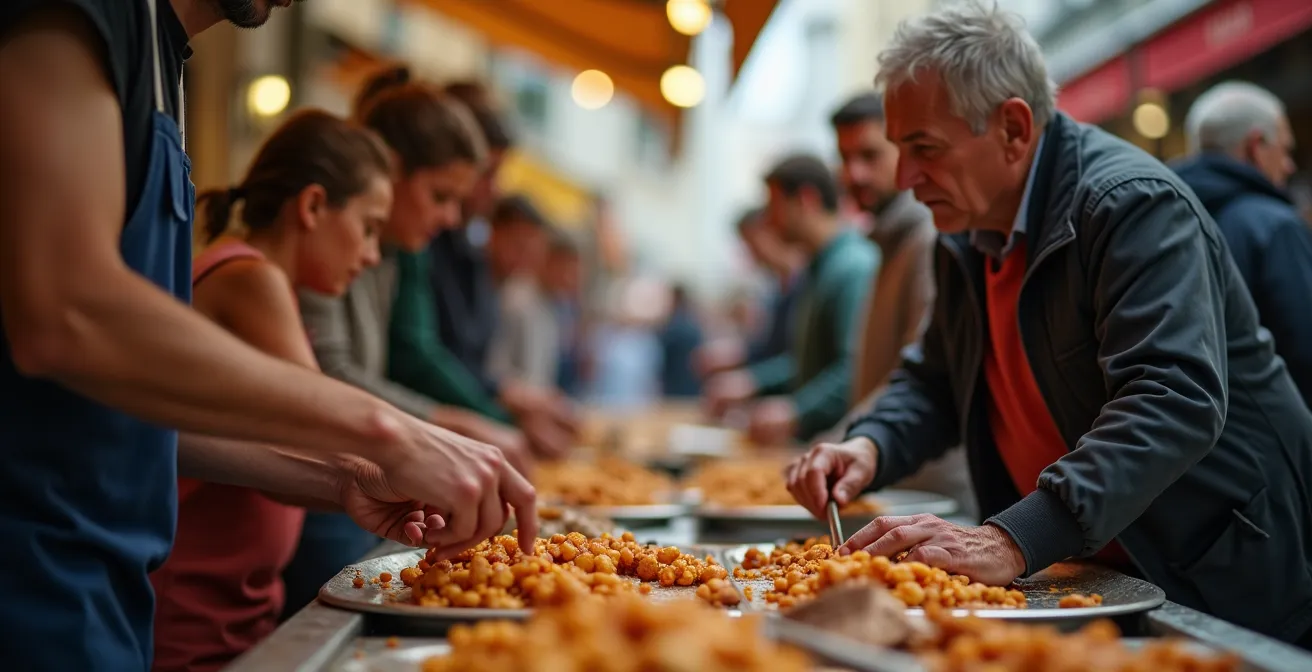
This table breaks down the key differences in their underlying business models. The most telling factor is often the menu’s scope: a master of one craft versus a jack-of-all-trades.
| Aspect | Street Food | Michelin Restaurant | Tourist Trap |
|---|---|---|---|
| Cultural Driver | Daily lived culture | Culinary heritage revival | Location-based profit |
| Local Patronage | 90%+ locals | Mixed local/tourist | 95%+ tourists |
| Price Point | €5-10 per meal | €50-200+ per meal | €30-50 for basic dishes |
| Menu Changes | Daily based on ingredients | Seasonal refinements | Static year-round |
| Specialization | 1-3 signature dishes | Tasting menus | Everything for everyone |
The “Dirty” Fallacy: Why Avoiding Street Food Makes You Miss the Best Meals?
Many travelers, particularly from North America, carry a fear of street food, associating its rustic setting with poor hygiene. This is the “dirty” fallacy, a misconception that causes them to miss out on some of the most vibrant and delicious food a culture has to offer. In reality, a busy street food stall is often a safer bet than an empty, mid-range tourist restaurant. The reason is simple: high turnover equals fresh food. A vendor with a long line of locals is selling out their inventory daily, meaning ingredients are bought fresh that morning.
In contrast, a quiet tourist-focused restaurant with a 10-page menu must rely on a massive frozen inventory to keep dozens of dishes “available” year-round. That paella you ordered was likely microwaved from a frozen package. The safety isn’t in the shiny facade; it’s in the constant flow of customers. As one analysis of food safety points out, a chef who specializes in one or two dishes does them exceptionally well because they aren’t juggling ingredients for dozens of disparate items. This specialization is a hallmark of quality and freshness. Culinary tourism is a massive industry, with Europe dominating with a revenue share of more than 30.0% in 2023, and much of that authentic experience is happening on the streets.
Case Study: The Safety Paradox of High Turnover
Studies on European street food reveal a compelling paradox. Stalls with visible, long queues of local patrons consistently demonstrate superior food safety practices compared to deserted tourist-facing eateries. The constant demand ensures that ingredients don’t sit around; they are purchased, prepared, and sold within hours. One chef noted that a cook who “narrows their scope and only does noodles or grilled meat usually does it well because they aren’t trying to sprint between four continents in a single dinner rush.” This high-turnover, high-specialization model is the unsung hero of food safety on the go.
The best rule of thumb for street food is to follow the crowd. Look for the longest line of locals, watch the food being prepared in front of you, and embrace the experience. That’s where you’ll find the true, living flavor of a city.
When to Book Top Tables: Why Walking In Doesn’t Work in Tokyo?
For the spontaneous traveler, the idea of making reservations weeks in advance can feel restrictive. The desire to wander the streets and stumble upon a hidden gem is a romantic one. And in many European cities, this can still lead to wonderful discoveries. However, this walk-in-and-hope strategy completely fails in certain food-centric cultures and for top-tier establishments. In cities like Tokyo or Copenhagen, the best restaurants—even casual-looking izakayas or neighborhood bistros—are often fully booked weeks, if not months, ahead. A walk-in attempt will be met with a polite but firm “no.”
This isn’t about exclusivity for its own sake; it’s a different cultural approach to dining and a business model built on precision. These restaurants buy exactly what they need for the number of guests they have booked. They don’t have extra food waiting for walk-ins. This practice ensures zero waste and maximum freshness, a stark contrast to the tourist trap that must keep a huge, often frozen, inventory just in case. The reservation book is not a barrier; it’s a sign of a well-run, quality-focused operation.

Even seasoned, spontaneous travelers acknowledge the need for a hybrid approach. As travel expert Chelsea Dickenson admits, flexibility is key:
I’m quite relaxed when I go away — I like to be spontaneous! But there are some places that have really surprised me, that the common practice is booking ahead
– Chelsea Dickenson, Travel Expert, Explore
The savvy traveler’s strategy is to book one or two “must-try” places in advance to anchor their culinary itinerary, then leave other meals open for spontaneous discovery. This balances the thrill of the hunt with the guarantee of at least a few stellar, authentic meals.
Supermarket Organic vs. Local Conventional: Which Is Actually Greener?
The question of sustainability in food often gets simplified to “organic vs. conventional.” But for a traveler seeking an authentic and responsible meal, the more important distinction is “local vs. global.” An “organic” tomato grown thousands of miles away and shipped in a refrigerated container has a far greater environmental footprint than a “conventionally” grown tomato from a farm ten miles outside the city. The true “greener” choice is almost always the one with the shortest supply chain.
This is where identifying truly local restaurants becomes an act of sustainable tourism. An authentic eatery is, by its nature, more likely to be sourcing from nearby producers. They aren’t just selling food; they are participating in a local food ecosystem. They know their farmers, their cheesemakers, and their fishermen. This is a world away from the tourist trap whose ingredients arrive on a large truck from a multinational foodservice distributor, the same one that supplies chain hotels and fast-food outlets globally. The scale of the European foodservice market is immense, projected to reach $950 billion in 2025, making conscious sourcing choices even more impactful.
So, how do you spot this commitment to local sourcing? The signs are subtle but clear:
- Handwritten specials: A chalkboard menu is the number one sign that the offerings change based on what’s available and in season.
- Named suppliers: Menus that proudly list the names of the farms or artisans they work with are showing, not just telling, their commitment to local.
- True seasonality: Look for dishes that couldn’t possibly exist year-round. If you see fresh asparagus in October in Italy, be suspicious.
- Proximity to markets: Restaurants located just off a major local food market often source directly from its vendors each morning.
By prioritizing restaurants that showcase these signs, you’re not just getting a better, fresher meal—you’re directly supporting the local economy and making a more environmentally sound choice.
Expat Community or Local Immersion: Which Accelerates Adaptation?
For any traveler, the choice of where you eat profoundly shapes your entire experience. Dining exclusively in the sanitized “tourist bubble”—restaurants clustered around major attractions—is the quickest way to isolate yourself from the country you came to see. It’s the difference between observing a culture through glass and actually participating in it. While finding a familiar expat bar can be a comfort, true adaptation and immersion are accelerated by venturing into local-first environments.
A compelling study of traveler experiences reveals a stark contrast. Those who dine just two or three blocks away from the main tourist drags report not only significantly lower meal costs but also much higher overall satisfaction. They describe more meaningful interactions, a better grasp of the local language, and receiving insider tips that lead to other authentic experiences. They break out of the bubble. When exploring historic cities, dining is not merely sustenance; it’s an experience intertwined with culture and history. Choosing a restaurant where locals gather is the gateway to that experience.
This isn’t just about food; it’s about context. Eating where locals eat puts you in the rhythm of their daily life. You overhear conversations, observe social norms, and become a temporary part of the neighborhood fabric. You might discover a local festival, a hidden park, or simply have a brief, genuine exchange with the person at the next table. These small moments of connection are what transform a trip from a sightseeing tour into a memorable journey. The tourist trap actively prevents this by creating an artificial environment populated only by other outsiders.
Therefore, choosing your restaurant is a strategic decision that dictates the trajectory of your trip. Do you want to remain in the curated, comfortable bubble with other expats and tourists, or do you want to accelerate your adaptation by immersing yourself in the authentic, everyday life of the city?
Key takeaways
- The menu is a business plan: Picture-heavy, multi-language menus are built for tourist turnover, not local loyalty.
- Busyness is a safety signal: A long line of locals at a street food stall indicates fresher ingredients than an empty, formal restaurant.
- Sourcing reveals the soul: Truly local restaurants build their menus around seasonal ingredients and supplier relationships, not a static, year-round offering.
How Joining a CSA Farm Share Supports Short Supply Chains?
At first glance, a Community Supported Agriculture (CSA) farm share seems unrelated to international travel. But the philosophy behind it provides the ultimate framework for finding authentic food anywhere in the world. A CSA member understands their food system intimately: they know the farmer, they know what’s in season, and they understand the direct link between the land and their plate. Applying this mindset as a traveler is the most powerful strategy for avoiding the entire industrial tourist-food complex.
The scale of tourism’s impact is staggering; in 2024 alone, Europe saw roughly 747 million tourist arrivals. This massive influx fuels a parallel food system built on frozen food trucks and global distributors, completely detached from local agriculture. To opt out, you must think like a CSA member and look for transparency in the supply chain. A restaurant that operates with this ethos will proudly display its connections. They are, in essence, curating a local farm share for you on a plate.
How do you spot this “CSA mindset” in a European bistro? The checklist is straightforward:
- Farm names on the menu: The clearest sign of a proud, direct relationship.
- Truly seasonal vegetables: A menu that changes to reflect the harvest is a menu you can trust. Restaurants that feature seasonal dishes are sourcing fresh, local ingredients.
- Daily fish specials: This indicates the chef is buying what’s best at the market that day, not ordering from a frozen catalog.
- Staff knowledge: Ask your server where the cheese or the vegetables come from. In an authentic place, they’ll know and be proud to tell you.
By seeking out these signs of a short, transparent supply chain, you are replicating the CSA experience abroad. You are choosing to participate in a local food culture, ensuring your money supports local producers, and guaranteeing yourself a meal that is fresher, more flavorful, and infinitely more authentic.
Now that you can spot the traps, the next step is to actively seek out the gems. Start planning your next trip with a food-first mindset, and challenge yourself to find one truly local meal each day. Your palate—and your travel memories—will thank you for it.