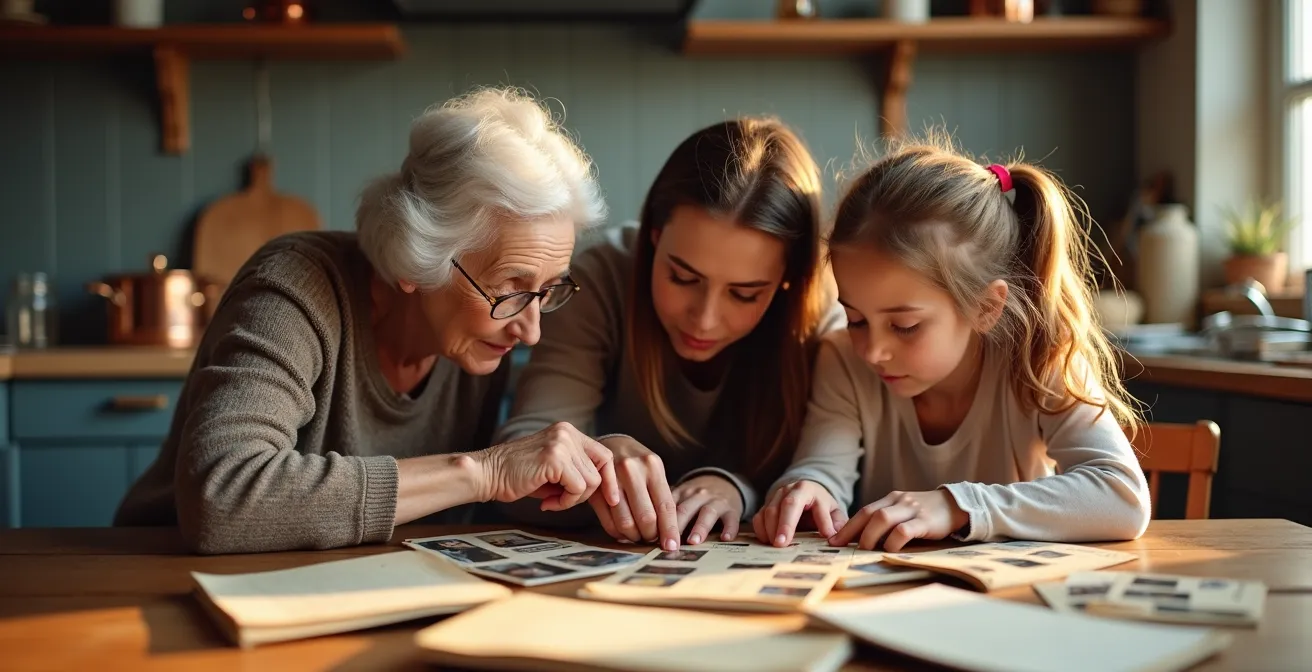
The heart-wrenching truth is that your family’s most precious stories and recipes are actively fading away due to the dual decay of human memory and physical media.
- Adopt an “archivist’s mindset,” focusing on capturing the essence of the person, not just facts.
- Use sensory-based questions to unlock deep memories and a methodical process to deconstruct intuitive recipes.
- Implement the 3-2-1 backup rule on modern, stable formats to ensure your work outlasts you.
Recommendation: Start today by scheduling one, low-pressure conversation. The goal is not perfection, but to begin the process of preservation before another memory is lost.
There’s a quiet urgency that settles in as you watch your parents or grandparents age. It’s the slow-dawning realization that the vast library of their lives—the stories behind old photographs, the unwritten recipe for their signature dish, the sound of their laughter—exists only in their memory. This living archive is incredibly fragile, and the clock is ticking. Many people grab their phones to start recording, thinking the technology is the solution. They ask generic questions and get generic answers, missing the soul of the story.
The common approach fails because it treats preservation as a simple task of data collection. It overlooks the two silent thieves working against you: the natural fading of memory and the insidious decay of the digital and physical media we use to store it. Saving a legacy isn’t about just hitting “record.” It requires the heart of a storyteller and the mind of an archivist to capture the true essence of a person.
But what if the key isn’t just to ask questions, but to create experiences that unlock memories? What if preserving a recipe meant documenting the “why” behind every pinch and dash? This guide moves beyond the superficial to offer a deeper, more meaningful framework. It’s about fighting that dual decay with a strategy that honors the person, captures their spirit, and ensures their story can be told for generations to come. We will explore how to establish the stakes of this mission, how to conduct interviews that yield treasure, the right tools for the job, and most importantly, how to build a digital ark that will protect your family’s heritage long after we are gone.
For those who prefer a visual introduction to the power of preserving personal narratives, the following video from StoryCorps beautifully illustrates the mission and impact of this vital work.
To navigate this essential journey, we’ve structured this guide to walk you through the process step-by-step. From understanding the urgency to mastering the technical details, here is a roadmap to becoming your family’s historian.
Summary: A Roadmap to Preserving Your Family’s Legacy
- Why Do 80% of Family Stories Disappear Within Two Generations?
- How to Ask Questions That Unlock Deep Memories During an Interview?
- Audio vs. Video: Which Format Best Captures the Essence of a Relative?
- The DVD Rot: Why Your Old Family Videos Are Dying on the Shelf?
- How to Quantify “A Pinch of This”: Converting Intuitive Cooking to Measurements?
- When to Update Your Encrypted Backups: The 3-2-1 Rule Explained
- Why Does Culture Shock Hit Hardest After the Third Month?
- How to Develop Cultural Awareness Before Relocating Abroad for Work?
Why Do 80% of Family Stories Disappear Within Two Generations?
The loss of family history is a swift and silent erosion. We often assume that the most important stories—the tales of resilience, love, and personal triumphs—will naturally be passed down. The reality is far more stark. Without a conscious effort to record and preserve them, the majority of a family’s oral history vanishes. This isn’t just about forgetting names and dates; it’s about the loss of the very narratives that shape our identity. The reason for this rapid decay is twofold: the fallibility of human memory and our misplaced faith in simple storytelling.
Stories are the currency of heritage, far more valuable than raw data. In fact, research shows that stories are significantly more resilient in our minds than statistics. An Oxford Academic study highlights that after just one day, the recall accuracy for stories is 73% compared to 33% for statistics. This demonstrates that narrative is the vessel through which memory survives. When we fail to capture these narratives, we lose the context, the emotion, and the lessons that give our family’s history its power. Each unrecorded story is a library of wisdom burned.
However, this loss is not inevitable. Proactive, structured projects can build a bulwark against generational amnesia. They create a permanent archive that turns fleeting memories into enduring legacies.
Case Study: The Great Thanksgiving Listen by StoryCorps
For over a decade, StoryCorps’ “Great Thanksgiving Listen” has mobilized young people to combat this very problem. Students across the country, like those in Stacy Flannery’s history class near Chicago, have used the holiday gathering as an opportunity to interview their elders. By providing a framework and a platform, the initiative has successfully archived thousands of personal interviews, saving countless family stories from being lost. It proves that a focused effort can transform a simple conversation into a permanent piece of history, demonstrating a powerful, scalable model for family story preservation.
This disappearance is a call to action. It urges us to move from passive listeners to active archivists, starting with the most fundamental skill: learning how to ask the right questions.
How to Ask Questions That Unlock Deep Memories During an Interview?
The difference between a sterile interview and a profound conversation lies in the art of the question. Generic prompts like “What was it like back then?” often lead to a dead end because they ask the brain to search a vast, unorganized archive. The key to unlocking rich, detailed memories is to bypass the conscious mind and appeal directly to the senses. This is the practice of sensory archaeology—using smells, sounds, tastes, and textures as triggers for forgotten stories.
Instead of asking about a general period, anchor your questions in specific, tangible details. A query about the smell of their mother’s kitchen or the feel of the steering wheel on their first car provides a concrete starting point for memory to latch onto. These sensory details act as doorways to entire worlds of experience that a general question could never access. Physical artifacts are also incredibly powerful catalysts. An old photograph, a family heirloom, or even a map of their childhood town can ground the conversation and evoke stories they haven’t thought about in decades.
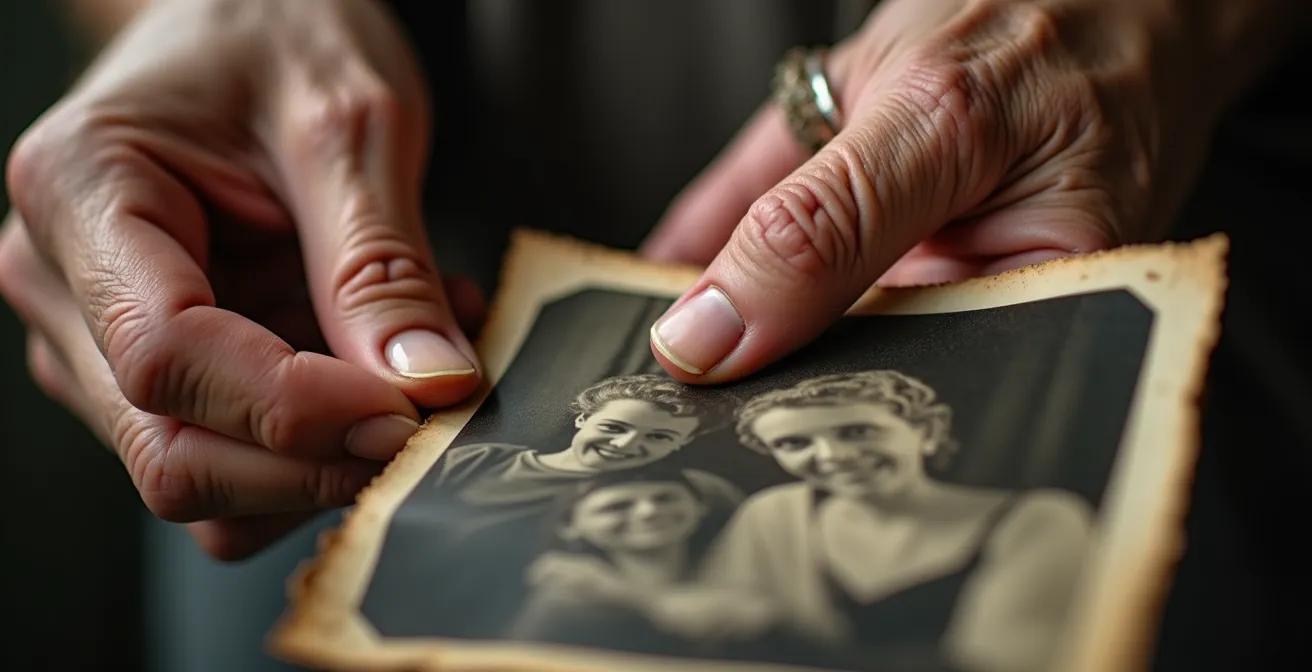
As the image above suggests, the tactile connection to the past can be a powerful conduit for memory. The goal is to move beyond facts and dates to capture the emotional texture of a life. Focus on daily rituals and routines—Sunday dinners, holiday preparations, the walk to school—as these ordinary moments are often where the most extraordinary details and feelings are stored. By crafting your questions this way, you are not merely interviewing; you are co-creating a space where memories can safely resurface.
- Replace generic questions with sensory-specific prompts: Instead of “What was your childhood like?”, ask “What did your grandmother’s kitchen smell like when you came home from school?”
- Use location-based triggers: Ask about specific rooms, streets, or places – “Walk me through your childhood home room by room.”
- Leverage musical memories: Play songs from their youth or ask about music they associate with specific life events.
- Bring physical artifacts: Use old photos, maps of their hometown, or family heirlooms as conversation catalysts.
- Focus on routine moments: Ask about daily rituals like Sunday dinners or morning routines that often hold rich details.
Once you’ve learned how to draw out these stories, the next crucial decision is choosing the right medium to capture them for eternity.
Audio vs. Video: Which Format Best Captures the Essence of a Relative?
Choosing between an audio or video recording is more than a technical decision; it’s a choice about what aspects of a person’s essence you want to prioritize. There is no single “best” format. The right choice depends on your goals, your relative’s comfort level, and the practicalities of long-term preservation. Video captures everything—facial expressions, hand gestures, the twinkle in their eye—but this comprehensiveness comes at a cost. It can feel performative, requires more equipment, and creates large files that are complex to store and migrate over time.
There’s nothing quite like hearing a family story in the actual voice of the storyteller.
– Family Tree Magazine, 10 Top Tech Tools for Sharing Family History
Audio, on the other hand, offers a unique intimacy. Without the pressure of a camera, subjects are often more relaxed and candid. The focus shifts entirely to their voice: its unique cadence, its emotional tremors, its moments of laughter or hesitation. These vocal nuances can be just as expressive as a facial expression. Audio files are also significantly smaller, making them easier to manage, back up, and preserve. For many, the disembodied voice carries a timeless, powerful quality that stimulates the listener’s own imagination.
A hybrid approach is often ideal. Use video for special occasions, like a cooking demonstration or a tour of a meaningful place, and use audio for more frequent, intimate storytelling sessions. The following comparison, based on insights from family history experts, breaks down the key considerations for each format as highlighted in a comprehensive guide to recording family stories.
| Aspect | Audio Recording | Video Recording |
|---|---|---|
| Storage Requirements | ~10MB per hour (MP3) | ~1-4GB per hour (HD) |
| Equipment Needed | Smartphone or basic recorder | Camera, tripod, lighting |
| Comfort Level | Less intimidating for elderly | Can feel performative |
| Longevity | Easier to migrate formats | More complex preservation |
| Emotional Impact | Focus on voice nuance | Captures gestures, expressions |
| Best For | Intimate stories, regular sessions | Special occasions, demonstrations |
Regardless of which format you choose, capturing the story is only half the battle. The next, and perhaps most overlooked, challenge is ensuring that your recording survives the test of time.
The DVD Rot: Why Your Old Family Videos Are Dying on the Shelf?
You’ve done the work. You recorded hours of precious interviews and carefully burned them onto DVDs, believing you’ve created a permanent archive. This belief is a dangerous illusion. Most consumer-grade optical discs (DVD-R, CD-R) are ticking time bombs, subject to a process known as “disc rot.” The organic dye layer used to store data on these discs inevitably breaks down, often leading to catastrophic data loss in as little as two to five years, even under ideal storage conditions.
This is the physical side of the “dual decay” threatening your family’s legacy. While memory fades in the mind, the digital vessel you’ve entrusted with its preservation is physically deteriorating on the shelf. Heat, humidity, and light all accelerate this decay, and by the time you discover a disc is unreadable, it’s often too late. The videos of a first birthday or a grandparent’s life story can be rendered unplayable, lost forever due to a failure of the medium.
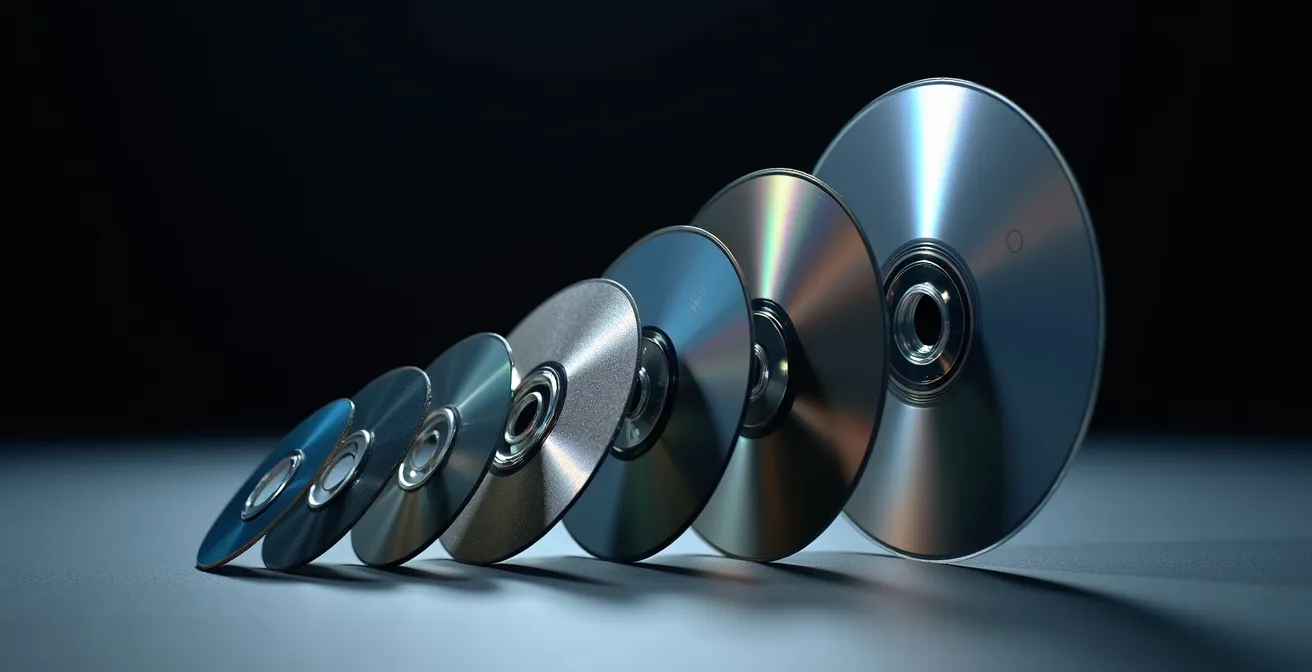
As this visualization suggests, time is the enemy of unstable media. Fortunately, an archival mindset leads to better solutions. Archival-grade media, such as M-DISC, offers a way out of this cycle of decay. Unlike standard DVDs, M-DISCs use a rock-like, inorganic data layer that is physically etched, making it resistant to degradation from light, temperature, and humidity. According to U.S. Department of Defense testing, this technology was designed for longevity, showing no data degradation within 2-5 years, a stark contrast to the rapid failure of standard discs. They found the M-DISC’s inorganic layer maintained integrity through accelerated aging tests that simulated centuries of storage, making it suitable for critical archives.
This same archival mindset—one that anticipates problems and seeks robust solutions—is just as crucial when tackling another intangible piece of family heritage: the unwritten recipe.
How to Quantify “A Pinch of This”: Converting Intuitive Cooking to Measurements?
Few things are as evocative as a family recipe. Yet, these culinary heirlooms are often the most difficult to preserve because they exist not in text, but in muscle memory. For a grandparent who has made the same dish for sixty years, measurements are intuitive—a “pinch” of salt, a “handful” of flour, dough kneaded “until it feels right.” Asking them to quantify these actions can be frustrating and unnatural. The challenge is to become a culinary translator, documenting the process without disrupting the cook’s natural flow.
The solution is not to force them to use measuring spoons, but to observe and “shadow” their process. Record their cooking from a bird’s-eye view, focusing on their hands. After they perform an intuitive action, like grabbing a pinch of an ingredient, you can then replicate their movement with measuring spoons to determine the actual volume. This method captures the precise measurement without making the cook feel scrutinized. It’s also vital to document the sensory cues they rely on. A recipe is more than a list of amounts; it’s a series of “if-then” conditions. Capturing “add flour until the dough no longer sticks to your fingers” is more valuable than a fixed number of cups.
When documenting my grandmother’s recipes, I discovered that her ‘pinch of salt’ was actually about 1/4 teaspoon, but more importantly, she explained that she knew it was enough when she could just taste it bringing out the sweetness in the tomatoes. Recording both the measurement and her reasoning helped me understand not just the ‘what’ but the ‘why’ of her cooking.
This process of deconstruction turns an ephemeral art into a replicable science. By documenting both the measurements and the reasoning, you preserve not just a recipe, but the wisdom and intuition of the cook for future generations to follow.
Action Plan: The Shadow and Measure Technique
- Position a camera directly above the cooking surface to film the hands from a bird’s-eye view.
- Have the cook use their normal “pinch” or “handful” while you observe their movements and the ingredient’s effect.
- After they complete the step, pause and replicate their hand motions with measuring spoons to determine the actual volume.
- Document both the standard measurement AND the sensory cue they used (e.g., “1.5 tsp or until the dough stops sticking”).
- Create tolerance ranges rather than fixed amounts to account for variables (e.g., “1.5-2 cups flour, depending on humidity”).
- Record the “why” behind each intuitive decision by asking questions like, “How do you know when it’s ready?”
Once you’ve captured these stories and recipes, your final responsibility as a family archivist is to build a system that ensures their survival long into the future.
When to Update Your Encrypted Backups: The 3-2-1 Rule Explained
Recording your family’s history is a monumental achievement, but it’s only the first half of the job. Without a robust backup strategy, your entire archive—every story, every recipe video, every scanned photo—is vulnerable to a single point of failure like a hard drive crash, a house fire, or file corruption. An archivist’s mindset means planning for disaster. The gold standard for this is the 3-2-1 Rule, a simple yet powerful strategy for data protection.
The rule dictates that you should have:
- Three copies of your data.
- On two different types of media (e.g., an external hard drive and cloud storage).
- With one copy stored off-site.
This redundancy ensures that no single event can wipe out your entire collection. If your computer’s hard drive fails, you have the external drive. If a fire destroys both your computer and the local backup, you have the off-site copy in the cloud or at a relative’s house. This isn’t paranoia; it’s professional-grade preservation.
But creating backups is not a one-time event. It’s an ongoing process. You must periodically test your backups to ensure the files are not corrupted and remain accessible. Furthermore, file formats become obsolete. The .wmv video that plays today might not be supported in a decade. A key part of the archivist’s duty is to proactively migrate your archive to modern, open-standard formats (like MP4 for video and MP3 for audio) every 5-7 years to ensure future compatibility.
Case Study: The “Family Archive Day” Ritual
The Thompson family transformed this chore into a meaningful tradition. They established an “Annual Archive Day” on their grandmother’s birthday. On this day, family members across three states simultaneously check their backup copies of the family’s 600+ interviews, test file readability, and share one archived story on a group video call. This simple ritual has ensured their collection remained intact and accessible through three different format migrations over 12 years, all while strengthening family bonds by making the archive a living part of their connection.
Implementing such a rigorous system requires dedication, and the emotional journey of the family archivist can have its own surprising challenges.
Why Does Culture Shock Hit Hardest After the Third Month?
In the context of preserving family history, “culture shock” takes on a deeply personal and metaphorical meaning. It doesn’t come from visiting a new country, but from immersing yourself in the “foreign land” of your own family’s past. The first few weeks of this journey are often a “honeymoon phase.” The excitement is palpable as you unearth new stories, connect with relatives, and feel a profound sense of purpose. Every recording feels like a victory, and the project is filled with discovery and wonder.
However, much like traditional culture shock, this initial euphoria eventually gives way to a more challenging phase. This often hits around the “third month” of the project, a symbolic point where the initial momentum wanes and the true scale of the task becomes clear. The shock is the dawning realization of just how much has already been lost. You start noticing the gaps in the timeline, the stories that can never be recovered because someone is gone, the questions you wish you had asked sooner. This can trigger feelings of frustration, anxiety, and even guilt.
This phase is the emotional crucible of the family historian. The logistical challenges—managing files, scheduling interviews, dealing with technical glitches—pile up, and the project can start to feel overwhelming rather than inspiring. It is the moment when the sentimental drive is tested by the stark reality of the work. It is also the most critical period to persevere through. Acknowledging this “culture shock” as a normal part of the process is the first step to overcoming it. This is when your mission transforms from a hobby into a true commitment.
Pushing through this shock requires more than just perseverance; it requires a shift in perspective, adopting the mindset of a respectful and curious explorer.
Key Takeaways
- Family stories are at high risk of disappearing due to the dual decay of memory and media; you must act as an active archivist.
- Use sensory-based questions and artifact triggers to unlock deep, emotional memories beyond generic facts.
- Adopt the 3-2-1 Rule for backups (3 copies, 2 media types, 1 offsite) and plan for regular file format migrations to ensure long-term survival.
How to Develop Cultural Awareness Before Relocating Abroad for Work?
Embarking on the journey to preserve your family’s legacy is akin to preparing for a relocation to a foreign country. The “country” is your family’s past, and its “culture” is the complex web of unwritten rules, shared memories, inside jokes, and subtle dynamics that define it. To be a successful family historian, you must approach this world not as a native, but as a respectful visitor seeking to learn. This is the ultimate form of cultural awareness.
Before you “relocate” by diving deep into interviews, take time to observe. Listen to how family members talk to each other. Identify the topics that bring joy and the ones that are carefully avoided. Understand that every family has its own “language”—a shorthand of references and stories that may be incomprehensible to an outsider. Your first job is not to extract information, but to learn this language. This awareness prevents you from unintentionally causing offense or shutting down a conversation by treading on sensitive ground.
Developing this awareness means approaching your own relatives with the curiosity of an anthropologist. Be humble. Acknowledge that despite being family, you are an outsider to their specific life experiences. Frame your project as a gift to the family, an act of honoring them, rather than an interrogation. This mindset shift is crucial. It changes your role from a data collector to a trusted custodian of memory. When your relatives see that you are genuinely interested in understanding their world on their terms, they will open up in ways you never thought possible, sharing not just stories, but the very soul of their experience.
This respectful, aware approach is the final key to unlocking your family’s true legacy. Now that you have the framework, the only thing left to do is begin.
Frequently Asked Questions on Archiving Family History
How often should I test my archived family recordings?
Test your archives at least annually. Check that files open correctly, audio/video plays without errors, and make fresh backups if any issues are detected.
What’s the difference between 3-2-1 and LOCKSS strategies?
The 3-2-1 rule means 3 copies, 2 different media types, 1 offsite. LOCKSS (Lots Of Copies Keep Stuff Safe) extends this by distributing many copies among multiple trusted family members.
Should I update file formats proactively?
Yes, migrate to current standard formats every 5-7 years. Convert old proprietary formats to open standards like MP3 for audio, MP4 for video, and PDF/A for documents.