
To get your condo board to approve EV chargers, you must shift from being a resident asking for a perk to a consultant presenting a de-risked business case.
- Address the board’s core fears upfront: unfair cost allocation, electrical capacity overload, and long-term management burdens.
- Frame the project not as an expense, but as a future-proofed building upgrade with clear, equitable billing and professional management solutions.
Recommendation: Present a “user-pay” model combined with a zero-cost installation option (like CaaS) to make the proposal fiscally and operationally irresistible.
The conversation often starts with hopeful enthusiasm and ends in frustrating gridlock. You want to buy an electric vehicle, but your condominium has nowhere to charge it. You approach the board, armed with data about rising property values and environmental benefits, only to be met with concerns about cost, fairness, and complexity. The resistance you feel isn’t necessarily opposition to EVs; it’s a natural reaction to perceived operational and financial risk.
Most residents make the mistake of focusing on the “why” (EVs are great!) instead of the “how” (here’s a plan that creates no new problems for us). The platitudes about attracting modern buyers and increasing building prestige fall flat against a board’s primary mandate: fiscal responsibility and operational stability. They aren’t just thinking about your car; they’re thinking about every resident, the building’s aging electrical panel, and the potential for new disputes over parking spots and electricity bills.
The true key to success lies in changing your role. Instead of petitioning as a resident, you must present your case as a strategic consultant. This guide is built on that premise. We will move beyond the common talking points and provide a framework for addressing your board’s legitimate operational fears head-on. We will demonstrate how to transform your request from a costly amenity for a few into a sensible, future-proof infrastructure upgrade for the entire community.
This article will provide a strategic roadmap, detailing how to defuse resistance around costs, assess electrical capacity without causing alarm, navigate technology choices, and propose systems that prevent future management headaches. By following this structure, you can build a proposal that is not just persuasive, but practically undeniable.
Summary: How to Petition Your Condo Board to Install EV Charging Stations?
- Why Does “User-Pay” Billing Solve Condo Board Resistance?
- How to Determine if Your Building’s Panel Can Handle 10 New Chargers?
- Level 1 vs. Level 2:Is Technological Innovation Threatening or Saving Your Industry Career?
- The Parking Dispute: Preventing Gas Cars From Blocking EV Spots
- How to Apply for Government Rebates for Multi-Unit Charger Installation?
- PPA vs. Cash Purchase: Which Yields Better Long-Term Savings?
- When to Charge Your EV: Coordinating With Off-Peak Grid Availability
- What Is the Payback Period for Solar Panels in Cloudy Climates?
Why Does “User-Pay” Billing Solve Condo Board Resistance?
The single greatest obstacle in any condo EV charging project is the question of “who pays?” A condo board’s primary duty is to the entire community, and they are rightfully hesitant to use common funds for an amenity that only a few residents will initially use. Proposing that the entire association shoulder the installation and electricity costs is almost always a non-starter. This is where the “user-pay” principle becomes your most powerful tool.
A user-pay model is a system where the residents who use the EV chargers pay for both the electricity they consume and a portion of the installation and maintenance costs. This immediately removes the board’s biggest objection: financial inequity. By presenting a plan where the cost is borne directly by the beneficiaries, you transform the project from a community expense into a self-funding utility. Modern smart chargers make this seamless, tracking individual usage and handling billing automatically, which means no extra administrative work for the board or property manager.
This approach also addresses the high upfront investment. With a multi-unit installation costing anywhere from $2,000 to over $10,000 per Level 2 charger, proposing a plan where these costs are amortized over time through user fees is far more palatable. You are no longer asking for a large capital expenditure from reserve funds; you are presenting a financially sustainable, equitable system that pays for itself. This reframes the conversation from “can we afford this?” to “how do we implement this logical utility?”
How to Determine if Your Building’s Panel Can Handle 10 New Chargers?
After cost, the second major operational fear for a condo board is electrical capacity. The nightmare scenario is a series of tripped breakers or, worse, an expensive and disruptive main panel upgrade. Simply asking “can our building handle it?” is a vague question that invites a “no” out of caution. A strategic approach involves presenting a clear, low-cost path to getting a definitive answer and offering solutions that work within existing limitations.
The first step is a preliminary, non-invasive audit. You, or a small group of interested residents, can gather much of the necessary information before ever hiring an electrician. This shows initiative and respect for the board’s time and budget. The goal is to collect enough data to have an intelligent first conversation with an electrical contractor. This initial diligence demonstrates that you are a serious partner in solving the problem, not just demanding a solution.
Action Plan: Your Pre-Assessment Electrical Capacity Checklist
- Gather Data: Photograph your building’s main electrical panel and sub-panels, noting brand and model numbers.
- Analyze Usage: Collect the last 12 months of utility bills to identify the building’s historical peak electricity demand.
- Document Capacity: Note the current amperage capacity listed on the main breaker and count the number of available breaker spaces in the panel.
- Survey Needs: Discreetly survey potential EV owners about their daily driving habits to estimate a realistic charging load, rather than a theoretical maximum.
- Map It Out: Note the physical distance from the electrical room to the proposed charging locations in the parking garage, as distance impacts wiring costs.
Armed with this data, you can approach the board with a proposal for a formal “EV-Ready Assessment” by a qualified electrician. Crucially, your presentation should also include modern solutions that can often prevent the need for a costly panel upgrade. This is where you introduce the concept of Dynamic Load Management (DLM) or “load sharing.”
This technology allows a group of chargers to share a single electrical circuit, intelligently distributing available power among them. If only one car is charging, it gets the full power. If ten cars plug in, the system automatically reduces the power to each car, ensuring the building’s main breaker is never overloaded. This is often a far more scalable and cost-effective solution than a full panel overhaul.
By presenting both the problem (capacity) and a range of modern, cost-effective solutions, you move the conversation away from a simple “yes/no” and towards a collaborative discussion about which smart solution is the best fit for the building.
| Solution | Initial Cost | Installation Time | Capacity Added | Future Scalability |
|---|---|---|---|---|
| Full Panel Upgrade | $10,000-$25,000 | 4-8 weeks | Fixed increase | Limited by new panel size |
| Dynamic Load Management | $2,000-$5,000 | 1-2 weeks | Flexible sharing | Easily expandable |
| Phased Infrastructure | $3,000-$7,000 | 2-3 weeks | Gradual increase | Built-in expansion capability |
Level 1 vs. Level 2:Is Technological Innovation Threatening or Saving Your Industry Career?
This seemingly odd question is a metaphor for the risk a condo board feels when making a long-term technology decision. Choosing the wrong standard can lead to wasted money, resident complaints, and the need for a costly do-over. Your role as a consultant is to de-risk this choice by explaining why one option, Level 2 charging, is the undisputed standard for multi-unit dwellings, and how to implement it in a future-proof way.
Level 1 charging uses a standard 120V wall outlet. While simple, it’s impractically slow for most daily drivers, adding only 3-5 miles of range per hour. It’s a solution that quickly creates dissatisfaction. Level 2 charging, which uses a 240V circuit similar to an electric dryer, is the gold standard. A modern Level 2 station can add up to 37 miles of range per hour, easily providing a full charge overnight. Presenting this clear distinction shows the board you’re planning for real-world use, not a barely-functional token solution.
However, the cost of installing a full Level 2 station for every interested resident at once can be prohibitive. The most strategic and scalable approach is to propose an “EV-Ready” infrastructure. This involves running the 240V electrical conduit and wiring to a number of parking stalls but only installing the actual charging station (the EVSE) when a resident requests and pays for it. This phased approach breaks a large capital project into smaller, manageable, user-funded steps. The building makes a one-time investment in the “backbone” infrastructure, future-proofing the property for decades.
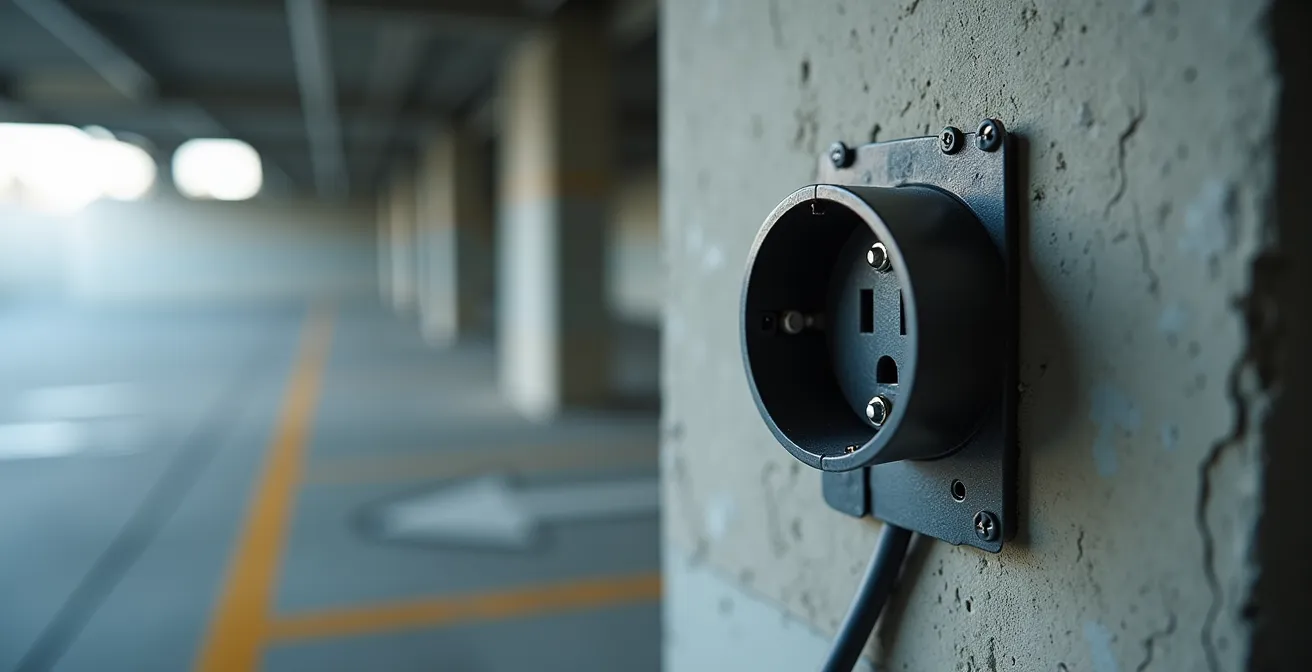
This strategy is the perfect compromise. It demonstrates long-term vision and fiscal prudence. The board can approve a single, well-defined infrastructure project that prepares the building for the future, while the higher cost of the individual charging units is passed on to the end-users as they come online. It saves your “career” as the project champion by ensuring the chosen technology is both effective today and scalable for tomorrow.
The Parking Dispute: Preventing Gas Cars From Blocking EV Spots
A board’s third core fear is administrative chaos. They envision endless emails about gasoline-powered cars blocking charging spots (“ICE-ing”), disputes between residents over who gets to charge next, and the headache of policing new rules. Your proposal must proactively address this by presenting a system that is as self-managing as possible, relying on smart technology and clear policy, not constant board intervention.
The solution has three layers: clear designation, smart management, and community education. First, physical designation is critical. This means more than just a sign. Propose using high-visibility green paint on the ground to clearly mark the stalls as “EV Charging Only.” This creates an unambiguous visual cue that reduces accidental misuse. Second, and most importantly, leverage the power of smart chargers. These networked units can implement rules automatically. For example, they can charge “idle fees”—an automatic billing penalty for a car that remains plugged in after its battery is full. This encourages turnover without anyone having to play “parking police.”
Finally, embedding clear rules into the building’s official policies provides the necessary enforcement framework. Your proposal should include draft language for a “Community Charging Policy.” This document sets expectations for all residents, EV and non-EV owners alike.
Case Study: Clarksburg Condominium II’s Proactive Policy
In spring 2022, the Clarksburg Condominium II community in Maryland successfully navigated this process. By conducting thorough research, gathering resident support, and implementing a clear and fair usage policy from day one, they installed Level 2 EV chargers in their shared lot. Their proactive approach, which defined rules for use, scheduling, and etiquette, effectively prevented the potential for conflicts between EV and non-EV owners, creating a blueprint for successful community integration.
By presenting a comprehensive plan that includes physical design, smart technology, and thoughtful policy, you show the board you are not just thinking about getting a charger for yourself. You are presenting a complete, turn-key operational plan that minimizes future management burdens for everyone.
How to Apply for Government Rebates for Multi-Unit Charger Installation?
Once you have addressed the board’s primary fears, you can sweeten the deal. Financial incentives from federal, state/provincial, and even local utility programs can significantly reduce the project’s total cost, making a “yes” even easier to obtain. Your role is to do the homework and present these opportunities not as a vague possibility, but as a concrete part of the financial plan. In many jurisdictions, the legal tide is also turning in favor of residents.
For example, in the U.S., more than nine states have enacted ‘right-to-charge’ laws, which prevent condo associations from unreasonably restricting the installation of EV chargers. While these laws vary, they provide a powerful legal backdrop to your request, shifting the conversation from “if” to “how.” Mentioning this shows you’ve done your legal homework, but it should be used as a tool for collaboration, not a threat.
The core of your financial presentation should be a clear summary of available rebates. The practice of “incentive stacking”—combining funds from multiple programs—can sometimes cover a substantial portion of the installation cost. You should research and present a list of specific, applicable programs.

To make this process seamless for the board, your proposal should include a clear action plan for securing these funds. This is not their job to figure out; it’s part of the solution you are presenting. This includes a timeline and a list of required documents.
- Research & Stack: Identify and list all federal, state/provincial, and local utility rebates available for multi-unit dwelling (MUD) installations.
- Pre-Approval is Key: Emphasize that many programs require pre-approval *before* any equipment is purchased.
- Vet Installers: Recommend selecting an electrical contractor who has specific experience with the rebate application process in your area. They often handle the paperwork.
- Prepare Documentation: Outline the typical required documents, such as building permits, proof of ownership, and the formal electrical assessment.
By presenting a clear map to accessing “free money,” you significantly lower the financial barrier and demonstrate an exceptional level of preparation, reinforcing your image as a capable and strategic partner.
PPA vs. Cash Purchase: Which Yields Better Long-Term Savings?
For a risk-averse condo board, even a heavily rebated project can seem daunting due to upfront costs and long-term maintenance responsibilities. This is your moment to introduce the ultimate de-risking strategy: third-party ownership models. Instead of the condo association buying and owning the equipment, an outside company does it for them. This shifts the conversation from a capital expense to a zero-cost amenity.
The two main models are a cash purchase by the condo corporation versus a “Charging-as-a-Service” (CaaS) model, which is similar in principle to a Power Purchase Agreement (PPA) used in the solar industry. In a CaaS agreement, a specialized EV charging company installs, owns, and maintains the stations at no upfront cost to the building. They make their money by collecting the revenue from the drivers who use the chargers, often sharing a small percentage back with the condo association.
As experts from RISE Energy Management explain in their Guide to EV Charging for Condo Buildings, this is a model:
Where a third-party company installs, owns, and maintains the chargers at no cost to the condo board
– RISE Energy Management, Guide to EV Charging for Condo Buildings
This single option can completely neutralize the board’s financial and operational fears. It eliminates the need for capital outlay, removes the burden of maintenance and repairs, and outsources all the administrative work of billing and customer service. While the condo gives up most of the potential revenue, it gains a professionally managed, state-of-the-art amenity with zero risk. For most volunteer condo boards, this trade-off is incredibly appealing.
Presenting these options in a clear, comparative way allows the board to make an informed business decision. You aren’t just asking for chargers; you’re presenting a menu of vetted financial models, including one that costs them nothing.
| Model | Upfront Cost | Maintenance Responsibility | Administrative Burden | Revenue Potential |
|---|---|---|---|---|
| Cash Purchase | $10,000-$25,000 | Condo Board | High | 100% retained |
| Financing | $0-$5,000 | Shared | Medium | After loan payoff |
| CaaS (Zero-CAPEX) | $0 | Service Provider | Low | Revenue sharing only |
When to Charge Your EV: Coordinating With Off-Peak Grid Availability
Once the system is approved, optimizing its use demonstrates a final layer of strategic thinking. This means being a good “grid citizen” and programming the charging system to operate in harmony with the building’s overall electricity demand. This not only prevents strain on the grid but can also unlock further cost savings and even revenue opportunities for the building.
The peak demand for electricity in a residential building is typically in the evening, from 6 PM to 9 PM, when residents return home, turn on lights, cook dinner, and run air conditioning. The worst-case scenario is having 10 EVs plug in and start charging at maximum power at the exact same time. This is where scheduled and smart charging become essential. Modern charging networks can be programmed to delay the start of charging sessions until late at night when the building’s overall demand is low—for instance, after 10 PM. Since most cars are parked overnight for 8-12 hours, this delay has no impact on the driver, who still wakes up to a fully charged vehicle.
This off-peak coordination is a core feature of the Dynamic Load Management systems discussed earlier. They not only manage the load between chargers but can also manage the total load in relation to the entire building’s consumption, ensuring the chargers only draw significant power when it’s cheapest and most available.
Case Study: Smart Charging for Peak Load Management
Condominiums that implement smart charging systems can automatically schedule charging to occur during off-peak hours. This preserves the building’s main electrical capacity for high-demand evening uses like air conditioning and cooking. Furthermore, some utility programs offer “demand response” revenues, paying buildings to reduce their electrical load during peak grid events, turning the EV charging system into a grid-stabilizing asset.
This strategy can also yield direct savings on the installation itself. By using smart systems to avoid ever reaching a theoretical maximum load, buildings can often utilize more efficient wiring methods, such as a “meter tap.” This can avoid the need for new, dedicated circuits from the main panel, resulting in between $10,000 and $25,000 in savings on a large installation. This is a final, powerful argument for a “smart” system over a “dumb” one.
Key Takeaways
- The key to success is shifting from a resident’s request to a consultant’s solution, addressing the board’s core fears about cost, capacity, and management.
- A “user-pay” model, where drivers cover electricity and hardware costs, is the most equitable and persuasive financial framework.
- Smart solutions like Dynamic Load Management and zero-cost CaaS (Charging-as-a-Service) models can eliminate the largest financial and operational barriers for the condo board.
What Is the Payback Period for Solar Panels in Cloudy Climates?
While it may seem like a separate project, integrating EV charging with on-site solar power generation is the ultimate future-proofing strategy. For a forward-thinking board, this can be the final piece of the puzzle that turns the entire EV project from a cost center into a long-term asset. The question of payback period, even in less-than-sunny climates, becomes surprisingly attractive when paired with the consistent demand from electric vehicles.
The synergy is simple: solar panels generate the most power during the day when many cars are away at work. This excess energy, which might otherwise be sold back to the grid for a low price, can be stored in battery systems. Then, at night, this stored solar energy can be used to charge the residents’ EVs. As the experts at Wallbox note, this creates a powerful, self-contained energy ecosystem.
If your condo has onsite renewable sources like solar panels, these chargers could also help you store this excess energy during the daytime to support energy demand at night.
– Wallbox, Enabling Electric Vehicle Charging in Condominiums
This model drastically changes the financial equation. The building is now generating its own “fuel,” insulating residents from rising utility electricity rates. A particularly effective implementation of this concept is the solar carport. These structures provide the dual benefit of offering covered parking—a valuable amenity in itself—while their roofs are used to generate clean energy specifically for the vehicles parked below.
Case Study: The Solar Carport as a Revenue Engine
Associa, a major community management firm, highlights that solar carports can create a significant revenue stream. The electricity generated can be sold to EV-driving residents, creating income that directly pays down the cost of the solar installation. This consistent, daily demand from EV charging dramatically shortens the solar panel payback period, making it a viable investment even in regions with less sunshine than traditional solar hotspots.
While proposing a solar project at the same time as an EV project may be too ambitious for some boards, presenting it as a logical “Phase 2” demonstrates incredible foresight. It shows you are not just thinking about your next car, but about the building’s energy independence and financial health for the next 20 years. It’s the ultimate strategic play.
The journey to installing EV charging in your condo is a marathon, not a sprint. By adopting a consultant’s mindset and presenting a comprehensive, de-risked solution that addresses costs, capacity, and management, you can transform the board from gatekeepers into partners. The next logical step is to formalize this strategy into a clear, concise proposal document to begin the conversation.
Frequently Asked Questions on Condo EV Charging
How can smart chargers help prevent parking disputes?
Smart chargers can automatically implement idle fees that charge vehicle owners for occupying a spot after their vehicle is fully charged, encouraging turnover without requiring board intervention or confrontation.
What visual strategies work best for EV spot designation?
High-visibility ground paint combined with strategic charger placement creates clear visual boundaries. This approach is often more effective than signs alone and reduces accidental ICE-ing (internal combustion engine cars parking in EV spots) incidents.
How can an EV Ambassador program reduce conflicts?
Resident volunteers serving as EV Ambassadors can handle new user education, basic troubleshooting, and informal conflict resolution. This peer-to-peer support significantly reduces the burden on property management and board members, fostering a more collaborative community environment.