
Your smart meter is a powerful diagnostic tool, and learning to interpret its data can directly cut your energy costs by up to 15%.
- Identify your home’s unique “energy metabolism” by analyzing time-of-use (TOU) data to shift heavy appliance use to cheaper, off-peak hours.
- Perform “energy forensics” to hunt down phantom loads and inefficient devices that secretly drain power and inflate your bills.
Recommendation: Start by accessing your utility’s online dashboard to identify your single highest-consumption appliance during peak hours (typically 5-8 PM) and create a plan to shift its usage.
For most homeowners, the smart meter on the side of the house is a black box. It sends data to the utility company, and a bill arrives in the mail. But treating it as just a billing device is like owning a high-performance vehicle and never looking at the dashboard. Hidden within its constant stream of data are the precise clues needed to understand your home’s unique energy metabolism, pinpoint inefficiencies, and unlock significant savings. While common advice suggests turning off lights or buying efficient appliances, these are shots in the dark without real data.
The real power comes from moving beyond generic tips and becoming an energy detective for your own home. The data your meter collects reveals specific patterns—the “data signature” of every device from your EV charger to your old refrigerator in the garage. By learning to read these signatures, you can uncover why your bill is so high and take targeted action. It’s not about guessing; it’s about data-driven diagnosis.
This guide abandons the vague platitudes. Instead, it provides a technical yet accessible framework for conducting your own “energy forensics.” We will move from deciphering peak-hour cost drivers to evaluating the real-world integration of smart thermostats and assessing the often-overlooked security implications of this data stream. You will learn not just what to do, but how to use your meter’s data to understand precisely why it works. The goal is to transform you from a passive bill-payer into an active manager of your home’s energy efficiency.
This article provides a comprehensive roadmap, breaking down the essential strategies and considerations for leveraging your smart meter. The following sections will guide you through each critical aspect, from cost analysis to security protocols.
Summary: How to Lower Your Utility Bill with Smart Meter Data
- Why Does Running Your Dryer at 6 PM Cost Twice as Much?
- How to Spot Appliances Draining Power via Your Smart Meter Dashboard?
- Nest vs. Ecobee: Which Integrates Better With Local Grid Demand Response?
- The Data Leak Risk: Can Thieves Tell When You Are on Vacation via Smart Meters?
- When to Charge Your EV: Coordinating With Off-Peak Grid Availability
- When to Add a Battery: Is Storage Worth It Without Frequent Blackouts?
- The IoT Backdoor: How a Cheap Smart Bulb Can Expose Your PC?
- What Is the Payback Period for Solar Panels in Cloudy Climates?
Why Does Running Your Dryer at 6 PM Cost Twice as Much?
The core reason your energy costs spike during evening hours lies in a pricing structure called Time-of-Use (TOU) rates. Utilities implement these rates to manage the overall strain on the power grid. Think of the grid as a highway: during rush hour (typically 4 PM to 9 PM), when everyone is coming home, turning on lights, cooking, and using electronics, the highway is congested. To discourage traffic, the “tolls” (electricity rates) are higher. Running a high-draw appliance like an electric dryer during this peak demand period forces the utility to fire up expensive, less-efficient power plants to meet the load, and that cost is passed directly to you.
In contrast, during off-peak hours, such as late at night or midday, demand is low. The highway is clear, and the tolls are cheap. Your smart meter meticulously tracks your consumption on an hourly (or even 15-minute) basis, allowing the utility to bill you precisely based on these fluctuating rates. Therefore, the same one-hour dryer cycle that costs $0.50 at 6 PM might only cost $0.25 at 11 PM. Understanding your home’s specific energy metabolism—when it consumes the most power—is the first step in managing these costs. Your smart meter dashboard is the EKG that lets you see your home’s energy heartbeat and identify these expensive peaks.
How to Spot Appliances Draining Power via Your Smart Meter Dashboard?
Your smart meter dashboard is more than a bill summary; it’s a forensic tool. The key to spotting energy-draining appliances is to look for their unique “data signature.” Every device creates a recognizable pattern of consumption when it turns on and off. A refrigerator, for example, will show small, regular spikes as its compressor cycles. An electric water heater will create a large, sustained block of usage. The most insidious culprits, however, are devices with a phantom load (or vampire power)—those that draw energy even when they are supposedly “off.”
To begin your energy forensics, look at your hourly usage graph during a time when you believe everything is off, such as in the middle of the night or when the house is empty. Is the baseline consumption truly zero? If you see a constant, low-level draw of 50-200 watts, you have a phantom load problem. Common suspects include cable boxes, game consoles in standby mode, and chargers left plugged in. By systematically unplugging devices and observing the real-time data on your dashboard, you can pinpoint exactly which ones are the silent contributors to your bill. Advanced platforms for real-time energy disaggregation have shown they can help homeowners save between 5%-15% on utility spend just by identifying and managing these hidden loads.
This visualization shows how an energy monitoring device can reveal these distinct consumption patterns, allowing you to differentiate between the normal cycling of a refrigerator and the constant drain of a phantom load.

As you become more familiar with these signatures, you can spot anomalies. A refrigerator compressor cycling more frequently than usual could indicate a failing seal, while a sudden, unexplained spike in your baseline consumption might point to a new device drawing more standby power than you realized. This granular analysis transforms energy saving from guesswork into a precise, data-driven science.
Nest vs. Ecobee: Which Integrates Better With Local Grid Demand Response?
Smart thermostats like Nest and Ecobee are frontline soldiers in the battle for energy efficiency, but their true power is unlocked when they participate in Demand Response (DR) programs. These are partnerships with your local utility where you allow minor, automated adjustments to your thermostat settings during peak grid stress in exchange for bill credits or lower rates. The thermostat’s ability to seamlessly integrate with these local programs is a critical factor in its overall value.
Nest, backed by Google, generally boasts a larger number of direct utility partnerships. For many homeowners, this means enrollment can be a simple, one-click process within the Nest app. However, this convenience sometimes comes at the cost of control, as adjustments are often pushed by the provider with limited user override. Ecobee, conversely, often relies on a more open approach, integrating with platforms like Apple HomeKit and IFTTT. This can provide the user with more granular control over their participation but may require a more technically involved setup. A key differentiator is data privacy; Nest operates within the broader Google ecosystem, while Ecobee offers options for more localized data processing.
To make the right choice, you must first check which thermostats your specific utility supports for its DR programs. The effectiveness of either device is moot if it cannot communicate with your local grid operator. As shown by recent U.S. Department of Energy data, the features and partnerships vary significantly.
| Feature | Nest | Ecobee |
|---|---|---|
| Utility Partnerships | 100+ utilities | 60+ utilities |
| API Access | Limited to partners | Open HomeKit/IFTTT |
| User Control | Provider-pushed | User-controlled |
| Data Privacy | Google ecosystem | Local processing option |
Ultimately, with a smart meter adoption rate in North America approaching 77%, the question is not just which device is “smarter,” but which one integrates most intelligently with the hyper-local demands of your specific power grid.
The Data Leak Risk: Can Thieves Tell When You Are on Vacation via Smart Meters?
The same high-resolution data that empowers you to save money can, if unsecured, create a significant privacy risk. Smart meters report granular energy consumption, which can inadvertently reveal personal behavioral patterns. A sharp, prolonged drop in electricity usage is a classic indicator that a home is unoccupied, creating a potential data leak that could be exploited by sophisticated criminals. If a third party gains access to this data stream, they don’t need to drive by your house to see that the lights are off; they can see it on a graph.
The risk depends on the type of meter communication technology used. Older AMR (Automated Meter Reading) systems were typically one-way, broadcasting data out. Modern AMI (Advanced Metering Infrastructure) is a two-way communication network, which offers more features but also creates a potential attack surface. The existence of massive, detailed energy datasets, such as a Spanish smart meter dataset with 25,559 time series over several years, highlights the scale of information being collected. While utilities implement security measures, no system is impenetrable. It’s crucial for homeowners to be proactive in safeguarding their data and mitigating these risks.
Action plan: Secure your smart meter data
- Review your utility’s data privacy policy and understand what opt-out options are available to you.
- Set up randomized timers on a few lamps or smart plugs to simulate a normal consumption pattern when you are away.
- Check with your utility to confirm if your meter uses two-way AMI or one-way AMR communication to understand the risk profile.
- Enable all available data encryption and multi-factor authentication options in your online utility account settings.
- Regularly monitor and review any third-party data sharing agreements your utility has, and revoke access you are not comfortable with.
By treating your energy data with the same caution as your financial data, you can harness the benefits of smart metering while minimizing the exposure of your personal habits.
When to Charge Your EV: Coordinating With Off-Peak Grid Availability
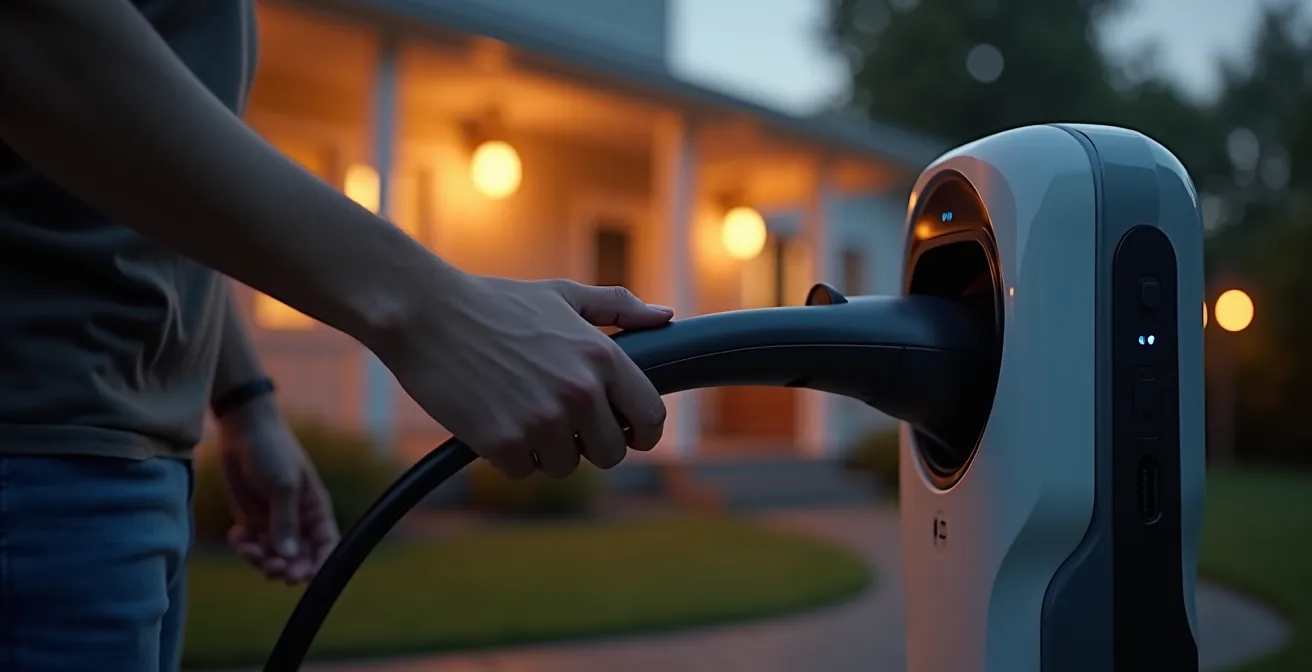
Charging an electric vehicle (EV) is one of the single largest electrical loads a home can have, equivalent to running multiple air conditioners at once. Simply plugging in your EV when you get home from work at 6 PM is a recipe for a massive utility bill, as you are charging during the most expensive peak hours. The key to cost-effective EV ownership is to achieve grid harmony: charging your vehicle when grid demand—and thus electricity cost—is at its lowest.
Your smart meter data is essential for this. By analyzing your hourly consumption graph, you can identify the deep troughs in your utility’s TOU schedule, typically from 11 PM to 7 AM. Most modern EVs and smart chargers allow you to schedule charging sessions to begin automatically during this off-peak window. This simple act of shifting your charging time can cut your vehicle’s “fueling” costs by 50% or more. This coordination turns your EV from a grid burden into a grid asset, helping to balance load by consuming power when there is a surplus.
The next frontier is Vehicle-to-Grid (V2G) technology, which allows your EV’s battery to not only draw power from the grid but also push it back during times of high demand, effectively turning your car into a mobile power plant. As companies like Octopus Energy in the UK launch mass-market V2G tariffs, this technology is rapidly moving from theory to reality. With industry forecasts indicating a $5 billion V2G market projected by 2024, coordinating your EV’s battery with the grid will become a primary strategy for both saving and earning money.
When to Add a Battery: Is Storage Worth It Without Frequent Blackouts?
Traditionally, home batteries were seen as expensive backup generators for blackout protection. However, in the age of smart meters and TOU rates, their primary value proposition has shifted to economic optimization. A battery allows you to perform “energy arbitrage”: you charge it with cheap, off-peak electricity (or free solar energy) and then discharge it to power your home during expensive peak hours, effectively insulating yourself from the highest rates. The question is no longer just about reliability, but about return on investment (ROI).
A battery dramatically increases your self-consumption rate for solar panels. Without a battery, much of the solar energy you generate midday (while you’re at work and consumption is low) is sold back to the grid for a low credit. With a battery, you store that free energy and use it yourself in the evening, avoiding the need to buy expensive peak-hour power. This financial calculus is the main driver of battery adoption in areas without frequent outages. Furthermore, many utilities offer Virtual Power Plant (VPP) programs, where they pay you to let them draw from your battery during grid emergencies, creating an additional revenue stream.
The financial benefits are stark. By analyzing smart meter data, you can calculate the exact ROI for your home. As outlined in a detailed financial analysis of battery storage, the savings on peak hour costs can be substantial.
| Scenario | Without Battery | With Battery |
|---|---|---|
| Peak Hour Costs (monthly) | $180 | $45 |
| Self-Consumption Rate | 30% | 85% |
| Grid Independence | 0% | 60-70% |
| VPP Revenue Potential | $0 | $50-100/month |
To determine if a battery is right for you, start by exporting 12 months of smart meter data to calculate your average daily peak consumption. Sizing the battery to cover about 80% of this peak usage typically offers the best balance between upfront cost and long-term savings.
The IoT Backdoor: How a Cheap Smart Bulb Can Expose Your PC?
While your smart meter itself is hardened by the utility, it’s part of a broader, interconnected home network. The greatest security vulnerability often comes from the cheapest and most overlooked devices: the smart bulbs, plugs, and cameras that form your Internet of Things (IoT) ecosystem. Many of these devices are manufactured with minimal security protocols and can serve as an “IoT backdoor” into your home network. A hacker may not target your smart meter directly; instead, they might compromise a cheap smart bulb, gain a foothold on your Wi-Fi, and then move laterally to access more sensitive devices like your PC or network-attached storage.
Smart meters generate vast amounts of data every passing minute, and simply collecting this data is not enough.
– Grid Research Team, Work on Grid Smart Meter Analysis
This sentiment from the Grid Research Team underscores that data generation and data security are two sides of the same coin. The smart meter’s data is valuable, but it resides on a network you are responsible for securing. A fundamental security practice is network segmentation. By creating a separate “guest” Wi-Fi network exclusively for your IoT devices, you isolate them from your primary network. If a smart bulb is compromised, the attacker is trapped in that sandbox, unable to see or access your work laptop or personal files.
Before purchasing any smart home device, it’s crucial to adopt a security-first mindset. Neglecting these simple steps is like installing a bank vault door on your house but leaving the window wide open.
- Create a separate guest network exclusively for IoT devices to isolate them from your primary computers and phones.
- Immediately change all default administrator passwords on new devices to unique, strong credentials.
- Check the manufacturer’s track record for providing regular security updates before making a purchase.
- Carefully review the permissions requested by the device’s companion app and deny access to contacts, microphones, or location if not strictly necessary.
- Monitor your router’s logs for any suspicious outbound traffic originating from IoT devices, which could indicate a compromise.
Key takeaways
- Time-of-Use (TOU) rates are the primary driver of cost variation; shifting appliance usage to off-peak hours is the single most effective savings strategy.
- Your smart meter dashboard is a forensic tool for spotting “data signatures” of inefficient appliances and hunting down phantom loads.
- True smart home savings come from integrating devices like thermostats and EV chargers with local grid demand response and off-peak schedules.
What Is the Payback Period for Solar Panels in Cloudy Climates?
A common misconception is that solar panels are only effective in perpetually sunny regions. While output is certainly higher in clear conditions, modern photovoltaic (PV) panels are highly efficient and still generate a significant amount of electricity on overcast days. They capture diffused sunlight that penetrates cloud cover, meaning production never drops to zero. Therefore, for homeowners in climates like the Pacific Northwest or New England, the question isn’t *if* solar works, but rather what the realistic payback period will be.
The payback period is the time it takes for the accumulated savings on your utility bills to equal the initial cost of the solar installation. This calculation depends on several factors: the total system cost, the amount of electricity generated (which is influenced by local climate), and the price of electricity you’re avoiding. In cloudy climates, the payback period will naturally be longer than in a desert, but it’s often much shorter than people assume. Industry analysis reveals an average payback period of 8-12 years, with optimal sunny conditions bringing it down to 5-8 years. Crucially, solar panels still generate 10-25% of their rated output even on a heavily overcast day.
Your smart meter data is invaluable for getting a precise estimate. By providing a full year of detailed consumption data to a solar installer, they can accurately model how a proposed system will perform against your specific usage patterns and local weather data. This data-driven approach replaces generic estimates with a personalized financial forecast, allowing you to make an informed decision based on a realistic ROI timeline for your specific location, regardless of the number of cloudy days.
Now that you understand the principles of reading and acting on your smart meter data, the next logical step is to begin your own energy forensics. Start today by logging into your utility’s dashboard and applying these strategies to transform raw data into tangible savings.