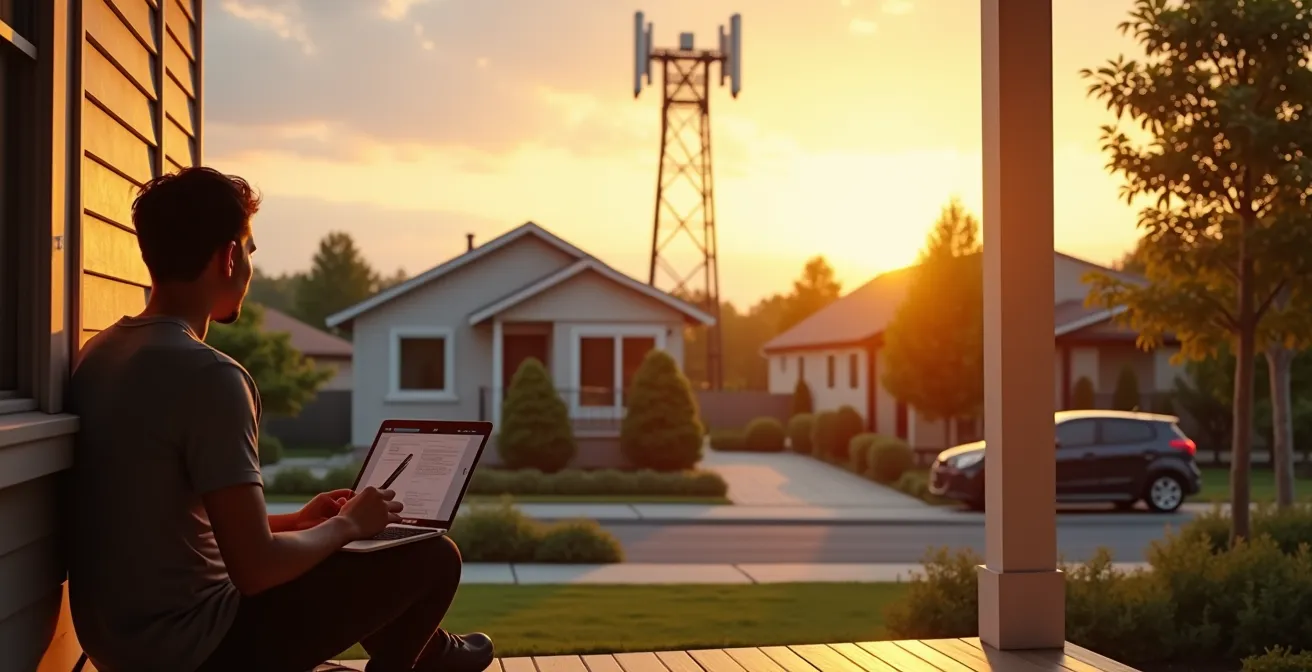
The anxiety around 5G towers stems from a misunderstanding of energy physics; the key to peace of mind is not avoiding the technology, but empowering yourself with scientific literacy.
- 5G radiation is fundamentally different from harmful radiation like UV light because its individual photons lack the energy to cause cellular damage.
- Concerns about exposure can be addressed with consumer-grade tools and an understanding of the inverse-square law, which proves distance is your greatest protection.
Recommendation: Shift your focus from unproven health risks to verifiable data security practices and the tangible benefits 5G infrastructure brings to your property and lifestyle.
The appearance of a new cell tower in your neighborhood can be unsettling. Surrounded by online rumors and conflicting information, it’s natural to feel concerned about the health and safety of your family. Many articles offer simple reassurances, but they often fail to address the core of the anxiety: a lack of control and understanding. You’re told not to worry, but not given the tools to understand *why*. This leads to a sense of unease, where abstract safety reports conflict with the very visible and imposing structure nearby.
The common approach is to compare 5G to other household items or dismiss concerns as misinformation. While well-intentioned, this doesn’t build confidence. The real issue isn’t just about radio waves; it’s about translating complex science into tangible, personal knowledge. But what if the key wasn’t simply to trust the experts, but to understand the principles they use? What if you could learn to separate credible information from noise and even take your own baseline measurements?
This guide takes a different approach. As a telecommunications scientist, my goal is to equip you with scientific literacy. We will move beyond simple reassurances and dive into the fundamental physics that govern electromagnetic energy. You will learn not only why 5G is different from dangerous radiation but also how to assess your own environment. We’ll dismantle the visual and informational illusions that fuel fear and, finally, explore the very real, positive impacts this technology has on modern life and property value. This is your guide to replacing anxiety with empowered understanding.
To navigate this complex topic, we have structured this guide to build your knowledge step-by-step, from the fundamental science to the practical, real-world implications for your home and community.
Summary: A Scientist’s Framework for Evaluating 5G
- Why Is 5G Radiation Less Energetic Than UV Sunlight?
- How to Measure EMF Levels in Your Bedroom Using Consumer Tools?
- Macro Towers vs. Small Cells: Which Has a Larger Visual Impact?
- The Social Media Echo Chamber: identifying Fake 5G Health Studies
- How to Use 5G Home Internet to Replace Expensive Cable Bundles?
- Why Do 40% of Homebuyers Now Rate Internet Speed Above Proximity to Schools?
- The Data Leak Risk: Can Thieves Tell When You Are on Vacation via Smart Meters?
- Does Fiber Optic Internet Access Increase Your Home’s Resale Value?
Why Is 5G Radiation Less Energetic Than UV Sunlight?
The most significant point of confusion regarding 5G safety lies in the word “radiation.” It’s a term that brings to mind nuclear energy or X-rays, but in physics, it simply means the emission of energy. The critical difference is the *type* of energy. The electromagnetic spectrum ranges from very low-energy radio waves to extremely high-energy gamma rays. The dividing line between safe and potentially harmful is whether the radiation is non-ionizing or ionizing.
Ionizing radiation, like ultraviolet (UV) light from the sun, X-rays, and gamma rays, carries enough energy in each individual particle (photon) to knock electrons out of atoms. This is the mechanism that can damage DNA and lead to health issues like skin cancer. In contrast, 5G, along with Wi-Fi, broadcast radio, and visible light, is non-ionizing. Its photons simply do not have the required energy to cause this effect, regardless of the signal’s power or intensity. It’s a fundamental difference in character, not just quantity.

This concept is proven by the Nobel Prize-winning research on the photoelectric effect. It demonstrates that it’s the energy per photon that matters. For instance, even an intensely bright red light (low-energy photons) cannot cause the photoelectric effect, while a faint UV light (high-energy photons) can. Similarly, the photons in 5G radio frequencies have energy levels thousands of times lower than even visible light. Research confirms that UV light photons have higher energy than visible light photons, while 5G frequencies operate in the non-ionizing spectrum far below. They can warm tissue at very high power levels (like a microwave oven), but they are physically incapable of “breaking” molecules in your body.
Therefore, fearing 5G for the same reasons we fear excessive sun exposure is like fearing a thrown tennis ball for the same reason we fear a bullet. They both transmit energy, but their fundamental properties and potential for impact are worlds apart.
How to Measure EMF Levels in Your Bedroom Using Consumer Tools?
Understanding the science is one thing, but seeing the data for yourself provides a powerful sense of reassurance. You don’t need to be a physicist to get a tangible sense of the electromagnetic field (EMF) levels in your own home. Using a consumer-grade EMF meter, you can establish a baseline and identify the true sources of EMF in your environment. You may be surprised to learn that internal sources often have a far greater impact than external ones.
The first step is to turn off all personal electronic devices—your Wi-Fi router, smartphones, smart speakers, and even the microwave—to establish a true “quiet” baseline. Then, using a reliable meter, you can measure the ambient levels near windows facing any nearby towers. Afterwards, turn your devices back on one by one and measure them. Note the readings at both one foot and ten feet away. This exercise powerfully demonstrates the inverse-square law: every time you double your distance from a source, you quarter your exposure. You will likely find the reading next to your Wi-Fi router is significantly higher than the ambient reading from a distant tower.
When choosing a meter, it’s important to select one that can detect the pulsed signals common in modern wireless technology. EMF measurement experts emphasize that consumer-grade meters with sampling rates above 10,000 samples/second can effectively detect these signals, which slower meters might miss. The following table compares some popular models suitable for home use.
| Meter Model | Price Range | Frequency Range | Key Features | Best For |
|---|---|---|---|---|
| Trifield TF2 | $150-200 | Up to 6 GHz | 3-axis measurement, audio output | General home use |
| Acoustimeter AM-11 | $350-400 | 200 MHz – 8 GHz | Peak & average readings, LED display | RF detection focus |
| Cornet ED88T Plus | $180-220 | 100 MHz – 8 GHz | 10,000 samples/sec, frequency display | Technical users |
| Safe & Sound Pro II | $400-450 | 200 MHz – 8 GHz | Professional grade, directional antenna | Accuracy priority |
By taking your own readings, you transform abstract fears into concrete data. This process demystifies your environment and provides an empirical, personal basis for feeling secure, shifting your focus from distant towers to the devices you control directly.
Macro Towers vs. Small Cells: Which Has a Larger Visual Impact?
A common source of anxiety is the sheer size of a traditional “macro” cell tower. Its large, industrial appearance can feel imposing and lead people to assume it’s blasting out a proportionally high amount of energy. However, this is a case where our visual intuition is misleading. In telecommunications, visibility and power at ground level are often inversely related. The future of 5G deployment, in fact, relies heavily on small, inconspicuous nodes known as “small cells.”
Macro towers are tall for a reason: to provide broad coverage over several miles. Because they are far from the users, their signals are relatively weak by the time they reach you, a direct consequence of the inverse-square law. In contrast, small cells are low-power nodes, often disguised on streetlights or utility poles. They are designed to cover a much smaller area, like a few city blocks, and fill in coverage gaps. While they are physically closer to users, their transmit power is a tiny fraction of a macro tower’s.

So, while a macro tower has a massive visual impact, its contribution to the EMF levels you experience on the ground is often negligible. A small cell has almost no visual impact but might be the primary source of your 5G signal. Crucially, both operate far below established safety limits. Measurements from official bodies confirm this. For example, a comprehensive study by Ofcom, the UK’s communications regulator, demonstrated the reality of this principle. The agency’s measurements showed that even at sites selected for maximum potential exposure, macro towers produce EMF levels at ground level averaging only 1.5% of safety guidelines, while small cells remain well below 7.1% of reference levels. This proves that a tower’s visible size is not a reliable indicator of its energy output at street level.
Ultimately, the large, visible tower is designed for distance, while the nearly invisible small cells handle close-range capacity. Both are essential parts of a modern network, and both have been shown through empirical data to operate with a vast safety margin.
The Social Media Echo Chamber: identifying Fake 5G Health Studies
In the digital age, our greatest exposure isn’t to radio waves, but to information—and misinformation. Social media algorithms are designed to show us more of what we engage with, creating powerful echo chambers. If you click on one alarming 5G story, you will be fed a dozen more, regardless of their scientific validity. Learning to distinguish credible research from “fake science” is perhaps the most critical skill for navigating this topic.
Authentic scientific findings are published in peer-reviewed journals, where other experts in the field scrutinize the methods and conclusions before publication. Misinformation, on the other hand, often appears on blogs, social media, or in predatory journals that publish anything for a fee. These articles frequently confuse correlation with causation (e.g., “cancer rates went up after 5G was installed,” ignoring all other factors) and use tiny, statistically insignificant sample sizes.
The scientific consensus from major global health and safety bodies is clear. As summarized by an extensive review of the evidence:
There are no scientifically proven adverse health impacts from the exposure to 5G radio frequency radiation with levels below those suggested by the guidelines of regulating bodies, including the International Commission on Non-Ionizing Radiation Protection (ICNIRP)
– Wikipedia contributors, 5G misinformation – Wikipedia
To protect yourself from the echo chamber, it’s essential to have a mental toolkit for evaluating any health claim you encounter. The following audit provides a framework for becoming a critical consumer of information.
Your Action Plan: A 5-Point Audit for Health Studies
- Check the Source: Is the study published in a reputable, peer-reviewed scientific journal (e.g., Nature, The Lancet), or is it on a personal blog or advocacy website?
- Identify the Funding: Look for the “conflicts of interest” or “funding” section. Does the source of funding have a vested interest in a particular outcome?
- Confront the Claims: Read the abstract and conclusion. Does the sensational headline accurately reflect the study’s actual, often more nuanced, findings?
- Assess the Logic: Does the study confuse correlation with causation? A link between two things doesn’t prove one caused the other.
- Verify with Replication: Has this finding been confirmed by other independent research groups? A single, un-replicated study is not a scientific consensus.
By treating information with the same rigor as science, you can effectively filter out the noise and focus on the vast body of evidence from trusted international institutions, breaking free from the cycle of algorithm-fueled anxiety.
How to Use 5G Home Internet to Replace Expensive Cable Bundles?
Once health concerns are placed in their proper, evidence-based context, you can begin to see the 5G tower not as a threat, but as an opportunity. One of the most immediate and tangible benefits is the emergence of 5G Home Internet as a powerful competitor to traditional cable and fiber providers. For decades, many neighborhoods have been beholden to a single cable company, leading to high prices and poor customer service. 5G changes that dynamic entirely.
5G Home Internet uses the same cellular network as your phone to deliver high-speed broadband directly to a dedicated router in your home. The technology is a game-changer because 5G networks enable data transmission rates in the order of gigabits per second (Gbps), transforming home connectivity options. This creates real competition, often resulting in lower monthly bills and more flexible terms for consumers.
Making the switch is remarkably simple and doesn’t require a technician to drill holes in your wall. The process typically involves checking service availability online, receiving a 5G router in the mail, and plugging it in. To determine if it’s the right move for you, consider the following points:
- Calculate Your Current Costs: Tally up your monthly cable or internet bill, including all taxes, equipment rental fees, and broadcast surcharges. Don’t forget any upcoming price hikes after a promotional period ends.
- Check 5G Availability: All major carriers (like T-Mobile, Verizon, and AT&T) have online tools where you can enter your address to check for 5G Home Internet eligibility and see their current offers.
- Compare Speeds vs. Needs: 5G Home Internet typically offers download speeds between 100-300 Mbps, with some areas seeing up to 1 Gbps. Cable can offer higher top-tier speeds, but consider what your household actually uses. For streaming 4K video, video conferencing, and online gaming, 5G is more than sufficient for most families.
- Factor in Simplicity and Flexibility: 5G installation is plug-and-play. Furthermore, many 5G plans come with no annual contracts, no data caps, and flat-rate pricing, a stark contrast to the complex bundling and long-term commitments of many cable providers.
By leveraging this new infrastructure, you can potentially cut your monthly bills, escape restrictive contracts, and enjoy greater freedom in how you connect to the digital world. The tower in your neighborhood is the very thing that makes this consumer-friendly competition possible.
Why Do 40% of Homebuyers Now Rate Internet Speed Above Proximity to Schools?
The COVID-19 pandemic acted as a massive catalyst, accelerating a trend that was already underway: the shift to remote work and education. This has fundamentally reordered the priorities of homebuyers. For decades, the mantra was “location, location, location,” often defined by school districts and commute times. Today, for a growing number of people, location is defined by a different kind of access: the quality and speed of an internet connection.
For a household with one or more remote workers or students, a fast, reliable internet connection is not a luxury; it is essential infrastructure, as critical as electricity or running water. A slow or unreliable connection can directly impact income, educational attainment, and overall quality of life. This new reality is reflected in what buyers are willing to pay for. Proximity to good schools still matters, but if a home can’t support multiple, simultaneous video calls without interruption, its appeal is severely diminished for a significant segment of the market.
Case Study: Digital Infrastructure as a Property Value Driver
The shift to remote work has fundamentally changed home buying priorities. Properties with verified high-speed internet access, whether through fiber or strong 5G coverage, now command premium prices. The presence of 5G infrastructure, once viewed with suspicion by some, is now being reframed by real estate agents as an indicator of a ‘future-proofed’ neighborhood with the robust digital connectivity essential for modern work, telemedicine, and education.
This paradigm shift reframes the 5G tower in a new light. It is no longer just a piece of utility hardware; it is a beacon of modern opportunity. Its presence signals that a neighborhood is equipped for the future of work and life.

The ability to work from home, access global education resources, and connect with family across distances is a powerful lifestyle benefit. The infrastructure that enables this—including nearby 5G towers—is increasingly being recognized as a core component of a home’s desirability and, consequently, its value.
Key Takeaways
- 5G operates on non-ionizing radiation, which lacks the energy to cause cellular damage, unlike UV rays from the sun.
- The inverse-square law is your best friend: your exposure to any radio frequency source decreases exponentially with distance. Your Wi-Fi router is likely a stronger source than a distant tower.
- The presence of high-speed internet infrastructure (5G or fiber) is now a major driver of home value, often prioritized by buyers over traditional amenities.
The Data Leak Risk: Can Thieves Tell When You Are on Vacation via Smart Meters?
After demystifying the physics of 5G, it’s crucial to shift our attention to a more realistic, albeit less discussed, risk: data security. While the tower itself poses no physical danger, the vast network of devices it connects—from your smart thermostat to your security camera—can create vulnerabilities if not properly managed. The concern isn’t that thieves are hacking smart meters to check your energy usage, but a broader issue of home network hygiene in an increasingly connected world.
The 5G network is like a highly secure superhighway. The risk doesn’t come from the road itself, but from the “vehicles” traveling on it—your personal Internet of Things (IoT) devices. Many consumer smart devices are built with convenience as the top priority, not security. They may use default passwords that are easily guessed or have software vulnerabilities that are never updated. This is where the real risk lies.
As cybersecurity experts at CISA point out, the infrastructure is robust, but user practices often are not:
5G networks are designed as highly secure ‘data highways’, but the risk comes from the ‘vehicles’ on them – insecure IoT devices and poorly configured home networks create vulnerabilities, not the tower infrastructure itself
Fortunately, securing your connected home is straightforward and doesn’t require a technical background. By taking a few simple steps, you can significantly reduce your risk profile. Think of it as locking the doors and windows of your digital home.
- Change Default Passwords: The most critical step. Change the default administrator password on your Wi-Fi router to a long, unique passphrase. Do the same for every smart device you own.
- Create a Guest Network: Most modern routers allow you to create a separate “guest” Wi-Fi network. Place all your IoT devices (smart speakers, plugs, cameras) on this network. This isolates them from your primary computers and phones, so if one device is compromised, the attacker can’t access your sensitive data.
- Enable Two-Factor Authentication (2FA): Activate 2FA on all your smart home accounts. This means that even if a thief steals your password, they can’t log in without a second code, usually sent to your phone.
- Keep Firmware Updated: Regularly check for and install firmware updates for your router and connected devices. These updates often contain critical security patches.
The conversation around 5G safety should include digital safety. By redirecting unfounded fears about radiation into productive actions to secure your home network, you are tackling a genuine threat and making your home truly safer.
Does Fiber Optic Internet Access Increase Your Home’s Resale Value?
The final piece of the puzzle is understanding the direct financial impact of connectivity on your most significant asset: your home. The simple answer is yes, both high-speed fiber and strong 5G home internet access can increase your home’s resale value. In today’s market, robust internet is no longer just an amenity; it’s a utility that buyers expect and are willing to pay a premium for.
While both technologies boost value, they have different characteristics that appeal to buyers. Fiber optic internet is often seen as the gold standard for speed and reliability, offering symmetrical upload and download speeds that can reach well beyond 1 Gbps. However, its rollout is slow and expensive, requiring physical trenching to each home. Many neighborhoods, especially older or more rural ones, may not see fiber for many years, if ever.
This is where 5G becomes a powerful asset. It can be deployed much more rapidly and provides “gigabit-class” speeds wirelessly, offering a fiber-like experience where fiber is unavailable. The presence of a 5G tower signals that a neighborhood has access to cutting-edge connectivity now, not at some undefined point in the future. In markets where remote work is common, real estate market analysis indicates that properties with verified high-speed internet access (either fiber or strong 5G) can command up to a 3-5% premium in sale price.
The table below breaks down the key differences and their impact from a homebuyer’s perspective.
| Feature | Fiber Optic | 5G Home Internet | Impact on Home Value |
|---|---|---|---|
| Installation | Requires trenching/drilling | Wireless, no physical installation | Both add value if available |
| Typical Speed | 500 Mbps – 5 Gbps | 100 Mbps – 1 Gbps | Fiber slight advantage |
| Availability Timeline | Slow rollout (years) | Rapid expansion | 5G reaching more areas faster |
| Monthly Cost | $50-150 | $30-80 | Competition benefits consumers |
| Weather Impact | None | Minor in heavy rain | Negligible for buyers |
The presence of advanced wireless infrastructure is a clear signal to potential buyers that a home is ready for the demands of modern life. That 5G tower, once a source of anxiety, can now be seen for what it truly is: a valuable investment in your community’s and your own property’s future.