
In summary:
- Effective insulation for renters focuses on non-permanent, damage-free solutions that maximize heat retention.
- Use thermal curtains with magnetic seals or apply window shrink film over a base layer of painter’s tape to protect surfaces.
- Prioritize removable draft stoppers (like “door snakes”) over adhesive sweeps to avoid residue on doors and floors.
- Actively manage indoor humidity with dehumidifiers and daily air exchange to prevent mold from growing behind insulation.
- Identify and unplug “phantom load” appliances that drain power even when off to cut energy waste at the source.
That familiar, icy draft seeping through your rental window is more than an annoyance; it’s a constant reminder of your heating bill climbing and your comfort plummeting. Standard advice often suggests solutions like shrink film or heavy curtains, but for a renter, the real question isn’t just “Will this work?” but “Will this cost me my security deposit?” The fear of peeling paint, sticky residue, or even causing mold damage is a major barrier to creating a truly cozy space.
What if the key to a warm winter wasn’t just about blocking cold, but about mastering the art of “reversible thermal hacking”? This approach reframes the goal: to implement effective, temporary insulation that can be completely removed without a trace. It’s a strategic game of maximizing heat retention while meticulously planning your exit strategy from the start. This means focusing as much on the *how-to-remove* as the *how-to-apply*.
This guide moves beyond the obvious tips to give you a playbook of deposit-proof techniques. We’ll explore how to properly install and remove common materials, which solutions offer the best performance without adhesives, and how to manage the hidden risks like condensation. You’ll learn how to turn your chilly rental into a warm sanctuary and walk away with your full deposit when it’s time to move.
To navigate these renter-friendly solutions, this article breaks down the most effective, damage-free strategies. The following summary outlines each key area we will cover, from maximizing the power of curtains to hunting down hidden energy vampires in your apartment.
Summary: Your Guide to Deposit-Safe Insulation
- Why Do Heavy Curtains Save More Energy Than You Think?
- How to Apply Shrink Film Without It Looking Like a Mess?
- Door Snakes vs. Sweeps: Which Blocks the Hallway Draft Better?
- The Mold Trap: avoiding Condensation Behind Temporary Insulation
- How to Bleed Radiators to Boost Heat Output by 20%?
- How to Spot Appliances Draining Power via Your Smart Meter Dashboard?
- The “Zero VOC” Myth: What Chemicals Are Still Hidden in the Can?
- How to Choose Non-Toxic Paints and Materials for a Baby Nursery?
Why Do Heavy Curtains Save More Energy Than You Think?
Heavy curtains are often recommended, but their true power isn’t just in the fabric’s thickness; it’s in their ability to create a strategic air pocket. This trapped layer of still air between the curtain and the cold windowpane acts as an insulating buffer, drastically slowing down heat transfer. According to the U.S. Department of Energy, mounting conventional draperies can result in a 10% to 25% reduction in heat loss. When properly installed, they are one of the most effective, non-damaging tools in a renter’s arsenal.
To maximize this effect, think like a thermal hacker. It’s not enough to just hang them. The goal is to seal the perimeter of this air pocket. Installing a pelmet box (a simple wooden or fabric-covered valance) above the curtain rod prevents warm air from escaping over the top. For a truly deposit-proof seal, you can attach magnetic tape or Velcro strips to the vertical edges of the curtains and the adjacent wall. This creates an airtight closure that dramatically boosts their R-value, with some heavy thermal-backed fabrics reaching an impressive R-value of up to R-5.
The financial impact is significant. Studies have shown that medium-colored draperies with white-plastic backings can reduce summer heat gains by 33%, and the savings principle is the same for winter heat loss. For the average household, this translates to annual savings of $100-$300. Finally, manage your curtains actively: open them on sunny winter days to capture free solar heat, and close them tightly at sunset to trap that warmth inside for the night. This simple daily habit turns your windows from energy drains into passive heat collectors.
How to Apply Shrink Film Without It Looking Like a Mess?
Window shrink film is a renter’s best friend for its low cost and high impact, but a messy application with peeling paint upon removal is a renter’s worst nightmare. The secret to a professional, damage-free result lies in creating a “deposit-proof seal” from the very beginning. Before you even touch the kit’s double-sided tape, apply a perimeter of high-quality, low-adhesion painter’s tape directly to the window frame. This becomes a protective base layer. You will then apply the kit’s aggressive double-sided tape onto the painter’s tape, not your wall’s paint.
With the protective layer in place, the application process becomes far less stressful. First, clean the window frame thoroughly with rubbing alcohol to ensure the painter’s tape adheres well. Apply the double-sided tape onto the painter’s tape, using the edge of a ruler to press it down firmly and prevent air bubbles. Unfurl the plastic film and press it onto the tape, starting from the top and working your way down. Don’t worry about wrinkles yet.
Now comes the magic. Using a hairdryer on a medium heat setting, start heating the film. The key to a wrinkle-free finish is a systematic pattern: work from the top to the bottom and from the center outwards. Keep the hairdryer moving to avoid overheating or melting the film. You’ll see the wrinkles vanish, leaving a taut, clear, and insulating barrier. When spring arrives, removal is simple: gently warm the tape with the hairdryer to soften the adhesive, then peel away the painter’s tape, which will lift everything off cleanly, leaving your paint untouched. Any minor residue can be safely removed with a citrus-based solvent.
Door Snakes vs. Sweeps: Which Blocks the Hallway Draft Better?
The gap under your apartment door is a major highway for cold air, but choosing the right blocker is critical for a renter. While adhesive door sweeps are effective, they pose a high risk of damaging the door’s finish or leaving a stubborn, sticky residue. For this reason, non-adhesive solutions are always preferable. The two best options are the classic “door snake” (or draft stopper) and the modern twin draft guard.
A door snake is simply a fabric tube filled with a weighty material. Its main advantage is its versatility; it requires no installation and works perfectly on uneven floors or with inconsistent gaps. A twin draft guard slides under the door and has foam tubes on both sides, blocking drafts from both directions and moving with the door. This is ideal for high-traffic doors as it doesn’t need to be repositioned. The choice between them depends on your specific door and floor.
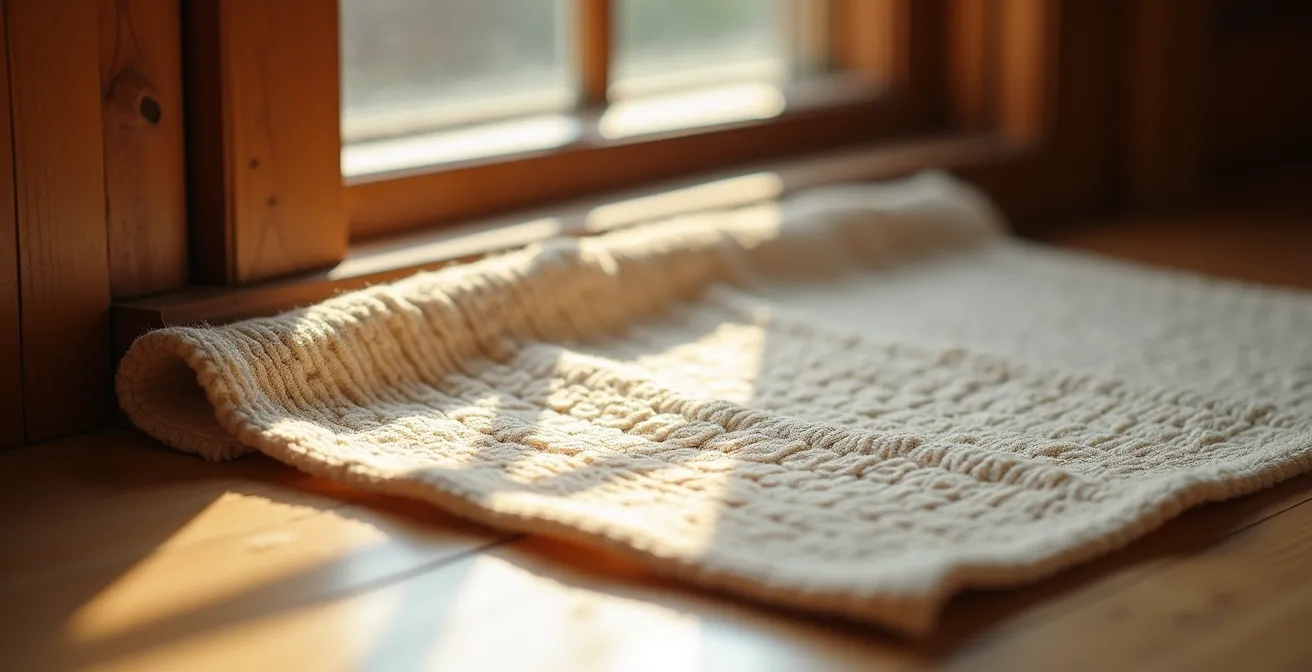
For the DIY hacker, a custom door snake offers the best performance. You can make one by sewing a fabric tube and filling it with a mix of rice for weight and polyester fill for loft. This combination ensures it stays firmly pressed against the gap. You can even add fabric loops to the ends and hang it on small, removable adhesive hooks when not in use. This keeps it off the floor and out of the way.
This simple comparison shows why non-adhesive options are the superior choice for tenants concerned about their deposit. As a comparative analysis for renters highlights, solutions that require no attachment are always the safest bet.
| Solution | Best For | Installation | Removal |
|---|---|---|---|
| Door Snake | Uneven floors/gaps | No adhesive needed | Simply pick up |
| Adhesive Sweep | Consistent gaps | Stick to door bottom | May leave residue |
| Twin Draft Guard | Both sides coverage | Slides under door | No damage risk |
The Mold Trap: avoiding Condensation Behind Temporary Insulation
Sealing your windows to stop drafts is a great first step, but it can create an unintended and dangerous side effect: the moisture trap. When you block air circulation, the warm, moist air inside your apartment can condense on the cold surface of the windowpane, now hidden behind your film or curtain. This trapped moisture creates the perfect breeding ground for mold, which is not only a health hazard but also a surefire way to lose your security deposit. According to the U.S. Department of Energy, you can lose about 30% of a home’s heating energy through inefficient windows, but solving this problem shouldn’t create another.
The key to prevention is active humidity control. Your goal is to keep the indoor relative humidity below 50%. A cheap digital hygrometer is an essential tool for monitoring this. If you see humidity levels creeping up, it’s time to act. Place a few disposable calcium chloride moisture absorbers on your windowsills. These products are designed to pull moisture out of the air and are completely passive and non-damaging.
The most powerful weapon in your arsenal, however, is a “10-Minute Purge.” At least once a day, open windows on opposite sides of your apartment for about ten minutes. This creates a cross-breeze that rapidly exchanges the stale, moist indoor air with fresh, drier outdoor air without significantly lowering the indoor temperature. Regularly check for the early signs of mold—small black or green specks on window frames or sills. If you spot any, clean it immediately with a 1:1 solution of white vinegar and water.
Action Plan: Your Moisture Control Strategy
- Monitor indoor humidity with a digital hygrometer, aiming to keep it below 50%.
- Place passive calcium chloride moisture absorbers on windowsills to capture excess water vapor.
- Implement a daily ’10-Minute Purge’ by opening opposite windows for rapid air exchange.
- Visually inspect window frames weekly for early mold signs like small black or green specks.
- If any mold appears, clean it immediately with a 1:1 solution of white vinegar and water.
How to Bleed Radiators to Boost Heat Output by 20%?
Sometimes the problem isn’t the window, but an inefficient radiator that’s not putting out its full heat potential. If your radiator is hot at the bottom but cool at the top, it’s likely full of trapped air. Bleeding the radiator is a simple process that releases this air, allowing hot water to circulate fully and dramatically increasing its heat output. This can make a room feel significantly warmer without touching the thermostat.
However, as a renter, you must proceed with caution. First, and most importantly, check your lease agreement for any clauses about maintenance. Some landlords forbid tenants from performing any repairs. Look for signs that you shouldn’t proceed, like a valve that has been painted shut or appears damaged. If in doubt, send a polite email to your landlord: “Hi, I’ve noticed the radiator is noisy and not heating evenly. I believe it may have trapped air. I’m comfortable and able to bleed it safely if you approve.” This protects you and documents your responsible approach.
If you get the go-ahead, the process is simple. You’ll need a radiator key (available at any hardware store), a towel, and a small bowl. Turn the heating system off and wait for the radiator to cool. Place the towel and bowl under the bleed valve (a small square nub at the top corner of the radiator). Fit the key onto the valve and turn it slowly counter-clockwise. You’ll hear a hissing sound as the trapped air escapes. The moment a steady stream of water appears, close the valve immediately by turning it clockwise. Don’t over-tighten it. This simple fix ensures you’re getting all the heat you’re paying for. Research shows proper heat distribution and maintenance can significantly improve thermal efficiency, a principle that increases average temperatures by 1.3°C in managed environments.
How to Spot Appliances Draining Power via Your Smart Meter Dashboard?
After you’ve sealed every draft, there’s another invisible source of energy waste to tackle: phantom loads. These are appliances and electronics that continue to draw power even when they’re supposedly “off.” Entertainment centers, coffee makers, and phone chargers are common culprits. As a renter, you can’t rewire the apartment, but you can become a “phantom load hunter” using your smart meter or even your main circuit breaker panel.
If you don’t have a user-friendly smart meter dashboard, you can use the circuit breaker method. It’s a low-tech hack that works wonders. First, make sure everything in your apartment is turned off. Go to your breaker box and take a picture of your electric meter, noting the current reading. Then, turn off all the circuit breakers except one—for example, the one labeled “Living Room.” Leave it on for exactly one hour, then check the meter reading again. The difference is the phantom load for that circuit.
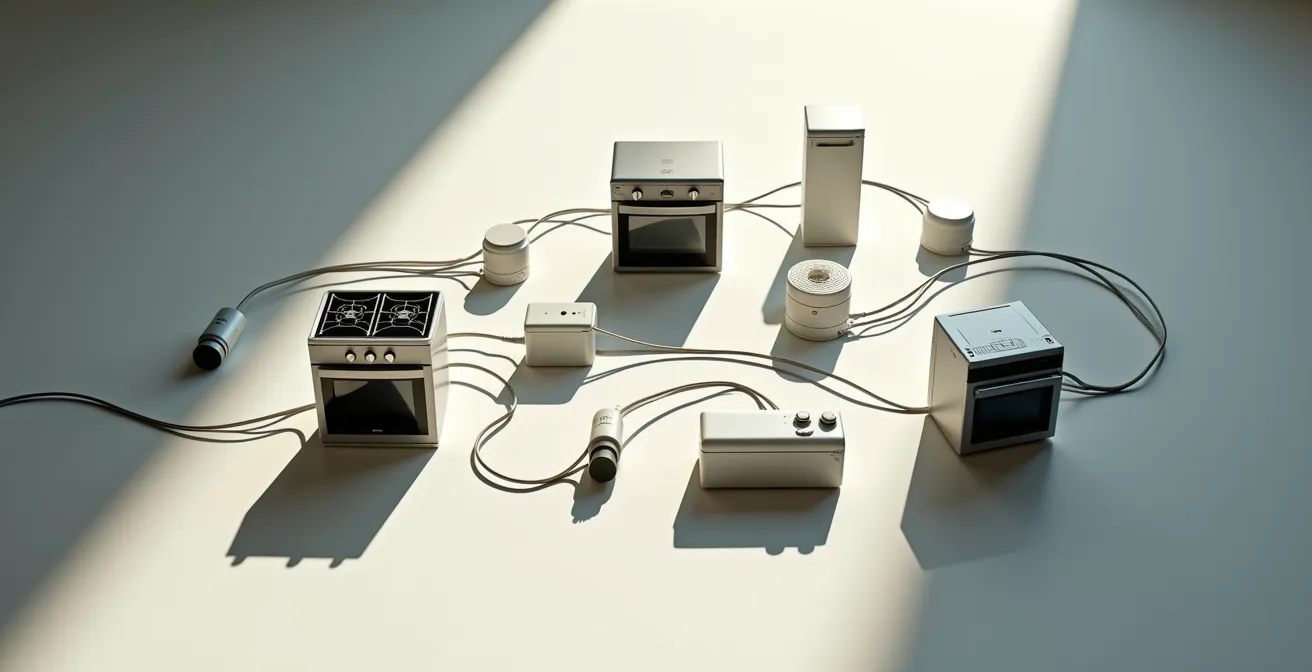
Repeat this process for each circuit in your apartment. You’ll quickly identify which areas of your home are the biggest energy vampires. The circuit for your entertainment center (TV, game console, speakers) is often the worst offender. Once you’ve identified the problem circuits, the solution is cheap and easy: smart plugs. Plug the power-hungry devices into a smart plug and set a schedule to completely cut their power overnight or when you’re at work. This simple, reversible hack can cut down on wasted energy and lower your electricity bill without any permanent changes.
The “Zero VOC” Myth: What Chemicals Are Still Hidden in the Can?
When sealing your apartment for warmth, the air you trap inside becomes the air you breathe 24/7. This makes the chemical composition of your insulation materials incredibly important. Many products market themselves as “Zero VOC” (Volatile Organic Compounds), but this label can be misleading. It often only means the product is free of a specific list of VOCs regulated by the EPA, not that it’s entirely free of all chemical off-gassing. Other unregulated or semi-volatile compounds can still be present.
This “Zero VOC” myth is especially relevant when choosing materials that will be heated by the sun or sealed in an enclosed space. For a renter using temporary solutions, this means looking beyond marketing claims and toward trusted third-party certifications. When choosing thermal curtains, look for the OEKO-TEX certification, which ensures the fabric has been tested for a wide range of harmful substances. For window films, prioritize polyethylene-based films over PVC, as PVC can contain phthalates, which are endocrine disruptors.
The core principle is to choose inert materials whenever possible. Wool, organic cotton, and polyethylene are generally more stable and less likely to off-gas than synthetic materials with added flame retardants or plasticizers. While you may not be painting, the principle applies to all materials you bring into your sealed environment. By understanding that “Zero VOC” is a marketing term, not a scientific guarantee, you can make smarter, healthier choices for your indoor air quality.
Key Takeaways
- The most effective insulation hacks for renters are non-permanent and focus on damage-free application and removal.
- Create an insulating air pocket with heavy curtains sealed at the edges, and use painter’s tape as a base layer for shrink film to protect paint.
- Actively control indoor humidity by monitoring levels and ensuring daily air exchange to prevent mold growth behind insulation.
- Boost your existing heating system’s efficiency by safely bleeding trapped air from radiators (with landlord permission).
How to Choose Non-Toxic Paints and Materials for a Baby Nursery?
While you might not be painting your rental, creating a healthy indoor environment is paramount, especially in a sensitive space like a nursery. The principles of choosing non-toxic materials extend directly to the temporary insulation you use. When you seal a room, any chemicals off-gassed by your materials become concentrated in the air. Therefore, selecting the right materials is just as important as the insulation technique itself.
For thermal curtains, the best choice for a nursery or any health-conscious space is a fabric with an OEKO-TEX or GOTS (Global Organic Textile Standard) certification. These standards guarantee the fabric is free from a long list of harmful chemicals, including flame retardants and heavy metals. Opt for natural fibers like organic cotton or wool, which are inherently less likely to contain synthetic additives. These choices ensure the largest surface area of new material in the room is safe and inert.
When it comes to window films, the material matters. Choose polyethylene-based films instead of those made from PVC. PVC films can release phthalates, which are a health concern, while polyethylene is a more stable and benign plastic. Look for products with a GreenGuard Gold certification, which indicates they have been tested and found to have very low chemical emissions, making them suitable for sensitive environments. As studies on creating healthy sealed homes show, combining proper insulation with low-emission materials is crucial for maintaining good indoor air quality. By applying these non-toxic principles to your insulation choices, you ensure your warm and cozy room is also a healthy one.
Stop letting your comfort (and your money) slip through the cracks. Pick one of these deposit-proof hacks this weekend and start reclaiming your warmth and your peace of mind.
Frequently Asked Questions on How to Insulate Drafty Rental Windows Without Losing Your Deposit?
Which window films are safest for indoor air quality?
Choose polyethylene films over PVC, as they don’t contain phthalates. Look for GreenGuard Gold certification, which tests for low chemical emissions, making them ideal for sensitive environments.
Are thermal curtains safe for nurseries?
Yes, they are very safe when you choose the right ones. Look for curtains made from natural fibers like organic cotton or wool with an OEKO-TEX certification. This ensures the fabric is free from harmful flame retardants and other chemicals.
Can VOCs from insulation materials contribute to mold?
Yes, indirectly. Some Volatile Organic Compounds (VOCs) can act as a food source for certain types of mold. Using low-VOC or zero-VOC materials is therefore an important part of a comprehensive mold prevention strategy for sealed windows.