
Calculating your carbon footprint isn’t an accounting chore; it’s a powerful business strategy to reduce costs and attract better customers.
- Your biggest environmental impact (and cost-saving opportunity) isn’t your lightbulbs, but your supply chain—specifically milk and coffee beans.
- Authentic action within your supply chain (“insetting”) is a more credible and marketable strategy than buying cheap, often questionable, carbon offsets.
Recommendation: Start by tracking the emissions from your single biggest ingredient. Use that data to tell a transparent story that attracts a growing customer base willing to pay a premium for sustainability.
You’re passionate about crafting the perfect cup of coffee. You obsess over bean origins, roast profiles, and extraction times. But as a modern business owner, there’s another, more persistent question brewing in the background: what is the true environmental cost of your business, and what can you actually do about it? The internet is full of vague advice to “go green” or “buy offsets,” but these platitudes often feel disconnected from the daily reality of running a small coffee shop.
The standard approach often involves hiring expensive consultants or getting lost in complex carbon accounting software. It feels overwhelming, academic, and far removed from your profit and loss statement. But what if tracking carbon wasn’t another chore, but a strategic lever for your business? What if every gram of CO2 you measured was a proxy for an inefficiency you could eliminate, a cost you could cut, or a powerful story you could tell to a customer base that’s hungry for authenticity?
This guide is designed for you, the pragmatic small business owner. We’re not going to get bogged down in abstract science. Instead, we’ll focus on the business-savvy approach to carbon calculation. We’ll identify the “emission hotspots” in your shop where small changes yield the biggest results, and we’ll show you how to turn your sustainability efforts into a genuine competitive advantage that resonates with today’s most valuable customers.
This article provides a step-by-step framework to demystify your coffee shop’s carbon footprint. By following this structure, you’ll gain actionable insights to make smarter, more sustainable business decisions.
Contents: How to Calculate Your Coffee Shop’s Carbon Footprint
- Why Are Gen Z Customers Willing to Pay 10% More for Carbon Neutral Products?
- How to Measure Scope 3 Emissions (Supply Chain) Without a Math Degree?
- Tree Planting vs. Clean Cookstoves: Which Carbon Offset Is Not a Scam?
- The Switch Cost: What Happens When You Ditch Cheap Suppliers for Green Ones?
- How to Switch to 100% Renewable Electricity Plans for Your Storefront?
- How to Group Your Orders to Reduce Carbon and Packaging Waste?
- Why Does Sending an Email With an Attachment Emit 50g of CO2?
- How to Reduce Your Digital Carbon Footprint Without Going Offline?
Why Are Gen Z Customers Willing to Pay 10% More for Carbon Neutral Products?
The first rule of smart business is to know your customer. And today’s fastest-growing consumer demographic, Generation Z, doesn’t just buy products; they buy into values. For them, a company’s environmental stance isn’t a bonus feature—it’s a core part of the brand’s identity. This isn’t just a feeling; it’s a proven market force. In fact, recent research shows that 73% of Gen Z consumers are willing to pay more for sustainable products, with the majority happy to accept a 10% premium.
What does this mean for your coffee shop? It means that every dollar you invest in sustainability is also an investment in marketing and customer loyalty. Calculating and reducing your carbon footprint isn’t an act of charity; it’s a direct appeal to a high-value customer segment. These are customers who are actively looking for businesses that align with their principles, and they are prepared to reward that alignment with their money and their loyalty.
However, this generation is also highly attuned to “greenwashing.” Vague claims of being “eco-friendly” are no longer effective. To capture this market, you need to communicate your impact with transparency and specificity. Here’s how you can do it:
- Provide Verifiable Data: Instead of general statements, show the numbers. Displaying the specific CO2 equivalent (CO2e) per drink can be a powerful tool. For instance, explaining that a 12 oz black coffee generates around 0.258 kg of CO₂e, while a latte’s emissions can jump to 0.844 kg CO₂e due to the milk, educates and empowers your customers.
- Create Tangible Narratives: Link a customer’s purchase to a specific, positive outcome. Talk about the regenerative agriculture practices of your coffee bean supplier or the local sourcing of your oat milk. Stories are more memorable than statistics.
- Show Supply Chain Visibility: True transparency means showing your work. If you can share data or stories about your efforts from the farm all the way to the cup, you build a level of trust that generic brands can’t match.
By understanding this key market driver, you can reframe your carbon calculation efforts not as a cost center, but as a vital part of your brand’s story and a direct path to sustainable growth.
How to Measure Scope 3 Emissions (Supply Chain) Without a Math Degree?
If the idea of carbon accounting gives you a headache, you’re not alone. The industry loves its jargon, especially terms like “Scope 1, 2, and 3 emissions.” Here’s a simple breakdown: Scope 1 is the fuel you burn on-site (like natural gas for a stove). Scope 2 is your purchased electricity. Scope 3 is everything else—and for a coffee shop, “everything else” is almost everything that matters. It’s your coffee beans, your milk, your pastries, your packaging, and your waste.
The scale of this is staggering. For major food service companies, analysis has shown that nearly 99% of their emissions are Scope 3. This means that focusing on your in-store lightbulbs while ignoring your supply chain is like meticulously mopping up a spill while a fire hose is running. Your biggest impact, and your biggest opportunity, lies in the goods you purchase.
So, how do you measure this without a team of analysts? You apply the 80/20 rule. Focus on the few sources that cause the majority of your emissions. Here’s a pragmatic, no-math-degree-required approach:
- Identify Your Top 3 Emission Sources: For virtually every coffee shop, the list is the same. The single greatest contributor is milk, due to the methane from dairy cows. This is followed by your other food items and, of course, the coffee beans themselves. Don’t worry about the carbon footprint of your napkins until you’ve tackled your milk supply.
- Use Your POS Data: You already have the data you need. Look at your invoices and Point-of-Sale reports to see how much you spend on each of your top categories (dairy, coffee, baked goods). You can use spend-based emission factors—industry averages that estimate CO2e per dollar spent—to get a surprisingly accurate first estimate.
- Track Your Energy Consumption: While smaller than your supply chain, your energy use (Scope 2) is still important and easy to measure. Gather your electricity bills to understand your consumption patterns and identify emissions from your operations.
- Engage Your Suppliers: You don’t have to do this alone. Create simple questionnaires for your main suppliers. Ask them about the recycled content in their packaging, their own energy sources, or any sustainable farming practices they use. Their answers become part of your data.
This approach moves you from “I have no idea” to “I have a solid, data-backed estimate” quickly and efficiently. It’s about being smart and targeted, not about counting every last gram of carbon.
Tree Planting vs. Clean Cookstoves: Which Carbon Offset Is Not a Scam?
Once you have an idea of your footprint, the most common advice is to “buy carbon offsets” to become “carbon neutral.” This is where a small business owner can easily get into trouble. The carbon offset market is notoriously complex and filled with projects of questionable quality. Many offsets, especially cheap ones, provide a false sense of security while doing little for the planet. The two most common types—tree planting and clean cookstoves—often come with significant problems.
Tree planting projects are vulnerable to fires, disease, and illegal logging, meaning the carbon you thought you “offset” can be released back into the atmosphere. These often generate what are known as ‘phantom credits’ that aren’t backed by permanent carbon storage. Similarly, many clean cookstove projects have been found to be massively over-credited, promising far more carbon reduction than they actually deliver. Choosing the right path requires looking beyond the marketing claims.

A more robust and authentic strategy is emerging: carbon insetting. Instead of paying a stranger to plant a tree in a distant country, you invest directly in reducing emissions *within your own supply chain*. As the International Platform for Insetting, cited by the World Economic Forum, explains:
Insetting is the implementation of nature-based solutions such as reforestation, agroforestry, renewable energy and regenerative agriculture.
– International Platform for Insetting, World Economic Forum
For a coffee shop, this could mean partnering with your coffee bean supplier to help them invest in agroforestry (planting trees on their farms) or helping your dairy supplier transition to more sustainable feed. This approach is not only more verifiable but also creates a powerful marketing story. You aren’t just buying an abstract credit; you are actively improving the ecosystem that produces your core product. The following table, based on recent scientific findings, breaks down the key differences.
This comparative data, highlighted in a recent analysis of carbon offset efficacy, shows the clear advantages of investing within your own value chain.
| Offset Type | Additionality | Permanence | Key Finding |
|---|---|---|---|
| Tree Planting | Variable | Low-Medium (vulnerable to fire, disease) | Often generates ‘phantom credits’ not backed by actual carbon storage. |
| Clean Cookstoves | Weak | Immediate but temporary | Cookstove offsets are often overvalued by a factor of 10, according to a UC Berkeley study. |
| Insetting (Supply Chain) | High | Medium-High | Investment in emission reduction within own supply chain provides tangible, verifiable results. |
The Switch Cost: What Happens When You Ditch Cheap Suppliers for Green Ones?
Let’s address the elephant in the room: sustainable suppliers often come with a higher price tag. The fear that switching to a “green” supplier will destroy your margins is a legitimate concern for any small business owner. However, viewing this decision solely through the lens of cost is a strategic mistake. It ignores the other side of the equation: revenue and brand value.
The modern consumer is increasingly making purchasing decisions based on more than just price. As PwC’s 2024 Voice of the Consumer Survey found, nearly 80% of consumers are willing to pay more for sustainably produced goods, with the average premium they’ll accept hitting 9.7%. This data point is a game-changer. It suggests that the “extra cost” of a sustainable supplier isn’t a loss; it’s an investment that can be directly recouped through higher prices that a significant portion of your customers are already willing to pay.
This trend is especially potent in the coffee industry, which has been moving towards “premiumization” for years. Customers are already accustomed to paying more for quality and a good story. As the market for specialty coffee shows, there’s a huge appetite for products that offer more than just a caffeine hit.
Market Trend: The Rise of Premium and Ethical Coffee
The specialty coffee market is booming precisely because consumers are actively seeking out higher quality and more ethically produced options. The growing demand for single-origin, organic, and sustainably sourced coffee varieties proves that a large segment of the market has already moved beyond price as their primary decision driver. They are investing in a superior product and the story behind it, which creates significant growth opportunities for businesses that can meet this demand.
When you switch from a cheap, anonymous supplier to a green one, you aren’t just buying a different product; you’re buying a story. You’re buying transparency. You’re buying a tangible way to connect with the values of your best customers. The “switch cost” is therefore not a cost at all, but an investment in building a more resilient, premium brand with higher margins and deeper customer loyalty.
How to Switch to 100% Renewable Electricity Plans for Your Storefront?
After tackling your supply chain, addressing your direct energy consumption is the next logical step. Switching your storefront to a 100% renewable electricity plan is one of the most high-impact and straightforward changes you can make. It directly cuts your Scope 2 emissions and provides a clear, easy-to-communicate sustainability win for your customers.
However, before you jump to a new provider, a little prep work can save you money and maximize your impact. The most business-savvy approach is to reduce your overall consumption first, so you’re paying for less green energy later. Think of it as right-sizing your needs before you upgrade the source.
Here is a practical roadmap for making the switch to renewable energy for your storefront:
- Conduct a Quick Energy Audit: Before you do anything else, identify your “energy hogs.” In a coffee shop, the main culprits are almost always the espresso machine, lighting, heating, air conditioning, and dishwashers. Understanding where your power is going helps you target efficiency measures.
- Implement Efficiency Measures First: Simple changes can make a big difference. Switch to LED lighting, ensure your equipment is well-maintained and running efficiently, and optimize your heating and cooling schedules. Reducing your total kilowatt-hour (kWh) usage is the cheapest way to cut your electricity bill and your carbon footprint.
- Compare Green Tariffs vs. RECs: Not all “green” plans are created equal. Some providers offer “Green Tariffs” that directly fund the creation of new renewable energy projects on the grid. Others sell Renewable Energy Certificates (RECs), which can sometimes be a less direct way of supporting green power. Research which options in your area actually contribute to adding new renewables to the grid.
- Explore Community Solar Programs: In many areas, you can join a community solar program. This allows you to benefit from solar power without installing panels on your own roof. It’s often a cost-effective option and provides a great local marketing angle, showing you’re invested in your community’s green infrastructure.
By following these steps, you ensure that your switch to renewable energy is not just an environmental statement, but also a financially sound business decision. You reduce waste first, then you green your supply.
How to Group Your Orders to Reduce Carbon and Packaging Waste?
Your supply chain’s carbon footprint isn’t just about what you buy; it’s also about *how* it gets to you. Frequent, small deliveries from multiple suppliers create a cascade of inefficiency: more trucks on the road, more fuel burned, and an excess of packaging materials like boxes and shrink wrap. Optimizing your ordering and delivery logistics is a powerful lever for reducing both your Scope 3 emissions and your operational costs.
The goal is to move away from a “just-in-time” model, which often results in many small shipments, to a “just-enough” model that relies on fewer, larger, and more consolidated deliveries. This requires a bit of forecasting and coordination but pays significant dividends in efficiency and waste reduction. By being more strategic about your ordering, you can take direct control of a major source of hidden emissions.
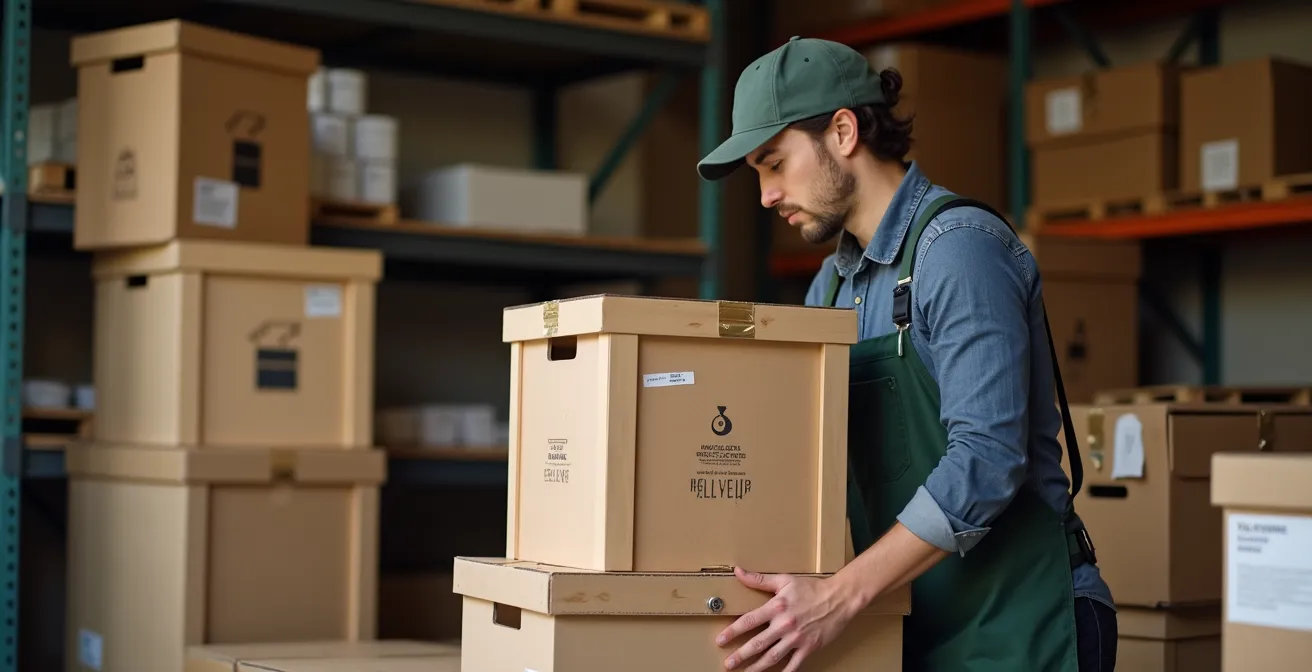
Here are some concrete strategies you can implement to consolidate orders and reduce your logistical footprint:
- Use POS Data for Demand Forecasting: Your sales data is a powerful tool. Analyze it to predict your usage of key supplies like milk, beans, and syrups. This allows you to place larger, less frequent orders with confidence, minimizing the risk of over-stocking or running out.
- Partner with Neighboring Businesses: Talk to other non-competing small businesses on your block. You may be able to place combined orders from shared suppliers (like a dairy or bakery), splitting the delivery fee and reducing the number of delivery trucks in your neighborhood.
- Negotiate Consolidated Shipping Dates: Work with your key suppliers. Instead of accepting deliveries whenever they happen to arrive, negotiate for a single, consolidated delivery day each week or every two weeks. This gives your supplier logistical certainty and dramatically reduces your carbon impact from transportation.
- Pilot Reusable Transport Packaging: Ask your regular suppliers if they offer or would be willing to pilot a program using returnable and reusable transport packaging, such as plastic crates for milk or beans. This can drastically cut down on the single-use cardboard and plastic waste your shop generates.
Each of these steps helps streamline your operations, cutting down on waste, emissions, and often, direct costs associated with shipping and handling.
Why Does Sending an Email With an Attachment Emit 50g of CO2?
In our hyper-connected world, it’s easy to think of digital activities as being “in the cloud” and therefore weightless and impact-free. But the reality is that every email, every search, and every file transfer relies on a massive global network of servers, routers, and data centers that consume vast amounts of electricity. This “digital footprint” is a real and measurable part of your business’s carbon emissions.
The impact of a single action can be surprisingly large. While a standard, text-only email has a tiny footprint, research shows that sending an email with a large attachment can generate up to 50g of CO2. This is because the attached file must be processed, transmitted, and stored on multiple servers, each step consuming energy. When multiplied across thousands of businesses sending millions of emails, this adds up to a significant environmental cost.
It may seem small on an individual level, but the cumulative effect is enormous. This concept highlights how seemingly trivial daily actions contribute to a larger carbon burden.
The “Thank You” Email Effect
To illustrate the scale of digital emissions, a study by OVO Energy in the UK calculated the impact of unnecessary emails. It found that if every adult in the UK sent just one fewer “thank you” email per day, the country could save over 16,433 tonnes of carbon annually. This is equivalent to taking more than 3,300 diesel cars off the road completely. This demonstrates how small, habitual digital actions, when aggregated, have a massive real-world environmental footprint.
For a coffee shop, this means being mindful of how you communicate with staff, suppliers, and customers. Sending large menu PDFs, uncompressed photos for social media, or lengthy email chains with multiple attachments all contribute to your digital carbon footprint. The key is to adopt more efficient digital habits, which not only reduces your environmental impact but also makes your communications more streamlined and professional.
Key Takeaways
- Carbon Is a Proxy for Cost: Tracking your emissions is a business-savvy way to identify and eliminate operational and supply chain inefficiencies.
- Focus on the 80/20 Rule: Your biggest levers for change are in your supply chain. Milk, coffee beans, and other food items account for the vast majority of your footprint.
- Authenticity Outperforms Offsets: Investing in sustainability within your own supply chain (insetting) is more credible, marketable, and impactful than buying cheap, abstract carbon offsets.
How to Reduce Your Digital Carbon Footprint Without Going Offline?
Recognizing your digital carbon footprint doesn’t mean you need to shut down your website or stop using email. It simply means adopting smarter, more efficient digital practices. Just as you would optimize your energy use in-store, you can optimize your digital operations to reduce waste and emissions. These changes are often simple to implement and can improve your workflow and website performance at the same time.
The goal is to be intentional with your digital resources. By treating data as a physical resource that requires energy to move and store, you can start making more conscious decisions. This approach not only shrinks your environmental impact but also declutters your digital life, making your business run more smoothly. From your website to your internal communications, there are numerous opportunities for improvement.
Adopting a “digital hygiene” mindset is key. By regularly cleaning up and optimizing your digital assets, you ensure that you are not wasting energy on unnecessary data storage or transfer. The following checklist provides a concrete plan to get started.
Action Plan: Your Digital Decarbonization Checklist
- Website & Marketing Channels: Audit all your digital points of contact. Start by compressing all images on your website, especially large latte art photos and menu PDFs. Switch to a web hosting provider that is powered by renewable energy.
- Internal Communications: Inventory your current practices. Instead of emailing different versions of documents back and forth, switch to using cloud-based collaboration tools like Google Docs or Microsoft 365. Mandate text-only email signatures for all staff.
- Data Storage & Management: Confront your data clutter. Unsubscribe from all the newsletters you never read. Archive and, more importantly, delete old data and emails from your cloud storage and servers regularly. This reduces the constant energy drain of storing irrelevant information.
- Behavioral Nudges: Assess your team’s digital habits. Is video streaming for background music in HD? Can it be switched to audio-only? Encourage thoughtful emailing to reduce the volume of unnecessary “thank you” or “got it” messages.
- Integration & Prioritization: Create a simple plan. Prioritize the easiest wins first, like compressing website images. Schedule a quarterly “digital clean-up” day for your team to archive old files and unsubscribe from mailing lists.
Starting this journey doesn’t require a massive overhaul. Begin by choosing one area—like measuring the emissions from your milk supply or implementing this digital checklist—and take the first, practical step. This pragmatic approach is how you build a more sustainable, resilient, and profitable coffee shop.