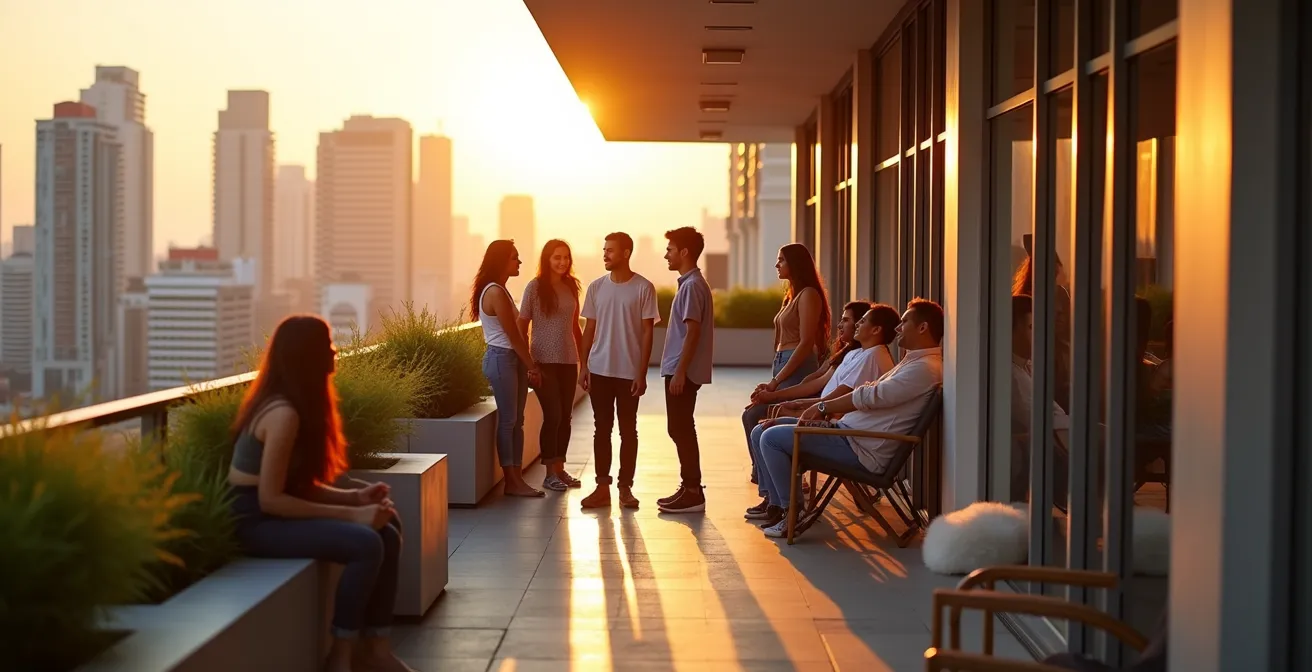
Feeling lonely in a full building is a modern paradox. The solution isn’t forced fun, but designing a better social infrastructure. This involves creating low-pressure opportunities for interaction, improving the safety and appeal of common areas, and establishing community-led guidelines. By focusing on small, intentional changes to your environment and routines, you can transform anonymity into a genuine, supportive neighborhood.
Living surrounded by people yet feeling completely alone is a common experience in today’s high-density apartment complexes. The conventional advice often involves hosting a potluck or simply saying “hello” more often. While well-intentioned, these efforts frequently fall flat, leading to awkward encounters or, worse, no change at all. We’re told to engage, but rarely are we shown how to build the underlying framework that makes engagement feel natural and rewarding.
The problem isn’t a lack of desire for connection; it’s the absence of a supportive social infrastructure. This article will move beyond the platitudes. Drawing on insights from urban sociology and community studies, we will explore a different approach. What if the key to building community wasn’t about more events, but about smarter social architecture? We’ll examine how small, deliberate changes to our shared spaces and communication habits can lower the barrier to trust and create “engineered serendipity”—positive, spontaneous interactions that build real bonds.
This guide will provide you with a blueprint for transforming your building from a collection of strangers into a thriving micro-community. We will analyze why connected neighborhoods are safer, how to design events that people actually enjoy, and how to navigate the inevitable friction of shared living without creating lasting resentment.
Summary: Forging Community in Vertical Neighborhoods
- Why Do Connected Neighborhoods Experience 40% Less Petty Crime?
- Why Do Well-Lit Bus Stops Reduce Crime Rates by Over 20%?
- How to Organize a Building Mixer That People Actually Want to Attend?
- Shared Laundry Etiquette: Handling Disputes Without creating Enemies
- WhatsApp Group vs. Face-to-Face: What Builds Real Trust?
- Why Do Introverts Burn Out Faster in Co-Living Arrangements?
- How to Survive the Kitchen Dynamics in a 10-Person Co-Living Space?
- When to intervene: Signs Your Neighborhood Community Is Fracturing
Why Do Connected Neighborhoods Experience 40% Less Petty Crime?
The idea that strong communities are safer isn’t just a comforting thought; it’s a sociological principle known as “collective efficacy.” This is the shared belief among neighbors that they can work together to maintain public order and achieve common goals. When residents know each other, trust each other, and feel a sense of shared ownership over their space, they are more likely to watch out for one another and intervene in subtle ways. This could mean questioning a stranger loitering in the hallway, picking up a package left at a neighbor’s door, or simply creating an environment where potential offenders feel they are being observed by a cohesive group, not a collection of isolated individuals.
This isn’t just theory. Tangible results emerge when communities actively foster these bonds. The feeling of safety that comes from knowing your neighbors is a powerful deterrent to opportunistic crime. The simple act of recognizing faces and exchanging greetings builds a foundational layer of informal surveillance that is more effective than any security camera alone. This creates a feedback loop: increased safety encourages more use of common spaces, which in turn strengthens social ties and further enhances collective efficacy.
Case Study: Pittsburgh’s Community-Led Crime Reduction
A powerful example of this principle in action comes from Pittsburgh. A program focused on improving the physical and social environments of acquired properties created a remarkable outcome. By fostering resident trust and building a sense of community control, the initiative led to an overall crime reduction of 49%. This demonstrates that investing in social connection is a direct and effective strategy for creating a safer living environment for everyone.
Ultimately, a building where neighbors are connected isn’t just a friendlier place to live—it’s a fundamentally safer one. The 40% reduction in petty crime is a direct result of this web of trust and mutual accountability.
Why Do Well-Lit Bus Stops Reduce Crime Rates by Over 20%?
The connection between lighting and safety goes far beyond the simple ability to see in the dark. Well-designed environmental features, like bright lighting in common areas, are a critical piece of social infrastructure. This concept, often called Crime Prevention Through Environmental Design (CPTED), argues that the physical environment can be strategically manipulated to reduce both the incidence and fear of crime. Well-lit pathways, entrances, and bus stops increase “natural surveillance”—the idea that residents can casually observe the activity around them, making potential criminals feel more visible and exposed.
This principle extends beyond just lighting. Clean, well-maintained common areas, clear lines of sight, and the absence of hiding spots all send a powerful signal: this space is cared for and actively used by its residents. A study of abandoned houses in Philadelphia found significant reductions in gun violence after they were remediated with working windows and doors, simply because the environment no longer signaled neglect and disorder. In an apartment complex, this translates to promptly repaired fixtures, clean hallways, and vibrant common spaces that invite positive use.

The psychological impact is just as important as the physical reality. A randomized experiment involving the provision of street lighting in New York City showed that these improvements led to significant crime reduction. For residents, a brightly lit path from the bus stop to their front door doesn’t just reduce the statistical risk of an incident; it dramatically reduces the *fear* of an incident, encouraging them to be out more and reinforcing the community’s presence in shared spaces.
Investing in the physical environment of a building is, therefore, a direct investment in its social fabric and safety. It’s a tangible way to build the stage upon which a secure and connected community can thrive.
How to Organize a Building Mixer That People Actually Want to Attend?
The classic “building mixer” often fails because it ignores basic social psychology. It puts a great deal of pressure on residents to be outgoing, navigate awkward silences, and approach total strangers. A successful gathering isn’t about free food; it’s about lowering the social barrier to entry and designing an experience that caters to different personalities. The goal is to create an environment for engineered serendipity, where natural, low-stakes interactions can occur.
First, abandon the one-size-fits-all model. Instead of a single, high-pressure evening event, start with low-commitment activities. A 15-minute “coffee and croissants” morning in the lobby on a weekday can catch people on their way out, requiring minimal time investment. A book or puzzle swap shelf in a common area creates a focal point for interaction without a scheduled event. These micro-events build familiarity over time, making larger gatherings feel less intimidating.
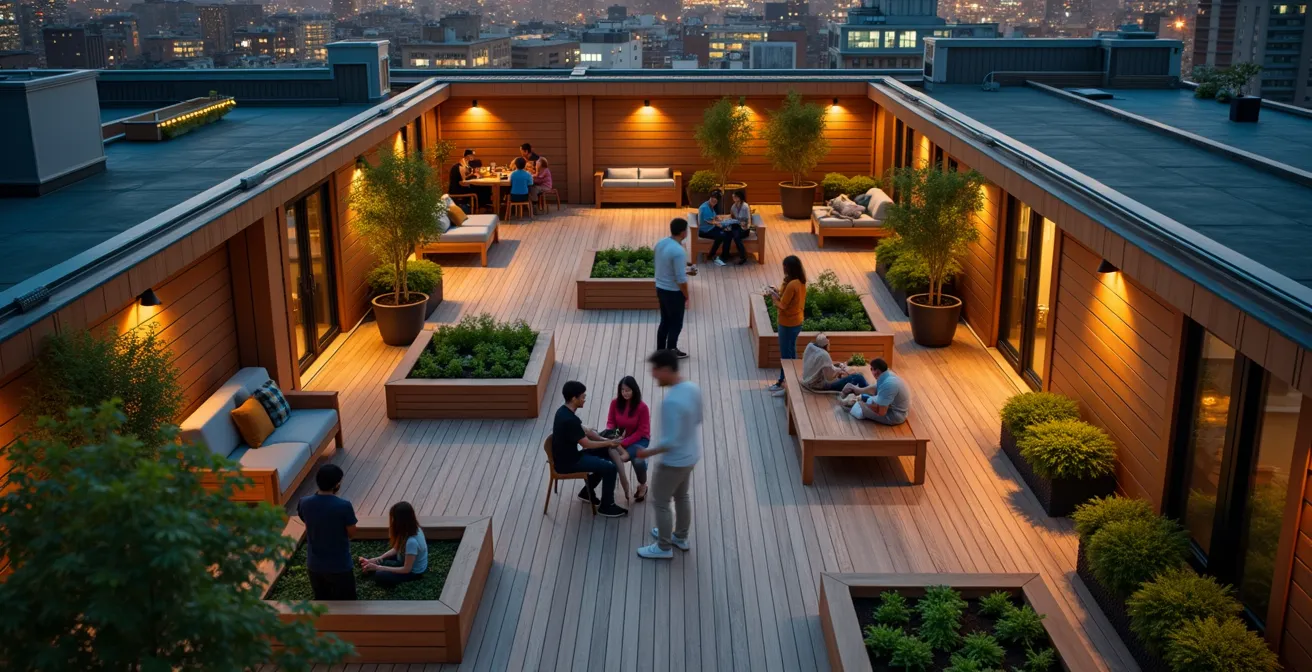
When you do host a larger event, design the space for inclusion. Create distinct zones: a central area for mingling, but also quieter corners with seating for one-on-one conversations. This allows both extroverts and introverts to participate comfortably. Crucially, implement an “anchor & host” strategy. Designate a few friendly, outgoing residents beforehand to act as social facilitators. Their job isn’t to be the life of the party, but to actively make introductions, connect people with shared interests, and ensure no one is left awkwardly standing alone.
By shifting the focus from a single, forced event to a series of thoughtfully designed social opportunities, you can create a welcoming atmosphere where genuine connections are not just possible, but probable.
Shared Laundry Etiquette: Handling Disputes Without creating Enemies
Shared spaces like laundry rooms are common flashpoints for conflict in apartment buildings. Disputes over forgotten clothes, messy lint traps, or monopolized machines can quickly escalate from minor annoyances to sources of deep-seated resentment. The key to managing this friction isn’t stricter rules from management, but fostering a sense of shared ownership and responsibility among residents. When residents feel they are part of a community with agreed-upon norms, they are more likely to self-regulate and handle issues constructively.
A powerful approach is to facilitate the creation of a resident-led “social contract.” Instead of a list of punitive “don’ts” posted by the building, this involves a collaborative process where residents themselves define the rules of engagement. This creates buy-in and makes enforcement a community responsibility rather than a top-down mandate. A study on community-led governance found that co-created rules are foundational for strengthening social cohesion because they transform residents from passive users into active stewards of their shared environment.
This approach shifts the dynamic from adversarial to cooperative. Instead of leaving passive-aggressive notes, residents have a shared framework to reference. The focus moves from blaming individuals to upholding a collective agreement. This not only resolves the immediate issue in the laundry room but also builds the community’s capacity for resolving future conflicts in a healthy way.
Your Action Plan: A Conflict Resolution Framework for Shared Spaces
- Establish a Social Contract: Facilitate a resident meeting to create agreed-upon rules and post them visibly, framed in positive language.
- Implement Positive Nudges: Use humor and celebratory signs (“Join the ‘Clean Lint Trap’ Hall of Fame!”) rather than punitive warnings.
- Create an ‘Amnesty Box’: Set up a designated lost-and-found box for forgotten socks or dryer sheets to depersonalize the issue of abandoned items.
- Use a Shared Calendar: For high-demand machines or times, set up a simple shared digital calendar (like a Google Calendar) for booking slots to prevent disputes.
- Schedule Regular Check-ins: Hold brief, optional resident meetings quarterly to discuss what’s working and address any new concerns before they escalate.
This process doesn’t just keep the laundry room clean; it strengthens the social fabric of the entire building, one load at a time.
WhatsApp Group vs. Face-to-Face: What Builds Real Trust?
In the quest to build community, digital tools like WhatsApp groups or building-wide apps seem like a modern solution. They are excellent for disseminating information quickly—announcing a water shutoff, organizing a last-minute get-together, or finding the owner of a stray package. However, it’s crucial to understand their limitations. These platforms are highly effective at building “task trust,” the confidence that someone will follow through on a logistical arrangement. They are far less effective at building “affective trust,” the deeper, emotion-based bond that forms the bedrock of a true community.
The nuance and non-verbal cues essential for deep relationship-building are lost in text-based communication. A joke can be misconstrued, a brief message can seem dismissive, and digital forums can easily devolve into complaint boards. Relying solely on digital tools can create a false sense of connection while bypassing the very interactions that foster genuine empathy and understanding. The stakes are high; research shows that increased social cohesion contributes to a 20% reduction in gun violence, an outcome built on real-world trust, not just digital efficiency.
The most effective strategy is a hybrid one: using digital tools as a catalyst for offline interaction. The WhatsApp group should not be the destination; it should be the map that leads to face-to-face connection. Use it to coordinate the community garden day, to find players for a weekly basketball game, or to organize a potluck. The real community building happens when people show up in person.
| Interaction Type | Task Trust Building | Affective Trust Building | Best Use Cases |
|---|---|---|---|
| WhatsApp/Digital Groups | High – Quick coordination | Low – Limited emotional connection | Organizing events, sharing resources, maintenance updates |
| Face-to-Face Meetings | Medium – Takes more effort | High – Deep relationships form | Conflict resolution, community bonding, emergency planning |
| Hybrid Approach | High – Best of both | High – Digital facilitates offline | Using digital to organize in-person gatherings |
By leveraging technology to facilitate, rather than replace, real-world connection, you can build a community that is both efficient and deeply interconnected.
Why Do Introverts Burn Out Faster in Co-Living Arrangements?
In any discussion about community building, it’s essential to recognize that not everyone engages with social situations in the same way. Co-living arrangements and high-density buildings, with their constant potential for interaction, can be particularly draining for introverts. This isn’t a matter of being anti-social; it’s a matter of neurology. For introverts, who make up a significant portion of the population, social interactions require a greater expenditure of mental energy. This phenomenon is often described as having a “social battery” that depletes more quickly.
As mental health professionals explain, this accelerated drain is linked to how introverts process stimuli. The constant noise, casual conversations in the hallway, and pressure to participate in group activities can be overwhelming.
Introverts typically experience faster social battery drain due to heightened sensitivity to external stimuli. Social interactions often require more mental energy from introverts, as they process information deeply.
– Mental Health Professionals, Therapy Group of DC
A thriving community must be designed to accommodate this reality. If all social opportunities are high-energy, large-group events, a significant portion of residents will inevitably feel excluded or burn out. True inclusivity means creating a varied social landscape with different “modes” of participation. This includes respecting the need for privacy and downtime, and not interpreting a closed door as a sign of unfriendliness. It means providing spaces and activities that allow for quieter, more focused interaction.
By building an infrastructure that offers both vibrant communal spaces and peaceful private retreats, and by normalizing different levels of social engagement, a building can become a welcoming home for all personality types, not just the most outgoing.
How to Survive the Kitchen Dynamics in a 10-Person Co-Living Space?
The shared kitchen is the heart of a co-living space, but it can also be a battlefield. With ten or more people trying to cook, store food, and clean up, it’s a high-stakes environment where small conflicts can easily boil over. Surviving—and thriving—in this dynamic requires moving beyond assumptions and establishing a clear, co-created system for resource management. The goal is to create a predictable and fair environment that minimizes friction and maximizes cooperation.
There is no single perfect system; the best approach depends on the specific group of residents. The key is to discuss the options openly and agree on a strategy together. A booking system, for instance, can be highly effective for managing peak-hour congestion. A simple shared digital calendar can allow residents to reserve the oven or main prep area during the busy 6-8 PM dinner slot. This replaces chaotic competition with predictable order. For cleaning, a simple rotating schedule might work, but an “adopt-a-spot” strategy can be even more effective. Here, each resident takes long-term ownership of a specific zone (e.g., the sink area, the stovetop, a fridge shelf), fostering a higher level of care and accountability.
Ultimately, the most effective tool is a set of clear, visible, and mutually agreed-upon usage rules. These guidelines should cover everything from dishwashing protocols to food labeling and cleaning schedules. When the rules are co-created by the residents who must live by them, they cease to be resented impositions and become a shared agreement for living together respectfully.
| Strategy | Implementation | Effectiveness | Best For |
|---|---|---|---|
| Booking System | Digital calendar for peak times | High for scheduling | Kitchens, laundry, gym |
| Cleaning Rotation | Weekly assigned responsibilities | Medium – requires enforcement | All common areas |
| Adopt-a-Spot | Individual ownership of specific areas | High for maintenance | Gardens, lounges, terraces |
| Usage Rules | Co-created guidelines posted visibly | High with community buy-in | All shared resources |
This structured approach turns the potential for daily conflict into a daily practice of cooperation and mutual respect.
Key takeaways
- True community is built on well-designed social infrastructure, not just random events.
- A sense of safety and “collective efficacy” is a direct outcome of strong neighborly connections.
- Inclusive community design must account for different personality types, especially the need for introverts to recharge their “social battery.”
When to intervene: Signs Your Neighborhood Community Is Fracturing
A community’s health is a dynamic state; it can strengthen or weaken over time. Being able to recognize the early warning signs of a fracturing community is a crucial skill for any resident who wishes to be a positive force. Intervention is most effective when it’s early, addressing small issues before they fester and grow into deep-seated divisions. Ignoring these signs allows negativity to take root, making it much harder to restore trust and cohesion later on.
The first indicators are often subtle shifts in daily interactions. A noticeable decrease in casual greetings in the hallway, elevators becoming silent spaces, or neighbors actively avoiding eye contact are red flags. Pay attention to the state of common areas. An increase in overflowing trash bins, unaddressed messes in the laundry room, or vandalism, however minor, signals a decline in shared ownership. This is physical evidence that the sense of “we’re all in this together” is eroding.

Digital communication can also be a barometer of community health. If the building’s WhatsApp group transitions from a place for positive sharing and coordination to a forum dominated by complaints and passive-aggressive comments, the community is in trouble. The rise of anonymous, accusatory notes posted in common areas is another classic sign that direct, healthy communication has broken down. These are symptoms of a community that has lost its ability to self-regulate and resolve conflict constructively.
When you spot these signs, it’s time to proactively re-invest in the strategies that build connection: organizing a low-commitment social event, initiating a conversation about co-creating rules for a problem area, or simply making a consistent, personal effort to greet your neighbors warmly.
Frequently asked questions on How to Build Social Cohesion in High-Density Apartment Complexes?
What are early indicators of declining social cohesion?
Watch for decreased casual greetings, overflowing common area trash, silent digital groups, and an increase in passive-aggressive notes rather than direct communication.
How can residents track community health metrics?
Monitor the ratio of positive to negative posts in group chats, track attendance at recurring events, and note any increase in formal complaints to management.
When should professional mediation be considered?
When informal conflict resolution fails, when distinct factions form within the building, or when safety concerns arise from ongoing disputes.