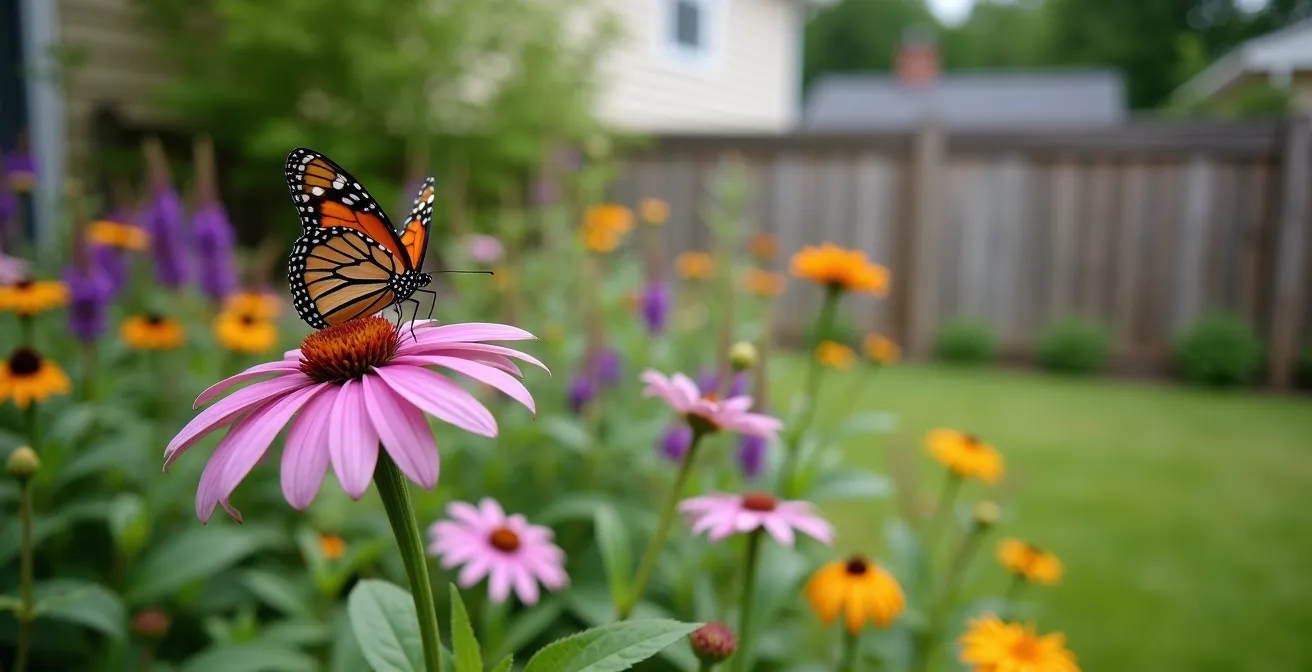
In summary:
- Your yard isn’t an island; it’s a potential link in a vital biodiversity corridor for local wildlife.
- Replacing even a small part of your lawn with keystone native plants provides exponentially more food for insects and birds.
- Think beyond flowers and feeders by providing habitat for the entire life cycle: larval host plants, nesting sites, and winter shelter.
- A “messy” winter garden is a life-saving habitat. Learn to make it look intentional with “cues to care.”
- Supporting local, ecologically-minded farms strengthens the entire regional food web your garden is part of.
That pristine, emerald-green lawn, the hallmark of suburban pride, is one of the greatest deceptions in modern landscaping. We pour water, time, and chemicals into maintaining a perfect monoculture carpet that, to the local wildlife, is as barren as a desert. Many well-meaning homeowners try to help by adding a bird feeder or planting a few popular “pollinator-friendly” flowers. These are kind gestures, but they are often isolated acts in a vast, fragmented landscape.
These common solutions treat the symptoms, not the cause. They offer a quick snack but fail to build a resilient, self-sustaining ecosystem. But what if the key wasn’t just to add a few decorative elements, but to fundamentally rethink the purpose of your yard? What if, instead of an isolated oasis, your small patch of land could become a critical service station on a great ecological highway, a vital link in a chain of habitats that supports life across your entire community?
This guide moves beyond the platitudes. We will deconstruct the suburban yard and rebuild it from the ground up, not with more work, but with more ecological intelligence. We’ll explore how to choose plants that function as entire ecosystems, why your “messy” fall garden is a five-star hotel for bees, and how your grocery shopping choices can directly support the birds you hope to see at your window. It’s time to stop just decorating nature and start truly participating in it.
This article will guide you through the essential shifts in mindset and practice needed to transform your yard into a functioning part of a larger biodiversity corridor. Below is a summary of the key areas we will cover to help you on your journey.
Summary: Transforming Your Yard Into a Pollinator Haven
- Why Does a Perfect Green Lawn Act as a Food Desert for Birds?
- How to Find Plants That Co-Evolved With Your Local Butterfly Species?
- Bird Feeder vs. Berry Bush: Which Provides Better Nutrition for Wildlife?
- The Cat Problem: Why Attracting Birds Is Cruel If You Have Outdoor Cats?
- When to Cut Back Perennials: Why Winter Mess Saves Hibernating Bees?
- Supermarket Organic vs. Local Conventional: Which Is Actually Greener?
- Beeswax Wraps vs. Silicone Lids: Which Reusable Lasts Longer?
- How Joining a CSA Farm Share Supports Short Supply Chains?
Why Does a Perfect Green Lawn Act as a Food Desert for Birds?
The concept of a “food desert” is typically applied to human communities, but it perfectly describes the modern suburban lawn from a bird’s perspective. While lush and green, this monoculture of turfgrass offers virtually no food. The reason is simple: most songbirds, like chickadees, don’t feed seeds to their young. They feed them insects, primarily caterpillars. And the numbers are staggering; research shows chickadees need to collect 6,000 to 9,000 caterpillars just to raise a single clutch of babies.
Where do these thousands of caterpillars come from? Not from turfgrass or the common non-native ornamentals like crepe myrtles and boxwoods that dominate our landscapes. They come from native plants with which they co-evolved. Lawns are not just neutral; they actively displace the plants that form the foundation of the food web. With approximately 40 million acres of lawn covering the United States, we have created an immense ecological void.
Case Study: The Carolina Chickadee’s Survival
Groundbreaking research from the Smithsonian in Washington, D.C. suburbs provided clear evidence of this crisis. Scientists found that Carolina Chickadee populations could only sustain themselves—meaning, produce enough young to replace the adults—when the landscape in their territory consisted of at least 70% native plant biomass. Yards dominated by non-native plants were effectively reproductive dead ends. While a native oak tree might host over 500 species of caterpillars, a non-native Ginkgo tree, for example, hosts virtually none. By choosing native plants, we are literally stocking the pantry for our local birds.
This isn’t an all-or-nothing proposition. You don’t need to eliminate your entire lawn. Simply converting a small portion of it to a multi-layered garden of native trees, shrubs, and perennials can dramatically increase the “carrying capacity” of your yard, turning it from a barren desert into a bustling cafeteria for wildlife.
How to Find Plants That Co-Evolved With Your Local Butterfly Species?
The secret to creating a vibrant butterfly and moth habitat lies in a single, powerful concept: co-evolution. For millennia, our local insects have adapted to feed on specific native plants. Many are “specialists,” meaning their caterpillars can only digest the leaves of a few plant species with which they share an evolutionary history. Planting the right native flora isn’t just a suggestion; it’s a requirement for their survival. But how do you identify these powerhouse plants for your specific area?
The most effective strategy is to focus on “keystone” plants. Much like the keystone in an arch, these are species that have a disproportionately large effect on their ecosystem. While native plants are all good, keystone species are the superstars. Astonishingly, just 14% of native plants support 90% of butterfly and moth species. By prioritizing these keystones, even in a small yard, you create the maximum possible ecological impact.
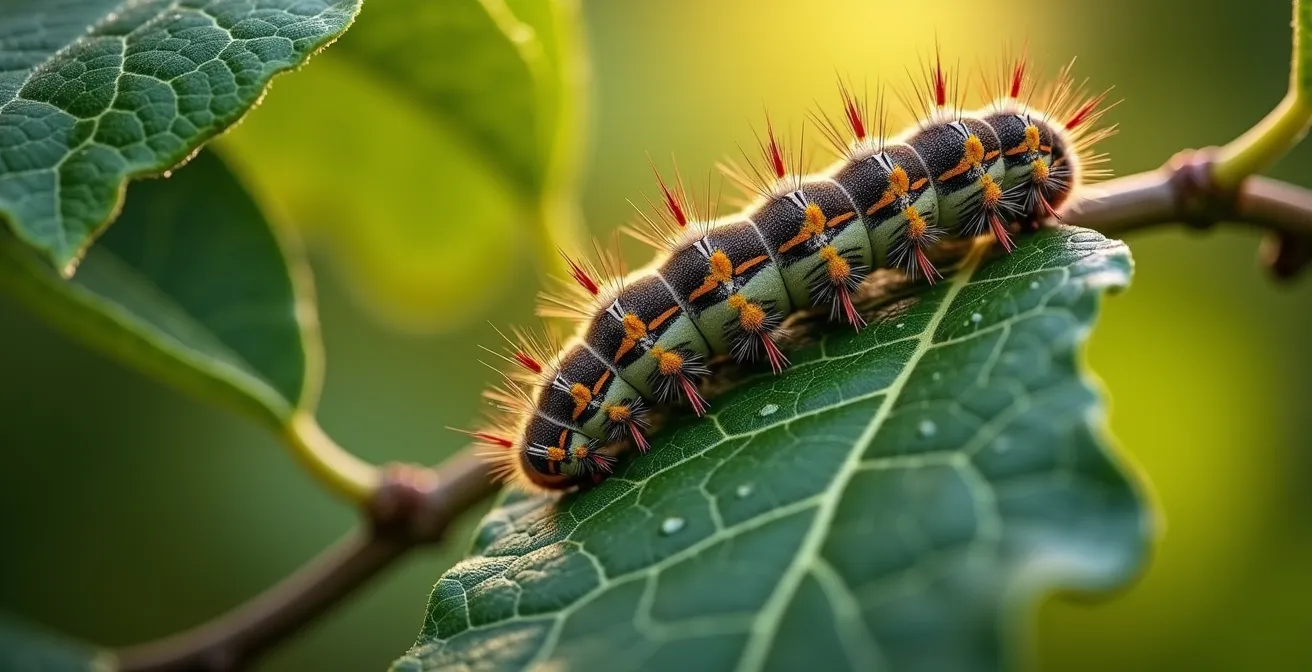
As the image above illustrates, a single keystone plant like an oak tree can become a universe of its own, providing food for hundreds of different caterpillar species, which in turn become food for birds. Your mission as a wildlife gardener is to identify and plant the keystone genera for your ecoregion. Thankfully, modern tools make this easier than ever.
Your Action Plan: Finding Local Keystone Plants
- Visit the National Wildlife Federation’s Native Plant Finder and enter your zip code to generate a ranked list of the most powerful plants for your area.
- The tool will identify your specific ecoregion, ensuring the plants listed are perfectly adapted to your local soil and climate conditions.
- Focus your efforts on the top-ranking “keystone” genera. For much of North America, this includes oaks, willows, cherries, and birches, which serve as larval hosts for hundreds of species.
- When shopping, seek out the “straight species” of these native plants rather than cultivated varieties (often called ‘nativars’), as changes in leaf color or flower shape can make them unrecognizable to specialist insects.
- Start small by adding just one keystone tree or a few keystone shrubs or perennials. The impact will be immediate and profound.
Bird Feeder vs. Berry Bush: Which Provides Better Nutrition for Wildlife?
Bird feeders are a common entry point into wildlife gardening. They bring life and color to our yards and give us a sense of connection. However, when we compare a feeder to a living, native berry bush, we see a stark difference in the quality of support we’re providing. A feeder is a single-purpose convenience store; a native shrub is a full-service, multi-functional community center. University of Delaware entomologist Doug Tallamy puts it best:
Each plant in your landscape you should think of as a bird feeder. It either has food in it, or it doesn’t.
– Doug Tallamy, University of Delaware entomologist
This simple reframing helps us see our entire yard as a potential feeding station. A feeder offers a static, often nutritionally incomplete, seed mix. A native shrub, on the other hand, provides a dynamic, seasonal buffet. For example, the berries of many native dogwoods or viburnums are high in fat and ripen just in time for fall migration, offering the perfect fuel for migrating birds on their long journey. The nutrition is perfectly timed and tailored by nature.
To truly understand the difference in value, a direct comparison is helpful. The following table, based on principles from research highlighted by the Audubon Society, breaks down the key factors.
| Factor | Bird Feeder | Native Berry Bush |
|---|---|---|
| Nutrition | Static seed mix, limited nutrients | High-fat fruits timed for migration |
| Disease Risk | Concentration increases transmission | Natural spacing reduces disease |
| Predator Safety | Creates predictable hunting spot | Provides protective cover |
| Multi-functionality | Single purpose – feeding | Food, shelter, nesting, insect habitat |
| Seasonal Support | Requires constant refilling | Self-sustaining year-round resource |
The takeaway is not that feeders are “bad,” but that they should be a supplement, not the foundation. The most resilient, healthy, and safe way to feed the birds is to plant native shrubs and trees that provide not only food but also the shelter and nesting sites they need to thrive.
The Cat Problem: Why Attracting Birds Is Cruel If You Have Outdoor Cats?
This is a difficult but essential topic for anyone passionate about supporting wildlife. If we are putting in the effort to attract birds to our yards, we have an ethical obligation to ensure we are not luring them into a trap. And the single greatest human-caused threat to birds is the free-ranging domestic cat. The statistics are devastating: a 2013 study revealed that free-ranging domestic cats in the United States kill approximately 1.3–4.0 billion birds every single year.
A bird feeder or a newly planted berry bush creates a predictable hotspot of activity, turning your well-intentioned sanctuary into an efficient hunting ground for outdoor cats—both pets and unowned animals. Even well-fed cats hunt by instinct, and the science is clear that bells on collars are not effective deterrents. The presence of an outdoor cat negates much of the positive work done by creating a pollinator garden.
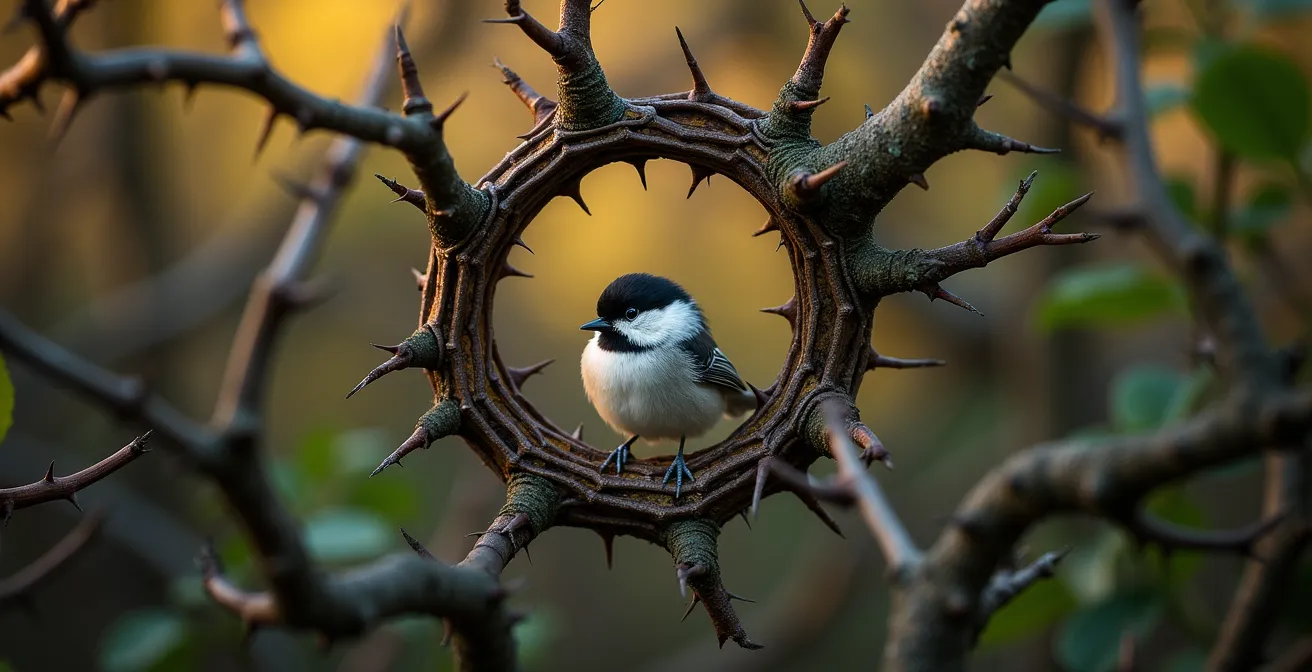
The most responsible solution is simple: keep cats indoors. It is safer for the cats, protecting them from cars, diseases, and predators, and it is exponentially safer for wildlife. However, we can’t control our neighbors’ cats. Our next line of defense is to design our gardens with protection in mind. This means planting “sanctuary” shrubs—dense, thorny native plants like hawthorn, native roses, or hollies. These create an impenetrable fortress where small birds can feed, rest, and nest, safe from predators.
Case Study: Quantifying the Feline Threat
The landmark 2013 Smithsonian Conservation Biology Institute study published in Nature Communications synthesized data from multiple sources to create the first comprehensive estimate of cat predation. It identified this as the single largest source of direct, human-caused mortality for birds and mammals, exceeding deaths from window strikes, vehicles, and poisoning combined. The study underscored that while unowned cats are a major part of the problem, owned cats allowed to roam freely still contribute significantly to the staggering death toll.
When to Cut Back Perennials: Why Winter Mess Saves Hibernating Bees?
The urge for a tidy fall cleanup is deeply ingrained in many gardeners. We see spent stems and seed heads as “mess” to be cleared away before winter. But from an ecological perspective, this “mess” is life. Those hollow perennial stems and dried flower heads are the winter homes for countless insects. Many of our native bee species, for instance, are solitary cavity-nesters. They lay their eggs inside hollow stems, and the larvae overwinter there, ready to emerge in spring. When we cut everything back, we are throwing away the next generation of pollinators.
The science is clear that a huge portion of our native biodiversity depends on this winter habitat. In fact, depending on the region, research shows that 15% to 60% of our native bees are pollen specialists that require specific native plants, and many of these same species also rely on the dead stems of those plants for shelter. By leaving the stems standing through the winter and into the following spring, you provide crucial overwintering habitat. The best time to “clean up” is in late spring, after the new growth has started and the daytime temperatures are consistently above 50°F (10°C), giving the hibernating insects a chance to emerge.
But how do we reconcile this ecological need for mess with neighborhood aesthetics and our own desire for some order? The solution is to use “cues to care.” These are design strategies that signal your “messy” areas are intentional, beautiful, and purposeful habitats, not just neglected spaces.
Checklist for an Attractive Winter Habitat Garden
- Frame your wildness: Create clean, sharp borders around your perennial beds using materials like stone, brick, or metal edging. This contrast makes the naturalistic interior look deliberate.
- Educate with signage: Add a small, tasteful sign that reads “Pollinator Habitat” or “Wildlife Garden.” This simple act transforms the perception of your yard from messy to mission-driven.
- Group the mess: Concentrate your wilder elements, like leaving leaf litter and stem bundles, in designated corners or less-visible areas of your yard, while keeping high-traffic areas more manicured.
- Create visual interest: When you do cut back stems in the spring, trim them to varying heights (from 8 to 24 inches). This creates a more dynamic look and provides nesting cavities of different sizes.
- Practice “Chop and Drop”: In late spring, instead of removing the old dead material, chop it into smaller pieces and let it fall to the ground. It will act as a natural mulch, returning nutrients to the soil and suppressing weeds.
Supermarket Organic vs. Local Conventional: Which Is Actually Greener?
As we become more ecologically conscious in our gardens, that mindset naturally extends to our kitchens. We’re faced with choices at the grocery store: is it better to buy a certified organic apple shipped from thousands of miles away, or a conventionally grown apple from a local farm just down the road? The answer isn’t always simple, but when viewed through the lens of building biodiversity corridors, the local choice often has a far greater positive impact on our regional ecosystem.
The “organic” label primarily governs the use of synthetic pesticides and fertilizers. It doesn’t account for “food miles”—the immense carbon footprint of long-distance transportation. More importantly, large-scale organic agriculture can still be a monoculture, offering limited habitat value. A local farm, even if not certified organic, may be contributing more directly to the health of the very pollinator populations you are trying to support in your own backyard.
Case Study: Local Farms as Biodiversity Anchors
Many local farms practice a holistic approach called Integrated Pest Management (IPM), which minimizes pesticide use and prioritizes ecosystem health. According to the National Wildlife Federation, supporting these farms is critical. They often maintain pollinator-friendly field margins, plant cover crops that enrich the soil and feed wildlife, and preserve hedgerows that serve as vital corridors for insects and birds. These farms act as major hubs in the landscape-scale habitat network, and our suburban pollinator gardens function as crucial satellite nodes and connecting pathways to these larger anchor habitats.
When you buy from a local farm that practices sustainable agriculture, you are not just purchasing food. You are investing in the health of your regional food web. You are funding the maintenance of the very biodiversity corridors that will allow pollinators to find your garden, thrive, and move through the landscape. Your consumer choice becomes an act of habitat creation.
Beeswax Wraps vs. Silicone Lids: Which Reusable Lasts Longer?
The ecological mindset that begins in the garden—questioning the sterile lawn, choosing native plants—inevitably finds its way into the home. A common area for this shift is the kitchen, where we seek to replace single-use plastics. Two popular alternatives to plastic wrap are beeswax wraps and silicone lids. When deciding between them, it’s helpful to consider their full lifecycle, from production to disposal.
Silicone lids are derived from silica, which comes from sand—an abundant resource. The manufacturing process is energy-intensive, but the final product is incredibly durable. A good quality set of silicone lids can last for many years, potentially a lifetime. They are non-toxic, temperature-resistant, and can be recycled at specialized facilities, though this is not always accessible. Their main sustainability credential is their extreme longevity, which prevents the consumption of countless rolls of plastic wrap.
Beeswax wraps, on the other hand, are made from cotton infused with beeswax, jojoba oil, and tree resin. They are products of agriculture and apiculture. Their lifespan is much shorter, typically lasting about a year with proper care. However, at the end of their life, they are fully biodegradable and can be composted in your backyard. Their advantage lies in their natural origins and their graceful return to the earth. If you choose this option, it’s worth considering the source of the beeswax. Supporting local, ethical beekeepers who prioritize bee health and minimize competition with native pollinators is another way to ensure your sustainable choices at home are aligned with your ecological goals in the garden.
Ultimately, the “greener” choice depends on your priorities. If your goal is maximum durability and longevity from a single purchase, silicone is a strong contender. If your priority is using a product from renewable resources that is fully compostable at its end of life, beeswax wraps are the superior choice. Both are significant improvements over single-use plastic.
Key Takeaways
- Transforming your yard begins with a mindset shift: your property is a vital ecological node, not an isolated decoration.
- Prioritize “keystone” native plants, as a small number of these species provide the vast majority of food for local food webs.
- A “messy” winter garden is a crucial habitat; use design cues like clean borders to make it look intentional and beautiful.
- Your role as a conservationist extends beyond the garden fence to your consumer choices, which can support larger habitat corridors.
How Joining a CSA Farm Share Supports Short Supply Chains?
The ultimate expression of connecting your yard to a larger ecological network is to directly invest in its agricultural heartland. Joining a Community Supported Agriculture (CSA) program is one of the most powerful ways to do this. A CSA model creates a direct partnership between you and a local farmer. You purchase a “share” of the harvest at the beginning of the season, providing the farmer with stable, predictable income. This financial security is not just an economic benefit; it is a profound ecological one.
This stability allows the farmer to move beyond the narrow logic of maximizing profit on every square foot of land. It empowers them to dedicate land to practices that are ecologically vital but not directly profitable. This includes planting beetle banks to harbor beneficial insects, cultivating extensive pollinator hedgerows, and maintaining wildflower meadows that act as reservoirs of biodiversity.
Case Study: CSA Farms as Biodiversity Hubs
Research into sustainable farming practices shows that CSA farms often become major hubs in regional biodiversity corridors. With the financial freedom provided by their members, these farms can afford to implement comprehensive IPM strategies and create rich, varied habitats. In this model, the farm becomes the central “national park” of the local ecosystem, and the yards of its CSA members—like your own pollinator garden—serve as crucial “service stations” and satellite habitat nodes, creating a robust and resilient ecological network across the entire landscape.
By joining a CSA, you are shortening your food supply chain to the absolute minimum, receiving fresh, seasonal produce directly from the source. But more importantly, you are becoming a direct patron of landscape-scale conservation. You are funding the very biodiversity that will, in turn, make your own small suburban yard a more vibrant and life-filled place.
The journey from a sterile lawn to a thriving habitat is a rewarding one. The next logical step is to turn these principles into action. Start by investigating local CSA programs in your area or visiting a native plant nursery to find the keystone species for your ecoregion.
Frequently Asked Questions about Native Pollinators
What’s the difference between honeybees and native bees?
Honeybees are European agricultural livestock brought to North America, while native bees include over 4,000 species that evolved with native plants. Many native bees are specialists that can only feed their young with pollen from specific native plants.
Should I prioritize honeybees or native bees in my garden?
Focus first on supporting native bees by planting keystone native plants. Native bees are often more effective pollinators for native flora and don’t compete with wild species for resources in the way that managed honeybee hives can.
How can I tell if beeswax products support ethical beekeeping?
Look for local beekeepers who manage their hives in a way that minimizes competition with wild bees, avoid large-scale migratory operations that can spread disease, and practice sustainable harvesting methods that ensure the health of the colony.