
The car ownership debate isn’t about mileage; it’s about stopping the financial bleed from a high-cost subscription you’ve forgotten you have.
- Your car’s value evaporates by over $300/month, even when parked, a hidden cost far greater than fuel.
- Treating transportation as a flexible “Mobility Portfolio” is thousands of dollars cheaper annually for most city dwellers.
Recommendation: Liquidate this underperforming asset and reallocate the funds to a strategic combination of transit, biking, and on-demand car rentals.
For most city dwellers, a personal car spends the majority of its life parked. Yet, the financial narrative remains fixated on variable costs like gas and mileage. We are taught to ask, “How much do I drive?” when the far more damaging question is, “How much am I paying for this asset to do nothing?” Standard advice to track insurance and maintenance is sound, but it misses the single largest cost: the silent erosion of your car’s value.
This isn’t a simple cost-per-mile calculation. It’s a fundamental reframing of asset management. The true key to saving money isn’t driving less; it’s stopping the massive, automatic, recurring payment you make to depreciation and fixed costs. Car ownership for the infrequent urban driver isn’t a transportation tool; it’s the most expensive, auto-renewing subscription in your budget—one that runs 24/7, whether you use it or not.
This analysis will dismantle that subscription. We will expose the hidden costs that drain your budget even when the keys are on the hook, explore how to build a resilient and far cheaper “mobility portfolio,” and provide the frameworks to optimize your spending. It’s time to move beyond the mileage myth and apply ruthless financial logic to your transportation strategy.
To guide this financial audit, the following sections break down each component of the ownership-versus-sharing equation. We will quantify the invisible costs, provide strategies for every use case, and reveal the psychological principles that make a pay-per-use model more effective for budget discipline.
Summary: The Brutal Math of When to Sell Your Car
- Why Is Depreciation Costing You $300/Month Even if You Don’t Drive?
- How to Manage Weekend Getaways Without Owning a Vehicle?
- Turo vs. Enterprise CarShare: Which Offers Better Insurance Protection?
- The Holiday Crunch: What to Do When Every Shared Car Is Booked?
- How to “Chain” Errands to Minimize Hourly Rental Costs?
- The $10 Leak: How Forgotten Subscriptions Drain $500/Year From Budgets
- How to Combine Transit Passes and Bike Maintenance for Lowest Total Cost?
- Does the Envelope Method for Personal Budgeting Work in a Cashless Society?
Why Is Depreciation Costing You $300/Month Even if You Don’t Drive?
The most significant and least understood cost of car ownership is not fuel or insurance; it is depreciation. This is the invisible financial erosion that occurs every moment your car exists, whether it is on the road or in a garage. Think of it as a “parking lot tax” you pay daily. For a new vehicle, this cost is staggering. According to a comprehensive analysis, the average annual depreciation cost is $4,334 per year, or $361 per month. This is money that vanishes from your net worth before you’ve even paid for a single gallon of gas.
Unlike a variable cost that scales with use, depreciation is a fixed drain. It is the primary reason why ownership is financially irrational for low-mileage drivers. You are paying a premium for an asset that is guaranteed to lose value. To calculate your personal “parking lot tax,” you don’t need complex formulas. First, use an online valuation tool like Kelley Blue Book to find your car’s current market value. Next, look up the private party value for the same make and model that is one year older; the difference is a rough estimate of your annual depreciation. Divide that number by 12, and you have the monthly fee you pay simply for the privilege of ownership.
Most vehicles lose up to 40% of their value in the first five years. This isn’t a cost you can negotiate or optimize. It is the built-in price of an underutilized asset. For a city dweller, this monthly sum could fully fund a comprehensive multi-modal transportation budget, including transit passes, bike maintenance, and dozens of hours of car-share use.
How to Manage Weekend Getaways Without Owning a Vehicle?
A common objection to selling a car is the perceived loss of freedom for spontaneous weekend trips. However, this freedom comes at a steep price. A financial analysis must weigh the cost of 52 weeks of ownership against the cost of 5-10 weekends of rentals. The math overwhelmingly favors a non-ownership model. The key is to shift from an “ownership” mindset to a strategic “access” mindset, building a Mobility Portfolio with different tools for different jobs.
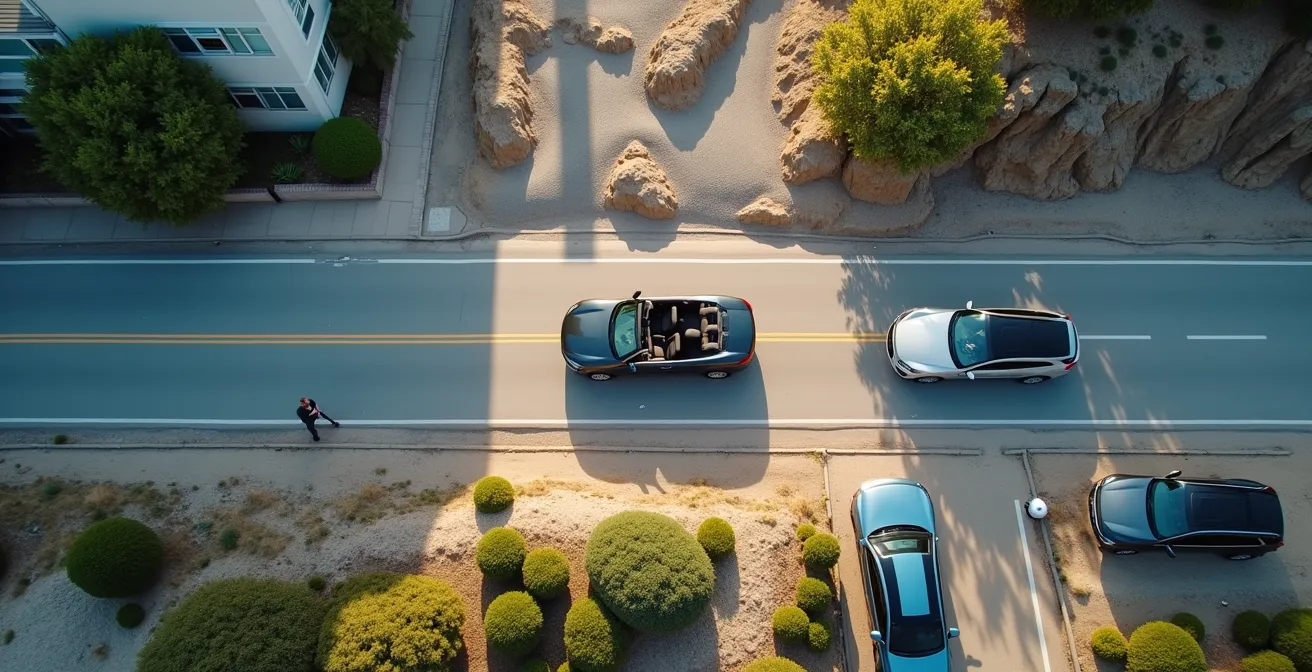
As the visual framework above suggests, your transportation needs can be tiered. Tier 1 involves daily, short-distance trips best served by public transit or a personal bike. Tier 2 covers hourly errands or experiences, perfect for a standard car-share vehicle. Tier 3 is the weekend getaway, which may require a specialized vehicle like an SUV or convertible—something you can rent on-demand without bearing the year-round cost. This strategy is not only cheaper but also more flexible, allowing you to choose the perfect vehicle for each trip. A Zipcar report found that members save an average of $1,173 per month compared to car owners, with many joining specifically to enable this flexible, tiered access for occasional long trips without the burden of ownership.
By unbundling your transportation needs, you convert the massive fixed cost of a single, all-purpose car into a series of smaller, variable costs. This puts you in complete control, paying only for what you use. The “freedom” of car ownership is an illusion; true financial freedom comes from eliminating the single largest drain on your discretionary income.
Turo vs. Enterprise CarShare: Which Offers Better Insurance Protection?
Once you transition to a car-sharing model, understanding the insurance landscape is critical. The protection offered varies significantly between peer-to-peer platforms like Turo and corporate-owned fleets like Enterprise CarShare or Zipcar. Your personal auto insurance may offer some coverage, but you should never assume it extends fully to a rental or shared vehicle. From a purely financial-analytical perspective, the goal is to secure adequate liability coverage without overpaying.
Enterprise CarShare, like Zipcar, operates a corporate fleet. Their model is simpler: insurance is typically included in the hourly or daily rate. This includes state-required liability coverage and damages to the vehicle, subject to a deductible (or “damage fee”). This is a straightforward, low-friction approach where the cost of protection is bundled into the service price.
Turo, as a peer-to-peer marketplace, has a more complex structure. The host’s personal insurance is not what covers you. Instead, Turo provides protection plans that the guest chooses and pays for at checkout. These plans offer varying levels of liability coverage and determine your maximum out-of-pocket cost for physical damage. Critically, Turo provides liability coverage up to $750,000 under its plans in most states, which is substantial protection. The choice of plan directly impacts your total rental cost, allowing you to tailor your risk tolerance. For a financial analyst, the optimal choice depends on the value of the car being rented and your personal risk profile, but the availability of high-limit coverage is a significant positive.
Ultimately, both models offer robust protection. The bundled model of Enterprise is simpler, while Turo’s tiered model offers more granular control over your cost and coverage level. The non-negotiable rule is to never decline the provider’s insurance plan in favor of a credit card’s secondary coverage without first confirming in writing exactly what the card covers.
The Holiday Crunch: What to Do When Every Shared Car Is Booked?
A valid stress point for car-free city dwellers is peak demand—Thanksgiving, Christmas, or a sunny three-day weekend when availability evaporates. An owner never faces this issue. However, this “guaranteed availability” comes at the cost of thousands of dollars per year. A strategist doesn’t pay that premium; they mitigate the risk with planning. The key is to build redundancy and flexibility into your Mobility Portfolio. Relying on a single car-share service is a recipe for failure. A robust strategy involves a combination of services and proactive booking.
During these high-demand periods, prices surge and cars disappear. This is where a clear framework for securing a vehicle becomes invaluable. Instead of scrambling last-minute, a systematic approach ensures you have access to transportation when you need it most. The following checklist outlines a practical, multi-pronged strategy.
Your Action Plan: The PAVE Framework for Peak Demand
- Plan Ahead: Book your vehicle at least 2-3 weeks before major holidays. This not only secures availability but often locks in lower, non-surge rates. Set a calendar reminder.
- Alternative Locations: Expand your search radius. Check car pods or rental locations in adjacent neighborhoods easily accessible by a short bus or train ride. A 2-mile expansion can reveal significant availability.
- Vary Your Vehicle: Be flexible on the car model. Sedans and compact SUVs are often the first to go. Larger vehicles like minivans or even cargo vans frequently have better availability and can be surprisingly affordable during peak times.
- Expand Your Options: Maintain memberships across multiple platforms. Holding a free Turo account and a low-cost Zipcar membership creates built-in redundancy. This “availability insurance” is your strongest defense against being stranded.
This PAVE framework transforms the problem from one of scarcity to one of strategy. The cost of maintaining a backup membership is negligible compared to the cost of ownership, and the discipline of planning ahead is a small price to pay for thousands of dollars in annual savings. The “holiday crunch” is not a flaw in the car-sharing model; it is a predictable variable that can be managed with foresight.
How to “Chain” Errands to Minimize Hourly Rental Costs?
When you shift from ownership to a pay-per-use model, your mindset must also shift from “time abundance” to “time optimization.” With car ownership, an inefficient, multi-stop trip costs only gas. With hourly rentals, it costs real money. This is not a disadvantage; it is a powerful incentive for efficiency. The goal is to “chain” your errands into a single, optimized loop rather than making multiple separate trips. This is the difference between a hub-and-spoke model (driving back and forth from home) and an efficient routing loop.

This tactical approach to trip planning has a direct and significant financial impact. The key is to batch all car-dependent tasks—the bulk grocery run, the trip to the hardware store, visiting a friend across town—into one consolidated block of time. Before booking the car, map your destinations logically to create the shortest possible route. This minimizes both mileage fees and, more importantly, the hourly rental duration.
Furthermore, understanding the pricing structure of your car-share service is critical. Most services have an hourly rate that caps out and converts to a more economical daily rate after a certain number of hours. For example, analysis of pricing structures often shows that daily rates become more economical than hourly rates after approximately 9 hours of use. If your chained errands will take more than this break-even point, booking the car for the full 24-hour period is the cheaper option, removing time pressure entirely. This allows for a long, leisurely day of tasks without the psychological stress of a ticking clock. The pay-per-use model forces a level of planning that ultimately saves both time and money.
The $10 Leak: How Forgotten Subscriptions Drain $500/Year From Budgets
In personal finance, we are often warned about “death by a thousand cuts”—small, recurring subscriptions for streaming services, apps, and news sites that cumulatively drain hundreds of dollars from a budget. An audit of bank statements often reveals multiple $10 leaks. But this focus on minor digital services completely misses the single largest forgotten subscription of all: car ownership.
According to AAA’s comprehensive cost analysis, the total cost of owning and operating a new vehicle runs as high as $11,577 annually. This is effectively a $964 per month subscription that auto-renews without question. This figure includes not just the obvious costs like fuel and maintenance, but the massive, silent killers of depreciation, financing charges, and insurance. Unlike a Netflix subscription, you cannot simply “cancel” it for a month when you’re not using it. It is the ultimate financial leak, draining your resources whether you drive 1,000 miles or 10.
The solution is a radical “Subscription Swap.” First, perform a ruthless audit of your last three months of bank and credit card statements to identify every recurring charge. Second, identify $40-$60 in underused or low-value digital subscriptions and cancel them immediately. Third, reallocate those funds. A basic car-share membership might cost around $9/month. The remaining $30-$50 in your budget now becomes your “flex ride fund,” covering 4-6 hours of car usage per month at typical rates. You have effectively swapped a collection of low-value digital clutter and one enormous, inefficient “car subscription” for a lean, flexible mobility budget that you only pay into as you use it.
How to Combine Transit Passes and Bike Maintenance for Lowest Total Cost?
Abandoning car ownership does not mean relying solely on car sharing. A truly optimized financial strategy involves building a resilient, multi-modal Mobility Portfolio. The goal is to use the most cost-effective tool for each specific transportation job. For the vast majority of urban trips—the daily commute, trips to the gym, meeting friends locally—a car is massive overkill. These are jobs for public transit and a well-maintained bicycle.
A monthly transit pass offers unlimited rides for a fixed, predictable cost, making it the bedrock of a daily commute. A bicycle, meanwhile, is the ultimate tool for “last-mile” trips—getting from the subway station to your final destination or for short trips where transit routes are inconvenient. The cost of a bike is a one-time expense, and its “fuel” is free. An annual maintenance budget of around $150-$240 ($15-$20/month) is all that’s required to keep it reliable. These two tools form the cost-effective base of your portfolio.
Car sharing and ride-hailing services then become the flexible top layer, reserved for specific use cases like bulk shopping, bad weather, or weekend trips. By creating a dedicated monthly transportation budget that allocates funds to each “sleeve” of your portfolio, you create a system that is far cheaper and more adaptable than the single-mode monolith of car ownership. The following table provides an example of what such a budget could look like in different urban environments, demonstrating its clear cost advantage.
This multi-modal approach converts the massive, inflexible cost of car ownership into a smaller, diversified, and predictable monthly expense, as shown in a comparative analysis of transportation options.
| Transportation Mode | Los Angeles Example | Milwaukee Example | Use Case |
|---|---|---|---|
| Public Transit Pass | $100/month | $72/month | Daily commute |
| Bike Maintenance Fund | $20/month | $15/month | Last-mile trips |
| Car-Share Membership | $8/month | $8/month | Weekend errands |
| Flex Ride Fund | $50/month | $40/month | Uber/one-off rentals |
| Total Multi-Modal | $178/month | $135/month | Complete mobility |
| vs. Car Ownership (local avg.) | $260/month | $234/month | Single mode only |
Key Takeaways
- Depreciation is a massive, non-negotiable “parking lot tax” that makes ownership financially illogical for infrequent drivers.
- A flexible “Mobility Portfolio” combining transit, biking, and on-demand rentals is thousands of dollars cheaper than owning a single vehicle.
- The pay-per-use model of car sharing enforces natural budget discipline by making transportation costs visible and tangible.
Does the Envelope Method for Personal Budgeting Work in a Cashless Society?
The classic envelope budgeting system, where cash for different spending categories is physically separated, works because it creates tangible limits and a “pain of paying.” In a cashless society, this friction disappears. However, the core principle can be powerfully reapplied to transportation spending. The abstract nature of a large monthly car payment ($530+) masks its true impact, while the small, frequent transactions of pay-per-use services ($8.50-$10 per hour) create psychological scarcity and enforce spending discipline.
This is, in effect, a “digital envelope” for mobility. Instead of a single credit card for all transportation expenses, you create dedicated funding sources. This can be achieved by pre-loading a fixed monthly amount onto your transit pass and your car-share account. For example, you might load $100 onto your transit card and $150 into your Zipcar account at the beginning of the month. This act creates the same psychological boundary as a physical cash envelope. You see the balance decrease with each use, making the cost of each trip tangible.
The effectiveness of this digital partitioning is not just theoretical. Analysis of user behavior shows that those who create dedicated sub-accounts or pre-load mobility funds demonstrate 23% better adherence to their transportation spending limits compared to those who use a single, commingled credit card. The small, visible “pain” of each tap of the card or each hourly charge is a more effective governor of behavior than the distant, abstract pain of a single large auto loan payment that gets lost in a sea of other bills. The pay-per-use model isn’t just a financial strategy; it’s a behavioral hack that forces smarter consumption.
Your car is an underperforming asset. The logical next step is to conduct a full audit of your personal transportation costs versus a multi-modal budget. Calculate your depreciation, track your mileage, and build a competing portfolio. The numbers will speak for themselves.