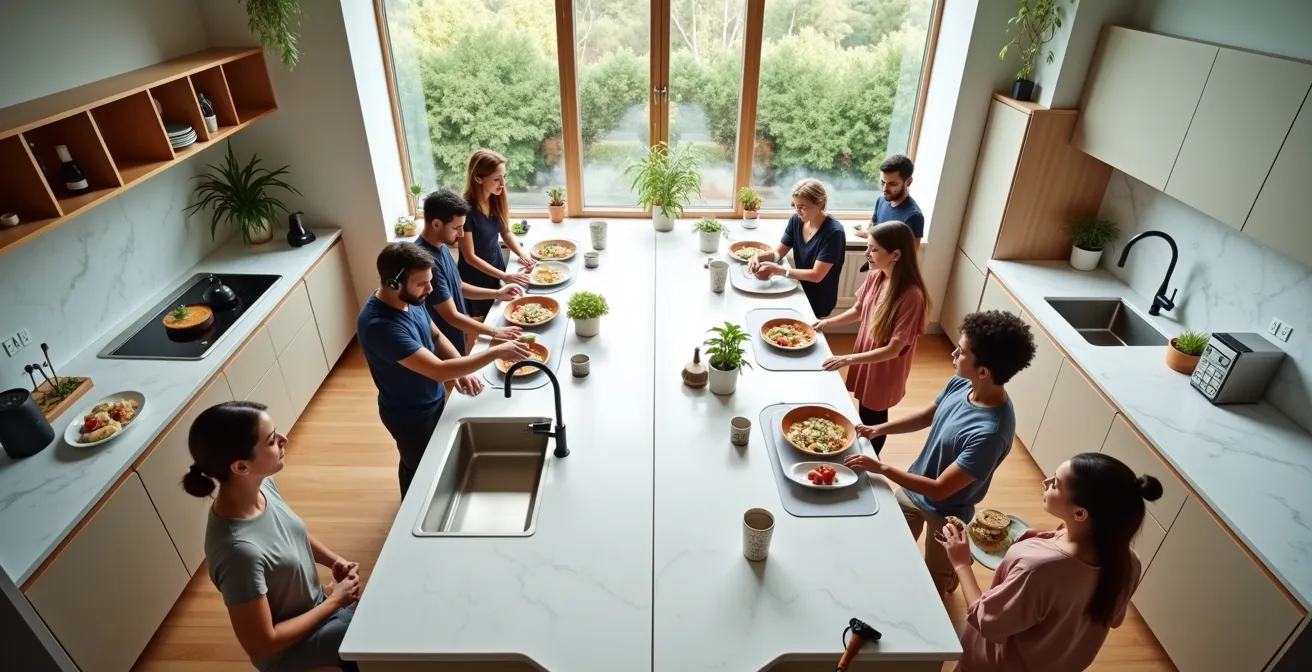
Successful co-living isn’t about creating more rules; it’s about designing social systems and personal boundaries that make most rules unnecessary.
- Conflict often stems from personal needs (like an introvert’s need to recharge) and systemic issues (like high turnover), not just laziness.
- Replacing passive aggression with structured communication frameworks like NVC (Nonviolent Communication) resolves issues before they escalate.
Recommendation: Stop treating symptoms like messy kitchens and start architecting your home’s social dynamics, from communication protocols to intentional community-building activities.
You signed up for co-living with visions of a vibrant community, spontaneous dinners, and lifelong friends. But the reality is often a sink full of dirty dishes, a washing machine held hostage, and a flurry of passive-aggressive Post-it notes. You fear the mess, the noise, and the slow erosion of that community dream into a tense roommate standoff. It’s a common story for young professionals who seek connection but find friction instead.
The standard advice is always the same: create a cleaning rota, label your food, and hold more house meetings. While these are not bad ideas, they are merely patches on a much deeper issue. They are rules imposed on a system, but they don’t fix the system itself. These solutions often fail because they don’t account for the complex human dynamics at play: different personalities, communication styles, and even how our brains are wired.
But what if the key wasn’t about enforcing stricter rules, but about designing a better social system? As a community manager, I’ve seen that the most harmonious shared homes run on well-designed social architecture, not an iron-fisted chore chart. It’s about understanding the underlying needs of residents—the “why” behind the conflict—and building a framework of communication and mutual understanding that prevents friction points from ever catching fire. This guide is about moving beyond the surface-level problems to build a resilient, respectful, and genuinely enjoyable co-living environment.
We’ll explore the hidden reasons for conflict, from introvert burnout to generational clashes, and provide concrete systems to address them. By the end, you’ll have a professional toolkit to transform your shared space from a source of stress into a true home and community.
Summary: A Community Manager’s Guide to Co-Living Harmony
- Why Do Introverts Burn Out Faster in Co-Living Arrangements?
- How to Address “Passive-Aggressive Post-It Notes” Effectively?
- Ensuite Bathroom vs. Cheaper Rent: Which Is Critical for Sanity?
- The Transient Trap: Why Constant Turnover Ruins the “Community” Vibe?
- How to Soundproof Your Co-Living Bedroom for Remote Work Privacy?
- Shared Laundry Etiquette: Handling Disputes Without creating Enemies
- Why Do Different Generations Perceive “Urgency” So Differently?
- How to Build Social Cohesion in High-Density Apartment Complexes?
Why Do Introverts Burn Out Faster in Co-Living Arrangements?
Co-living is often marketed as a social paradise, an antidote to urban loneliness. For an extrovert, the constant presence of people is energizing. But for an introvert, it can feel like a battery that’s constantly being drained with no chance to recharge. It’s not about being shy or antisocial; it’s about brain chemistry. As the Choosing Therapy Editorial Team clarifies in their work on the subject:
Extroverts feel energized around others, whereas introverts require solitude to recharge. Introversion is often conflated with being shy or disliking other people. However, in reality, introverts are just more sensitive to social environments and dopamine.
– Choosing Therapy Editorial Team, Introvert Burnout: Signs, Causes, & How to Cope
In a 10-person home, the ambient social energy is always high. The kitchen is rarely empty, the living room always has a conversation, and impromptu gatherings are common. Without a dedicated “recharge zone,” an introvert is in a state of constant, low-level overstimulation. This isn’t just a matter of preference; it has real consequences. The constant demand for social interaction without adequate recovery time can lead to burnout. In fact, research on introvert burnout shows that symptoms include physical exhaustion, heightened irritability, and anxiety. This is often the root cause when a housemate suddenly becomes withdrawn, seems perpetually annoyed, or starts avoiding common areas. They aren’t being rude; they’re experiencing a complete depletion of their social energy.
Understanding this is the first step in building a more inclusive social architecture. A healthy co-living space must be designed with both personality types in mind, providing ample opportunities for connection while fiercely protecting the ability for individuals to retreat and recharge. Without this balance, you risk losing valuable community members to burnout.
How to Address “Passive-Aggressive Post-It Notes” Effectively?
The infamous Post-it note on a dirty dish is a classic symptom of a communication breakdown. It’s a low-context, high-judgment broadcast that does nothing to solve the problem and everything to create resentment. This type of passive aggression is a clear sign that your home’s social architecture has failed. People resort to it when they don’t feel safe or equipped to have a direct, constructive conversation. The solution isn’t to ban Post-it notes; it’s to replace them with a better system: a shared framework for empathetic and effective communication.
The most powerful tool for this is Nonviolent Communication (NVC). It’s a method that shifts the focus from blame (“You’re so messy!”) to needs (“I need a clean space to cook”). It’s so effective that one study of healthcare professionals found that NVC training significantly reduced workplace social stress. Adopting this framework requires a conscious decision by the household, often established during a dedicated house meeting focused on creating a communication charter.

This image captures the goal: moving from isolated, written complaints to face-to-face, respectful dialogue. To make these conversations productive, the NVC framework provides a clear, four-step process that anyone can follow to express themselves without escalating conflict. It transforms a complaint into a collaborative problem-solving session.
Your Action Plan: The 4 Steps of Nonviolent Communication
- Observe without evaluating: State the facts neutrally. Instead of “The kitchen is a disgusting mess again,” try “I see there are unwashed dishes in the sink from last night.” This removes judgment and focuses on a shared reality.
- Express your feelings: Use “I feel” statements to own your emotional response. “I feel frustrated and stressed,” is about your experience, not an attack on someone else’s character.
- Connect feelings to needs: Articulate the underlying need that isn’t being met. “I feel frustrated because I need a clean and functional space to prepare my meals in the morning.” This reveals the ‘why’ behind your feelings.
- Make a specific, actionable request: Propose a clear, positive action. Instead of “Don’t be a slob,” ask “Would you be willing to wash your dishes right after you finish eating?”
Ensuite Bathroom vs. Cheaper Rent: Which Is Critical for Sanity?
When choosing a room in a large co-living space, the decision often boils down to a trade-off between price and privacy. Is it worth paying more for an ensuite bathroom? For many, especially introverts or those with demanding schedules, the answer is a resounding yes. This isn’t about luxury; it’s about control over your environment and securing a crucial “recharge zone.” A private bathroom guarantees you will never have to start your day waiting in line or end it by cleaning up someone else’s mess.
The “cost” of a shared bathroom isn’t just monetary. It’s paid in time, energy, and mental peace. While it seems small, the daily friction adds up. Simple calculations show that just 15 minutes a day spent waiting for a shared facility equates to 7.5 hours per month—nearly a full workday of lost personal time. This constant, low-level negotiation for a basic need is a significant contributor to co-living stress and burnout. It’s a classic friction point that erodes goodwill over time.
The dilemma is similar to choosing between a private or communal kitchen. While a shared kitchen fosters community, it comes at the cost of privacy and flexibility. A recent analysis of co-living amenities highlights this trade-off perfectly. The principles apply directly to the bathroom debate.
| Aspect | Private Space (Ensuite/Kitchen) | Communal Space (Shared) |
|---|---|---|
| Privacy Level | Complete control and solitude | Social interactions required |
| Flexibility | Use anytime without waiting | May need to coordinate timing |
| Resources | Limited to personal equipment | Access to wider range of equipment |
| Cost Efficiency | Higher individual costs | Shared expenses reduce costs |
| Social Opportunities | Minimal spontaneous interactions | Natural gathering point for community |
Ultimately, the choice is deeply personal. If you are someone who is easily drained by social interaction or has a rigid schedule, the extra rent for an ensuite can be the single best investment you make in your well-being. It carves out an untouchable sanctuary in an otherwise bustling home, which is priceless for long-term sanity.
The Transient Trap: Why Constant Turnover Ruins the “Community” Vibe?
Many co-living spaces inadvertently fall into the “transient trap.” They attract residents on short-term leases, leading to a revolving door of new faces. While this offers flexibility, it is fundamentally toxic to the promise of “community.” A true sense of community doesn’t just happen; it’s built over time through shared experiences, established trust, and predictable social norms. Constant turnover perpetually keeps the group in the awkward, initial “forming” stage of group development, never allowing it to progress to the “norming” or “performing” stages where real connection and cohesion happen.
Every time a new person arrives and another leaves, the group’s social contract is reset. Inside jokes are lost, established cleaning rhythms are disrupted, and the emotional energy of the entire house is spent on onboarding a new member rather than deepening existing relationships. This cycle is exhausting, especially for the long-term residents who become unofficial, unpaid community managers. They are the ones left to explain the laundry system for the tenth time or mediate a dispute over fridge space with someone they barely know.
This isn’t just a feeling; it goes against the very reason people choose this lifestyle. A large-scale survey by SPACE10 of over 7,000 people found that a primary driver for co-living was the desire for meaningful social interaction within a stable group, ideally between 4 and 10 people. People are actively seeking a “found family” or a supportive network, not a series of temporary acquaintances. When the environment is too transient, it fails to deliver on this core promise, leaving residents feeling more like they’re in a glorified hostel than a home.
For a community to thrive, there needs to be a critical mass of residents committed to a longer-term stay. This stability is the bedrock upon which trust, shared responsibility, and genuine friendship are built. Without it, the “community” vibe remains a marketing slogan rather than a lived reality.
How to Soundproof Your Co-Living Bedroom for Remote Work Privacy?
In the age of remote work, your bedroom is no longer just a place to sleep; it’s your office, your conference room, and your focus zone. In a bustling co-living house, sound leakage is a major threat to both productivity and privacy. The sound of a housemate’s video call, the kitchen blender, or late-night music can quickly turn your sanctuary into a source of stress. Effective soundproofing is not a luxury—it’s an essential part of creating a functional living and working environment.
Most standard construction, especially in older buildings, does little to block sound. Sound travels through air gaps (like under doors) and vibrates through solid structures (like thin walls). A comprehensive approach must address both pathways. While you can’t rebuild the walls, you can implement highly effective, and often stylish, solutions to dramatically reduce noise pollution. It’s about adding mass and sealing gaps.
A heavy, book-filled shelf against a shared wall, for example, is one of the most effective DIY sound blockers because it adds significant mass that deadens vibrations. Similarly, focusing on the weakest points—doors and windows—yields the biggest results for the least effort. Many residents are surprised to learn how much sound travels through the small gap at the bottom of a standard bedroom door. Investing in a solid-core door or even just a heavy-duty door sweep can make a world of difference.
Here are some professional-grade tips for creating your private sound oasis:
- Add Mass to Walls: Install heavy, book-filled shelving against shared walls. This serves a dual purpose of storage and sound absorption.
- Seal the Gaps: Use acoustic sealant (which remains flexible) to fill cracks around window frames and door edges where sound leaks in. Regular caulk will crack and become ineffective.
* Upgrade Your Door: If possible, replace a hollow-core door with a solid-core alternative. This is one of the single biggest upgrades for sound blocking. * Block Under-Door Gaps: Install a heavy-duty, automatic door sweep that seals the gap between the door and the floor when closed. * Mask Unwanted Noise: Use a white noise machine. It doesn’t eliminate sound, but it masks its intelligibility, making external conversations and noises far less distracting.
Shared Laundry Etiquette: Handling Disputes Without creating Enemies
The shared laundry room is a notorious friction point in any co-living space. A load of wet clothes left in the washing machine for hours isn’t just an inconvenience; it’s perceived as a profound act of disrespect. The conflict is rarely about the laundry itself. It’s about one person’s needs (to do their laundry) being blocked by another person’s perceived carelessness. This can quickly escalate from a simple request to a major house dispute because it triggers feelings of being ignored and devalued.
The typical solution—a sign-up sheet—often fails. Why? Because it’s a rigid rule imposed on a dynamic system. People forget to sign up, emergencies happen, and schedules change. A better approach is to design a more resilient laundry system based on principles of transparency and fairness, rather than rigid scheduling. For example, a house might agree on a “2-Hour Rule”: a load can be left for a maximum of two hours after it’s finished before another resident has the right to move it to a clean basket kept nearby. This sets a clear, community-agreed expectation.
Another effective system is creating “laundry blocks.” Instead of signing up for a specific time, residents claim a 4-hour block on a shared digital calendar (e.g., Sunday 8am-12pm). This gives them the flexibility to run multiple loads within their window without monopolizing the machines all day. The key is that the system is visible, agreed upon by everyone, and has a clear protocol for when things go wrong. It depersonalizes the conflict. It’s no longer “John is so inconsiderate”; it’s “The 2-Hour Rule wasn’t followed, so I can move the clothes.”
When disputes do arise, they should be handled using the same NVC framework for all other conflicts. Instead of a frustrated text, it’s a direct conversation: “When I see your clothes in the washer three hours after the cycle finished (observation), I feel frustrated (feeling) because I need to get my own laundry done before I go out (need). Would you be willing to set a timer on your phone as a reminder in the future (request)?”
Why Do Different Generations Perceive “Urgency” So Differently?
Have you ever sent a message about an overflowing trash can and been baffled when a housemate doesn’t respond for six hours? Or been annoyed by someone who expects an instant reply to a non-urgent question? This clash is often a result of different generational perceptions of “urgency.” It’s a subtle but powerful source of conflict in a multi-generational co-living home, and understanding it requires systemic empathy.
For a Gen Z resident who grew up with instant messaging, a seen message that goes unanswered can feel like a deliberate slight. For them, digital communication is immediate and ever-present. A Millennial, who came of age with asynchronous tools like email, may see that same message, mentally triage it as non-critical, and plan to deal with it later. A Gen X resident might not even have notifications turned on, preferring to check messages in designated batches. None of these approaches are inherently “wrong,” but they are fundamentally incompatible if not understood.
This isn’t just about technology habits; it reflects different work cultures and life experiences. A freelance gig worker might have a fluid schedule where “urgent” means “within the hour,” while someone in a traditional 9-to-5 role might see “urgent” as “by the end of the day.” When these different internal clocks collide in a shared living space, it creates friction. The overflowing bin isn’t the real problem; the real problem is the mismatched expectation of response time and action.
The solution is to make these implicit expectations explicit. During a house meeting, have a conversation about communication norms. What channel is for true emergencies (a phone call)? What’s for important but not time-sensitive issues (a dedicated WhatsApp chat)? What’s the expected response time for general inquiries? By creating a shared communication protocol, you replace generational assumptions with a clear, agreed-upon system. It’s an exercise in understanding that your housemates’ brains may simply operate on a different timeline, and that’s okay as long as you have a system to bridge the gap.
Key takeaways
- Effective co-living relies on designing social systems (like communication protocols) rather than just enforcing rules (like chore rotas).
- Most conflicts are symptoms of unmet needs; using frameworks like Nonviolent Communication (NVC) addresses the root cause instead of the symptom.
- A harmonious home must provide both spaces for community and guaranteed “recharge zones” for privacy and mental well-being, especially for introverts.
How to Build Social Cohesion in High-Density Apartment Complexes?
Resolving conflict is only half the battle. The ultimate goal of co-living is to move beyond simply tolerating each other to actively building a vibrant, supportive community. This doesn’t happen by accident. It requires a conscious shift from being a group of roommates to becoming an intentional community. This means creating systems and rituals that are specifically designed to foster connection and shared purpose. In a high-density home, you have the numbers to create amazing social energy, but it needs to be channeled constructively.
One of the most effective methods is project-based bonding. Instead of forced “fun nights,” you create activities where residents collaborate on a meaningful, recurring task. This could be anything from maintaining a communal herb garden to hosting a monthly potluck with a theme. The act of working together towards a common goal builds trust and camaraderie far more effectively than simply sharing a living room. It gives people a reason to interact beyond just saying “hello” in the hallway.
A brilliant real-world example of this is the shared dinner system, which can transform the daily chore of cooking into a powerful community-building ritual. A co-living space in the Alps perfected this model.
Case Study: The Alpiness Coliving Shared Dinner System
At Alpiness coliving, residents organize shared dinners from Monday to Friday. During a weekly meeting, a cooking schedule is created based on everyone’s availability. The person whose turn it is handles groceries, cooking, and cleanup for the entire group. This simple system has a profound effect: each person only has to cook once a week but gets a home-cooked meal every weekday. It’s an efficient and enjoyable way of living together that fosters daily connection and shared responsibility.
This system works because it aligns individual benefit (not having to cook 4 nights a week) with community contribution. It creates a natural, daily touchpoint for the entire household to connect. By implementing similar project-based systems, you can actively architect social cohesion and turn your high-density living situation into the thriving community you hoped it would be.
Start today by initiating a conversation with your housemates, not about the problems, but about the kind of home you collectively want to create. Use this guide as your blueprint to begin designing the social architecture for a more harmonious co-living experience.
Frequently Asked Questions about Shared Living Dynamics
How should we organize fridge and cupboard space fairly?
The best way to manage a shared kitchen is by dividing space evenly. Assign specific shelves in the fridge and cupboards to each person to avoid mix-ups and reduce “who took my yogurt?” conflicts. For shared items, consider a labeling system with names or dates, especially for condiments or leftovers.
What’s the best approach to cleaning schedules?
While a cleaning rota can work, the most effective rule is “clean as you go.” This means washing dishes and wiping down counters immediately after you cook, ensuring the next person always has a clean, ready-to-use space. For bigger weekly tasks like mopping floors or cleaning bathrooms, a rotating schedule is essential to ensure everyone contributes their fair share.
How can we prevent food theft in shared kitchens?
Food “theft” is often a result of poor organization or misunderstanding rather than malice. Having clearly designated and respected personal spaces in cupboards, the fridge, and the freezer is the first and most crucial step. When everyone knows exactly what is theirs, accidental “borrowing” is almost entirely eliminated, which is crucial for maintaining trust and well-being.